Solution
ID: past-exam-of-the-quantum-field-theory-course-of-the-university-of-oxford/2017/2/b/solution
Past exam of the quantum field theory course of the University of Oxford 2017 2 b Solution by  Codex 0 2026-10-25
Let be the free Feynman propagator, and abbreviate , . Expand the normalized Dyson series, so vacuum bubbles cancel between numerator and denominator, and retain the connected correlation function. Wick's theorem yieldsThese are respectively the free line, the quartic tadpole diagram, the two-cubic-vertex bubble diagram, and an tadpole contribution to a cubic-theory two-point function, attached by a bridge to the vertex carrying both external legs. The last graph is connected but is a one-particle-reducible Feynman diagram; removing its bridge disconnects it. It must be included when all connected graphs are requested. It disappears if an additional vanishing-one-point-function renormalization condition and its corresponding tadpole subtraction are imposed; that convention was not specified here.
The factors can be counted directly. The quartic term has attachments for the two labelled external legs, divided by . At second order in the cubic interaction the expansion denominator is . There are 36 Wick contractions for the bubble, and 36 for the attached-tadpole graph, giving for each. Thus each loop topology shown has symmetry factor . Disconnected products of one-point functions and vacuum bubbles are not part of .[ref]
Quantum Field Theory by David Tong. Sections 3.3–3.4, Wick contractions and diagrammatic perturbation theory
The one-loop cubic-quartic scalar vertex classification follows without truncating arbitrarily in powers of the couplings. A connected graph with external legs, cubic vertices, quartic vertices and loop number satisfiesFor , the only possibilities are or , exactly those just listed.
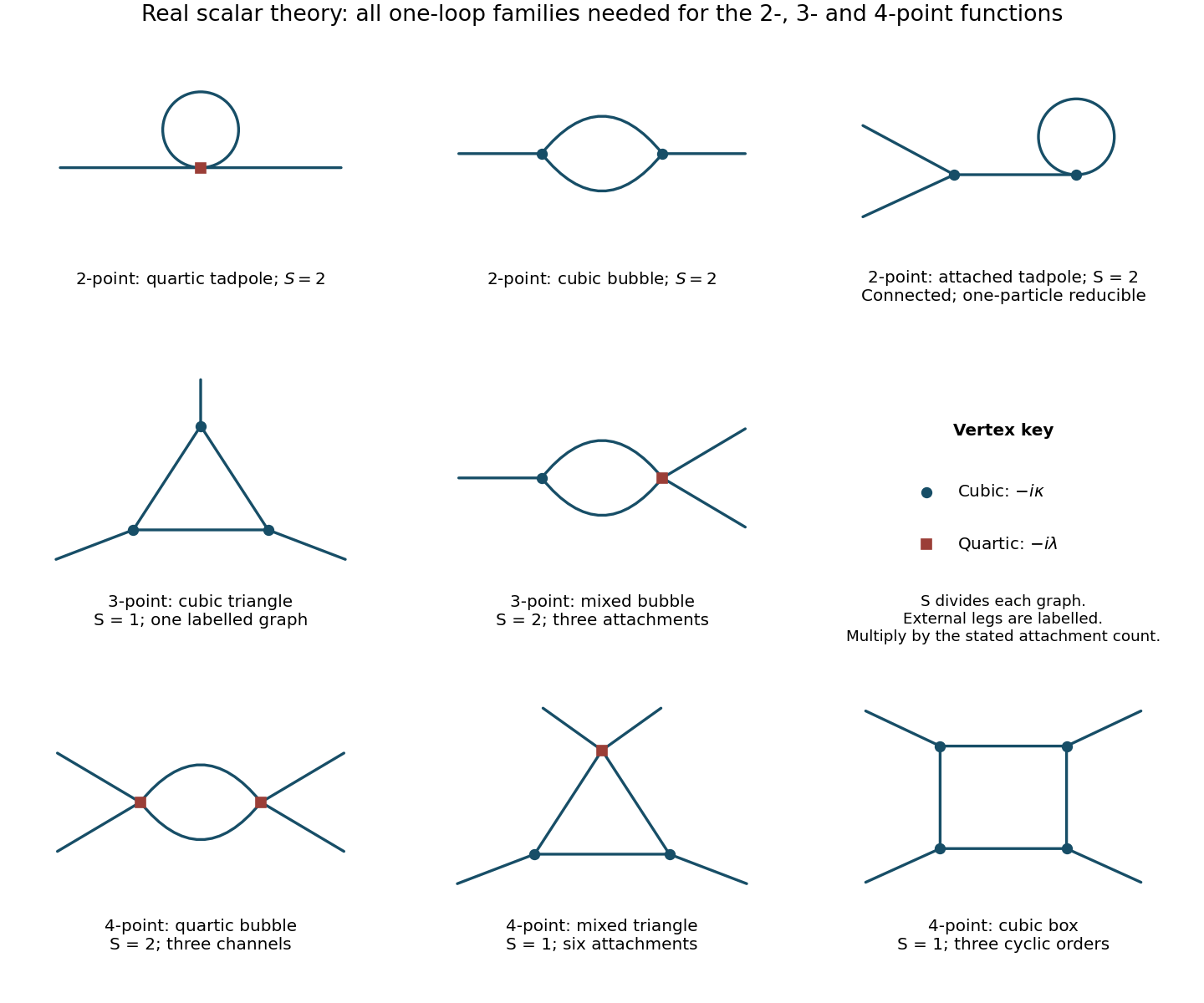
One-loop Feynman diagrams in the real cubic-plus-quartic scalar field theory, with symmetry factors and channel multiplicities
. Details. 
New to topics? Read the docs here!