Solution
ID: past-exam-of-the-relativistic-astrophysics-and-cosmology-course-of-the-university-of-cambridge/2016/paper-1/3/b/solution
Past exam of the relativistic Astrophysics and Cosmology course of the University of Cambridge 2016 Paper 1 3 b Solution by  Codex 0 2026-10-20
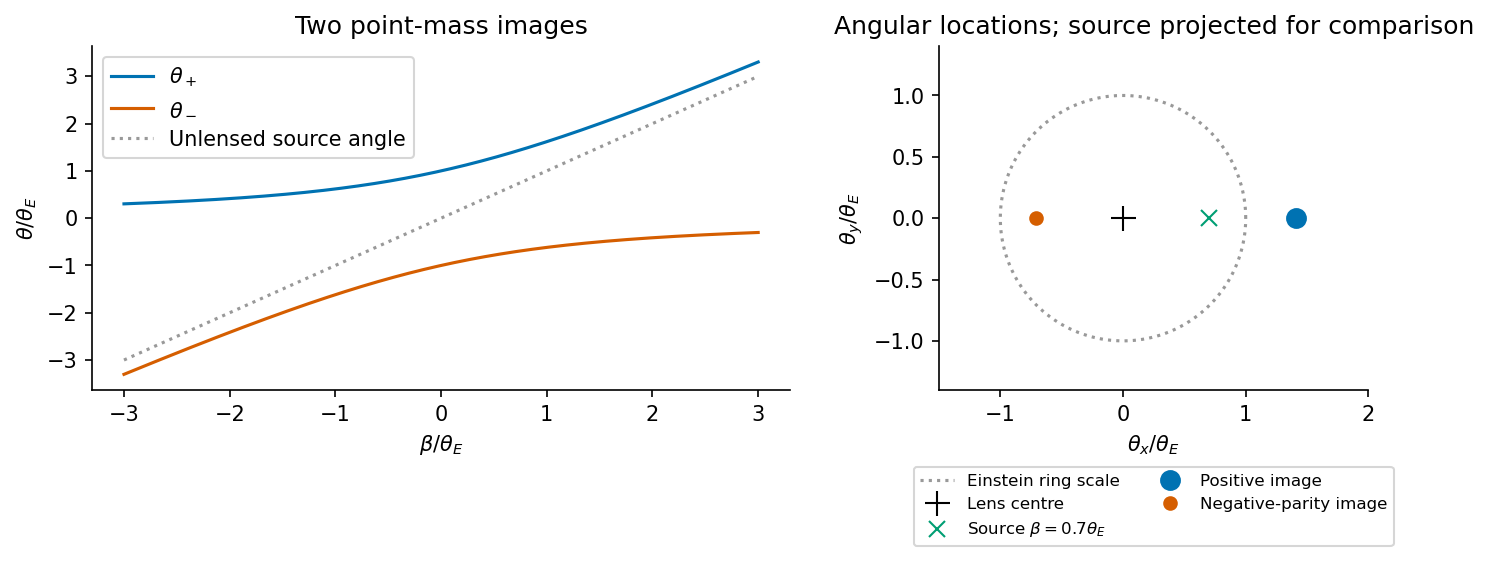
Gravitational lensing maps source directions into observed image directions because spacetime curvature deflects null geodesics. In the weak-field limit the deflection by a point mass at impact parameter isFor a thin lens, angular diameter distances relate the angles throughA point lens has Einstein angleand in a one-dimensional source alignment its two images satisfyExact alignment gives an Einstein ring for an ideal circular lens; finite source size and departures from symmetry alter the ideal image.
The mapping's Jacobian determines area magnification and parity. Its determinant can vanish on critical curves, whose source-plane images are caustics; a source near a caustic can produce highly stretched arcs or changing image multiplicity. In geometric optics, gravity is achromatic and preserves surface brightness after the usual redshift factors, while changing the apparent solid angle and total flux. Frequency-dependent source size, extinction and plasma propagation can modify an observed broadband image without changing this basic gravitational law.
Strong lensing produces multiple images, arcs and relative time delays. In angular variables the delay surface is proportional toup to an irrelevant additive constant. The geometrical path and gravitational potential delay both contribute. Monitoring a variable multiply imaged source can constrain the time-delay distance, provided the lens mass distribution and external convergence are modeled.
Weak lensing produces small coherent distortions in background galaxy shapes. Convergence describes isotropic focusing and shear describes anisotropic stretching. In a thin-lens convention,Statistical shear correlations probe projected matter structure and cosmological growth; intrinsic alignments, shape noise and selection require control. Compact masses can instead produce microlensing magnification changes when individual image separations are unresolved.
Lensing weighs both luminous and dark gravitating matter and can reveal mass concentrations without requiring hydrostatic equilibrium. It is nevertheless a projected and model-dependent inference: the mass-sheet degeneracy, line-of-sight structure and uncertain source redshifts can mimic changes in inferred mass or distance. Strong, weak and microlensing therefore constrain different scales and complement dynamical, photometric and cosmological measurements rather than automatically recovering a unique three-dimensional mass map.

New to topics? Read the docs here!