Solution
ID: past-exam-of-the-relativity-course-of-the-university-of-cambridge/2012/paper-1/2/a/solution
Past exam of the relativity course of the University of Cambridge 2012 Paper 1 2 a Solution by  Codex 0 2026-10-20
In general relativity, light follows null geodesics. A weak gravitational field outside an isolated spherical mass gives the Schwarzschild light deflectionfor impact parameter . At the solar limb this is approximately arcseconds. A Newtonian corpuscular calculation gives half this value; the full result depends on spatial curvature as well as the gravitational time dilation. The parametrized post-Newtonian formalism predicts , with in general relativity.
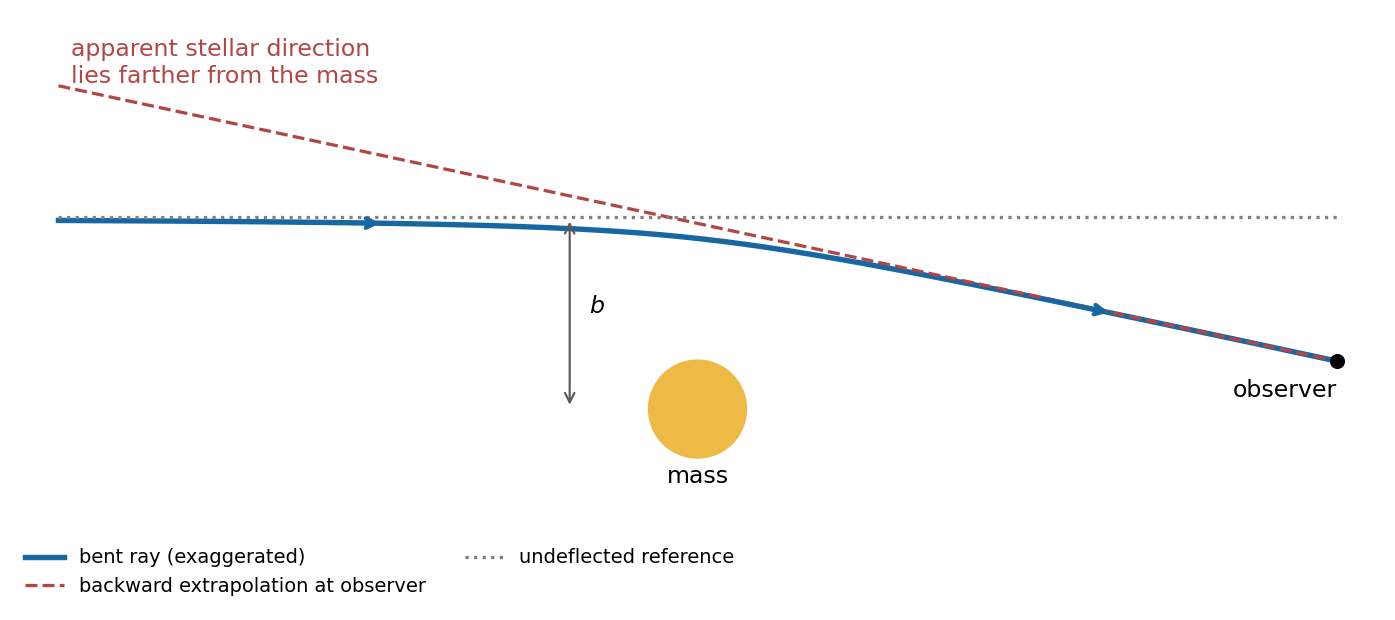

The Eddington experiment compared photographic star positions near the eclipsed Sun with reference exposures taken without the Sun in that field. Rays bend toward the Sun, but their backward extrapolations place the apparent stellar images farther from it. Plate scale, focus changes, atmospheric refraction and comparison-field alignment must be separated from a radial displacement proportional to . The original report discusses the instruments, plate reductions and competing predicted deflections; the test is a quantitative comparison with uncertainty, not a unique proof of a gravitational theory.[ref]
a determination of the deflection of light by the Sun's gravitational field by Frank Watson Dyson and others. 1920, pp. 291–333: eclipse observations, instruments and plate reductions
radio interferometry permits an independent test without an eclipse. A 2005 Very Long Baseline Array experiment observed four compact sources at 43, 23 and 15 GHz. Differential astrometry suppressed common antenna errors, while a fit separated refraction in the solar corona from achromatic gravitational deflection. Tropospheric errors and radio-source structure also required calibration. The reported was consistent with general relativity.[ref]
Progress in Measurements of the Gravitational Bending of Radio Waves Using the VLBA by Edward Fomalont and others. 2009, §§II–III on observations, calibration and coronal subtraction; §V on the reported result
New to topics? Read the docs here!