Radio interferometry measures the spatial coherence of received radio waves. At two antennas, a receiver preserves the relative wave phase, compensates the geometric delay for a chosen phase centre, and averages a product of one signal with the complex conjugate of the other. In a complex-signal description this correlation is . Its real and imaginary parts carry two complementary components of the complex visibility; measuring only the received powers discards the relative wave phase needed for general imaging.
A finite frequency band makes delay compensation essential. If the residual delay is , the residual wave phase varies by across a band of width . Averaging these differently oriented complex contributions reduces the correlation. For an ideal rectangular band the multiplicative factor is . A phase correction at just the central frequency cannot remove this variation across the band. Long time averages can likewise smear a changing signal.
The phase centre is the reference sky direction for removing geometric delay and its associated wave phase. An unresolved source exactly there ideally has constant complex visibility after calibration; a displaced source has a baseline-dependent wave phase.
An interferometric baseline is the displacement between two antennas. For a unit line of sight toward the phase centre, its projection onto the plane of the sky isHere is the speed of light. The signed delay depends on which receiver is delayed; the geometric path difference's magnitude does not. If is a unit tangent in the direction being imaged, the dimensionless coordinate is a spatial frequency, measured in cycles per radian of small sky offset. A single pair gives fringes of angular period along that tangent. This period specifies one measured oscillation; it does not specify a whole image's angular resolution or eliminate ambiguous source arrangements.
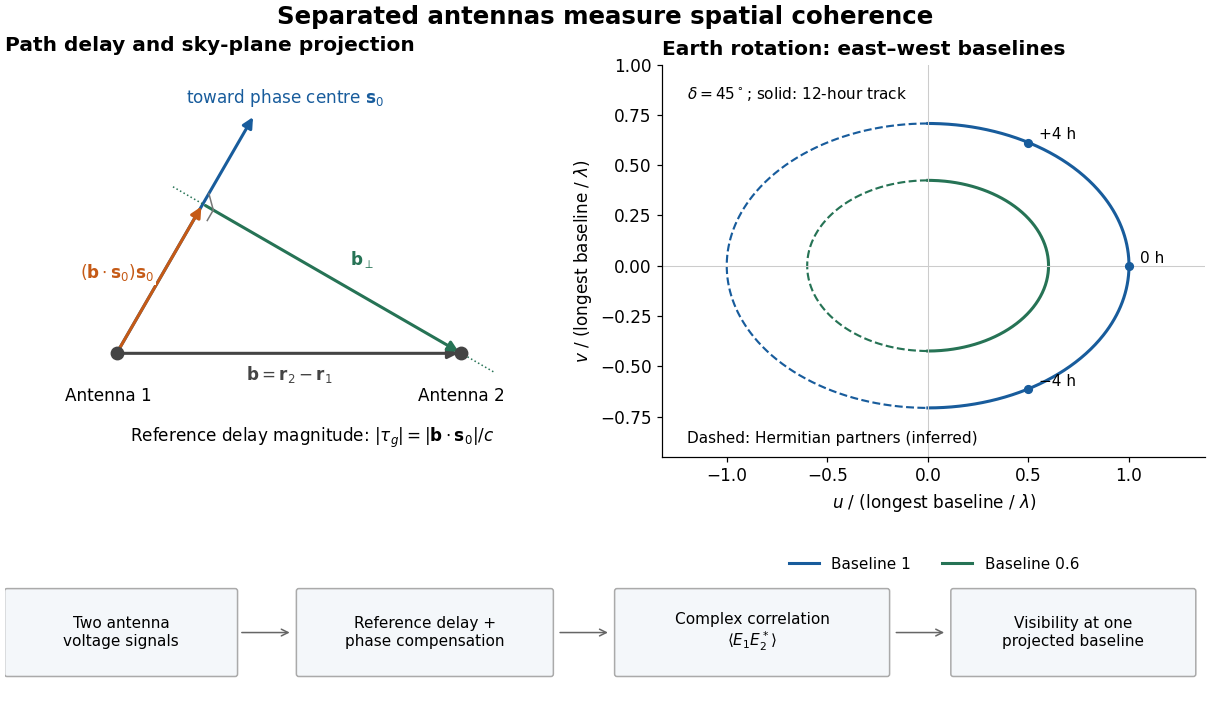
Geometric delay, projected baseline, and a schematic Earth-rotation track; original geometry, not telescope data
. Details. 
The left panel separates the component producing the reference delay from the component measuring angular structure. The right panel shows a possible Earth-rotation aperture synthesis track, with its opposite complex conjugate track. Those opposite samples provide the symmetry required by a real brightness distribution; they are not independent extra observations.
Earth-rotation aperture synthesis uses Earth's changing orientation to vary a fixed ground baseline's projection onto the plane of the sky. In two dimensions, and are the components of along two perpendicular sky tangents. Tracking one field traces a curve in this plane; changing the physical baseline supplies other curves. A track samples Fourier transform coordinates, rather than the brightness along a track across the sky.
For a horizontal east–west baseline of length , choose the sky-axis signs so thatwhere is hour angle and is declination. The ellipse follows by projecting the rotating baseline onto sky tangents. At a celestial pole it is a circle; near the celestial equator its minor axis collapses. Thus the same ground layout constrains different sky directions unequally. Rotation improves coverage, but does not fill every spatial frequency, and synthesis across many hours assumes that the source changes negligibly during that interval.
Radio interferometer calibration estimates instrumental and propagation effects that alter a complex visibility. A simple narrow-field model iswhere are complex receiver gains and represents additive noise. A point-like astronomical source of known position and stable strength constrains these gains: its expected complex visibility has a known wave phase and amplitude. A resolved or variable reference source requires a better source model. Errors in the reference model can be transferred into the inferred sky.
In a proposed extension, Martin Ryle described simultaneous observation of a nearby reference point source to correct atmospheric wave phase errors, using an additional dish at each element. He presented this as a possible extension, rather than the standard One-Mile Telescope arrangement.[ref]
Radio Telescopes of Large Resolving Power by Martin Ryle. Ryle (1974), p. 202: proposed reference-source correction
A complex visibility is a calibrated complex correlation of the signals received at a particular interferometric baseline. In a narrow field, with scalar radiation, the far-field approximation for an outgoing source, a narrow frequency channel, negligible noncoplanar phase curvature and a steady sky of mutually incoherent emitters,Here are small dimensionless sky-direction offsets, is brightness in the chosen channel, and is the primary beam. This is the Fourier transform of beam-weighted brightness. The two-dimensional formula requires those approximations: a wide field generally needs the third baseline coordinate and curved sky geometry.
For an explicit one-dimensional derivation, set the primary beam to one over the small field, and place independent emitters at angular offsets . Choose a wave phase convention in which, after removing the phase centre's delay, their received complex amplitudes areHere is the Kronecker delta and angle brackets denote an expected value estimated by time averaging a steady signal. The last equality states mutual incoherence: different emitters have zero averaged cross term, although each emitter's two received copies remain correlated. Multiplying and averaging givesFor continuous brightness this becomes . Real brightness implies the Hermitian symmetry ; it does not require brightness to be even. In particular, an asymmetric real source usually has a nonzero imaginary complex visibility. At zero baseline, is the total beam-weighted source strength. Ordinary separated-element correlations need not measure that zero-baseline value.
The primary beam is the individual antenna pair's directional sensitivity envelope in the complex visibility equation. For identical, identically pointed elements it is the individual element's power pattern. Its angular width sets the useful field of view; the much longer interferometric baselines set finer measured scales. The primary beam and the dirty beam describe different responses.
Articles by others on the same topic
There are currently no matching articles.