Solution
ID: past-exam-of-the-relativity-course-of-the-university-of-cambridge/2013/paper-1/4/solution
Past exam of the relativity course of the University of Cambridge 2013 Paper 1 4 Solution by  Codex 0 2026-10-20
redshift. An incoming radial null ray satisfies . Consecutive wave crests follow the same comoving path, so the endpoint changes in the fixed path integral obey . Comoving clocks read cosmic time; hence their measured periods and frequencies satisfyThe physical wavelength stretches with the scale factor during propagation. It is not necessary to assign a unique global inertial-frame recession velocity to a distant source.
Radial coordinate and cosmological look-back time. Differentiating gives . Combining this with the null-ray integral yieldsThe extra factor in the second denominator records the conversion from scale-factor change to elapsed cosmic time.
proper-motion distance. A small transverse displacement at emission has proper length . Define its source-frame transverse speed as ; cosmological time dilation makes . ThereforeEquivalently, , where the angular diameter distance is . The observer-time versus source-time distinction is essential. This calculation uses the stated transverse speed convention and the homogeneous background, without additional peculiar radial relativistic Doppler effect or gravitational lensing.
redshift shell volume at the present epoch. The induced spatial metric tensor on the present slice gives . Since ,This is the volume at the present epoch of the comoving shell intersected by the past light cone. Its proper volume at emission is smaller by ; a conserved population's proper number density is larger by the same factor, preserving its count.
Einstein-de Sitter cumulative number counts. In flat geometry . Inserting the stated Hubble parameter into the radial integral givesThe constant present-volume number density makes . With no members of the population before its formation epoch,As an independent check, substitution evaluates this toThis is exactly the Euclidean comoving volume per unit solid angle in the flat model. It assumes a complete count with the specified fixed population; luminosity selection, mergers or subsequent number-density evolution would require additional factors.
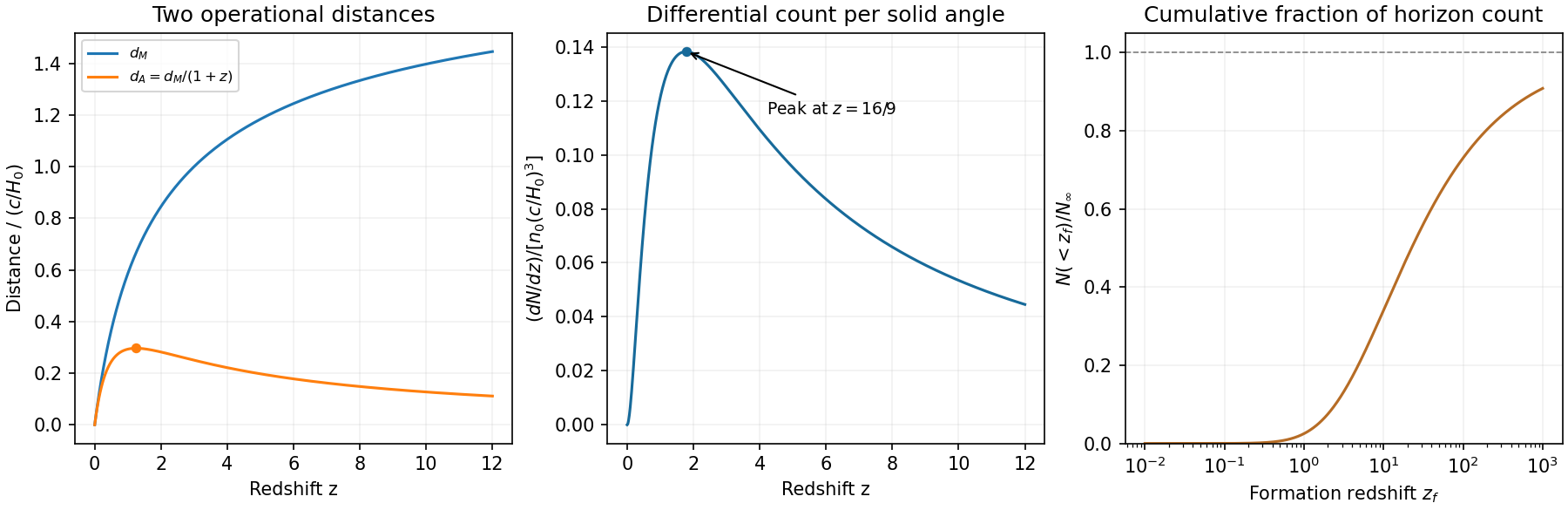
Original Einstein-de Sitter proper-motion and angular diameter distances, differential counts and cumulative fraction
. Details. 
New to topics? Read the docs here!