Solution
ID: past-exam-of-the-relativity-course-of-the-university-of-cambridge/2015/paper-1/2/b/solution
Past exam of the relativity course of the University of Cambridge 2015 Paper 1 2 b Solution by  Codex 0 2026-10-20
The cosmological principle idealizes spatial slices as homogeneous and isotropic. The corresponding Friedmann-Lemaître-Robertson-Walker metric can be writtenHere is cosmic time, has dimensions of length in this convention, and is a dimensionless comoving coordinate. The sign of gives positive, zero or negative spatial curvature. It does not alone determine global topology. A comoving pair at fixed radial coordinates has proper separation scaling with , so the Hubble parameter is , and cosmological redshift satisfies .
For a perfect fluid of mass-equivalent energy density and pressure , Einstein's equations giveThe last equation is local energy conservation for constant , with vacuum energy kept separate from . A component with has : pressureless matter dilutes as and radiation as , the additional radiation factor being photon redshift. With , matter domination gives and radiation domination gives . Positive vacuum energy alone gives exponential expansion, with .
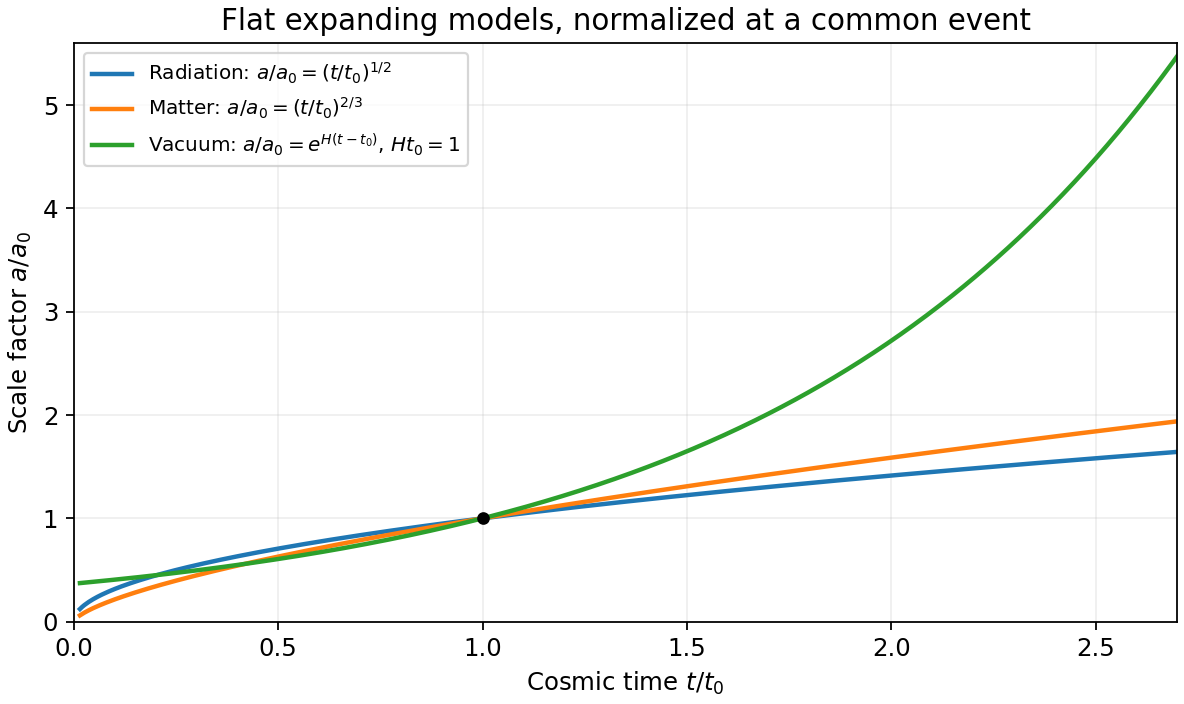
Original comparison of normalized scale factors in flat radiation, matter and positive-vacuum models; the vacuum model has no finite-time big-bang origin in this chart
. Details. 
Geometry, contents and initial conditions together determine the expansion history. A closed matter-only model recollapses; an open matter-only model expands indefinitely. With a cosmological constant, positive spatial curvature no longer by itself implies recollapse. Present critical density is and the density parameters obey , where . These models describe the large-scale background, while local structure and inhomogeneities require perturbations or more general metrics.
New to topics? Read the docs here!