Solution
ID: past-exam-of-the-soft-condensed-matter-course-of-the-university-of-cambridge/2012/paper-1/2/c/solution
Past exam of the soft condensed matter course of the University of Cambridge 2012 Paper 1 2 c Solution by  Codex 0 2026-10-20
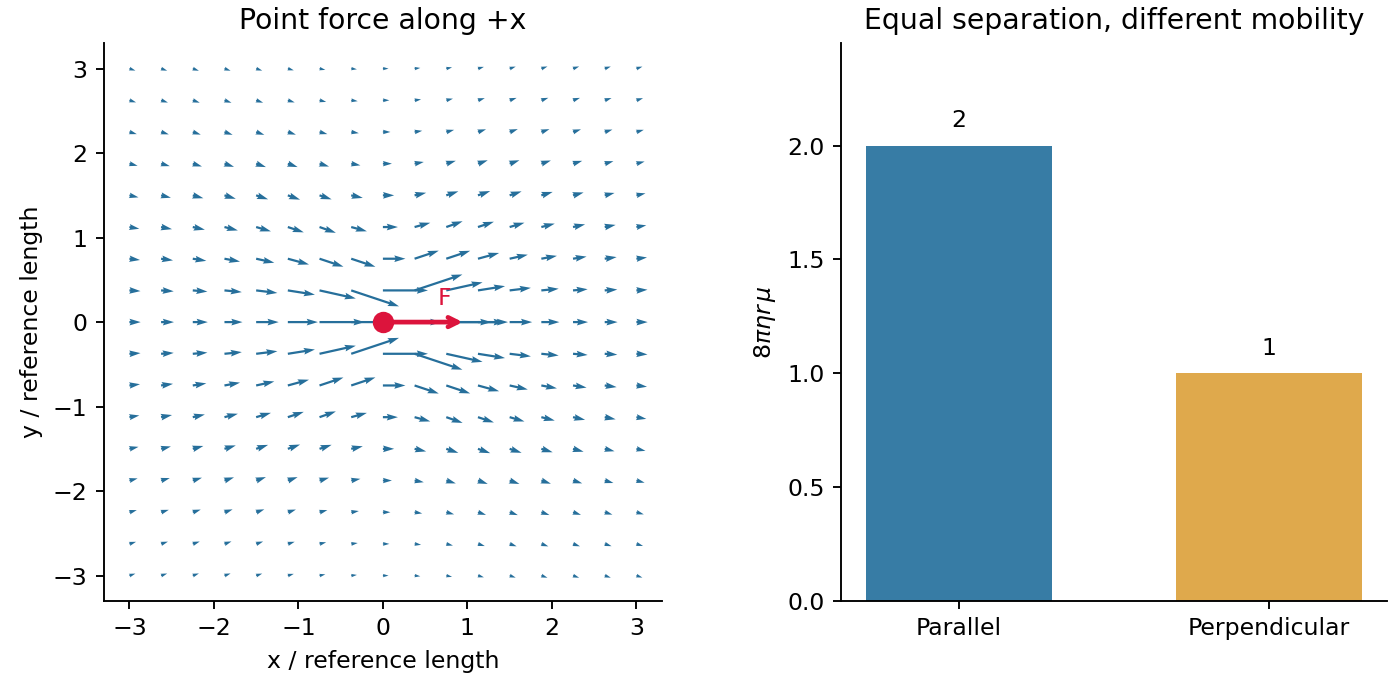
A moving or externally forced colloid disturbs the surrounding fluid, changing the velocity of other colloids even without direct contact. These hydrodynamic interactions are long-ranged at small Reynolds number. In an unbounded incompressible Newtonian liquid, the Stokes flow response to a point force is the Stokeslet:Its Oseen tensor isThis is a mobility tensor, with units velocity per force, rather than a stress tensor. At separation the response parallel to the line of centres is ; the perpendicular response is . Flow is not isotropic even though the solvent is. The disturbance decays as , so treating all drag forces as independent can miss correlated motion.
For well-separated equal spheres of radius , the leading hydrodynamic mobility matrix givesThe first term is the isolated-sphere self mobility; the remaining terms couple distinct particles. At thermal equilibrium the fluctuation-dissipation theorem also predicts correlated short-time increments, with the configuration locally fixed. Thus correlated Brownian displacements can reveal hydrodynamic coupling without an applied force.
The point-force approximation requires and negligible inertia. It diverges at the origin and cannot replace the finite self mobility. Near-contact lubrication, walls, many-body corrections, and a viscoelastic solvent require more complete mobility laws. A force-free particle can instead have a faster-decaying leading disturbance, so the claim specifically concerns a net-force-driven object.

New to topics? Read the docs here!