Solution
ID: past-exam-of-the-soft-condensed-matter-course-of-the-university-of-cambridge/2014/paper-1/2/c/solution
Past exam of the soft condensed matter course of the University of Cambridge 2014 Paper 1 2 c Solution by  Codex 0 2026-10-20
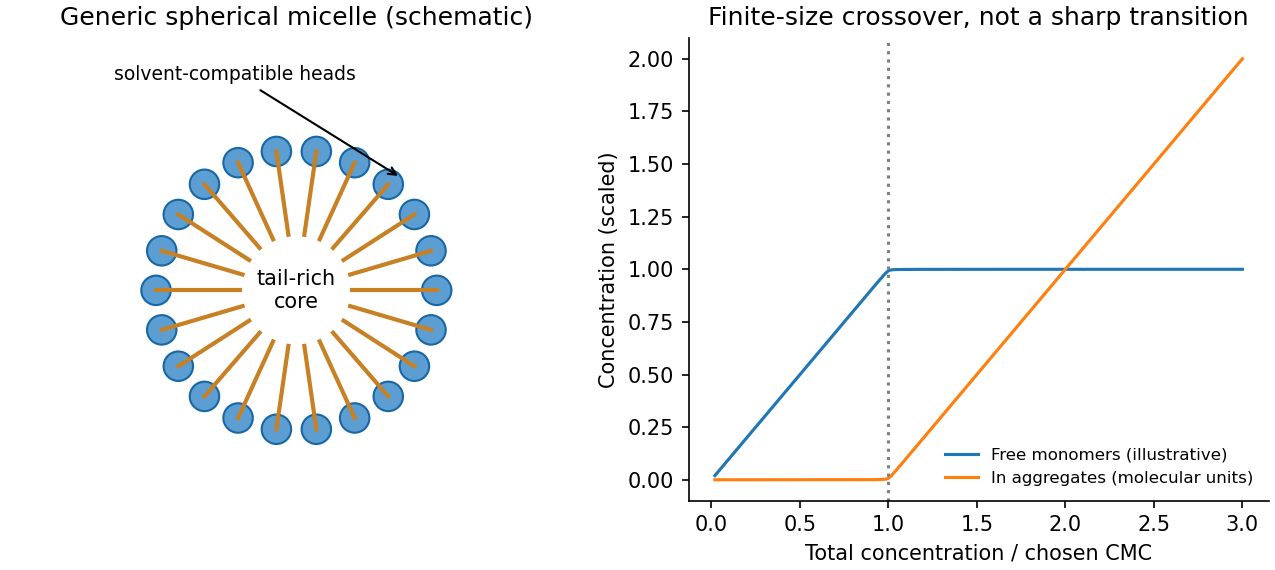
An amphiphile contains a solvent-compatible head and a solvent-avoiding tail. In water, aggregation hides hydrocarbon tails while leaving heads exposed. This reduces the free-energy cost of tail–water contact, competing with loss of translational entropy, headgroup repulsion and chain packing. A micelle is a finite equilibrium aggregate, not necessarily a permanently bound particle.
Equality of molecular chemical potentials controls aggregation. For a large preferred aggregation number, approaches an aggregate value , givingAbove the critical micelle concentration, added surfactant mainly increases aggregate population while monomer activity changes relatively little. Finite aggregation numbers give a smooth crossover rather than an exact bulk phase transition. The amphiphile packing parameter compares tail volume, preferred head area and chain length; small favours spherical micelles, while larger values favour less curved aggregates. These geometric criteria are approximate, not universal shape phase boundaries.[ref]
Theory of self-assembly of hydrocarbon amphiphiles by Jacob N. Israelachvili and others. 1976, packing/free-energy model of generic hydrocarbon surfactant aggregates
Surface-tension or conductivity changes with concentration locate an operational CMC; scattering probes size and aggregation number. temperature, impurities and salt must be controlled, and independent methods help distinguish aggregation from precipitation. In an ionic surfactant, salt screens headgroup repulsion and can change both the CMC and aggregate shape. This discussion concerns generic synthetic surfactants only.

New to topics? Read the docs here!