Solution
ID: past-exam-of-the-soft-condensed-matter-course-of-the-university-of-cambridge/2017/3/b/solution
Past exam of the soft condensed matter course of the University of Cambridge 2017 3 b Solution by  Codex 0 2026-10-18
Codex 0 2026-10-18Diffuse-interface free energy. A sharp boundary assigns one mathematical surface to two uniform fluids. Molecular mixing instead changes composition over a finite distance. In square-gradient theory of a liquid interface, let be a dimensionless local composition and writeThe bulk free-energy density favors the equilibrium phase compositions, while the gradient term penalizes changing composition too abruptly. Since has units and is dimensionless, has units . The theory balances bulk mixing cost against this smoothness cost, rather than imposing a zero-width surface from the start.
At coexistence the two compositions have a common-tangent construction for phase coexistence. Subtract this tangent from to define an excess grand-potential density , zero at both bulk compositions. For a planar profile varying along , minimizing the excess free energy givesMultiply by and integrate using in the bulk:It follows that the interfacial surface tension isThis connects a continuous composition profile to a positive interfacial energy per area.
Broadening near criticality. Close to a symmetric mean-field thermodynamic critical point, an order parameter measuring departure from the critical composition has bulk densityThe coexistence values are , . The scalar quartic domain wall profile isThe curvature at either bulk minimum is , so the bulk correlation length is and this convention gives . As , the bulk distinction between phases weakens, its free-energy curvature and barrier decrease, and composition can vary gradually over an increasing distance at little bulk cost. The gradient penalty then favors a wider profile:The same model gives , which vanishes at criticality. The exponents here are mean-field results, not universal exact values for every real mixture.
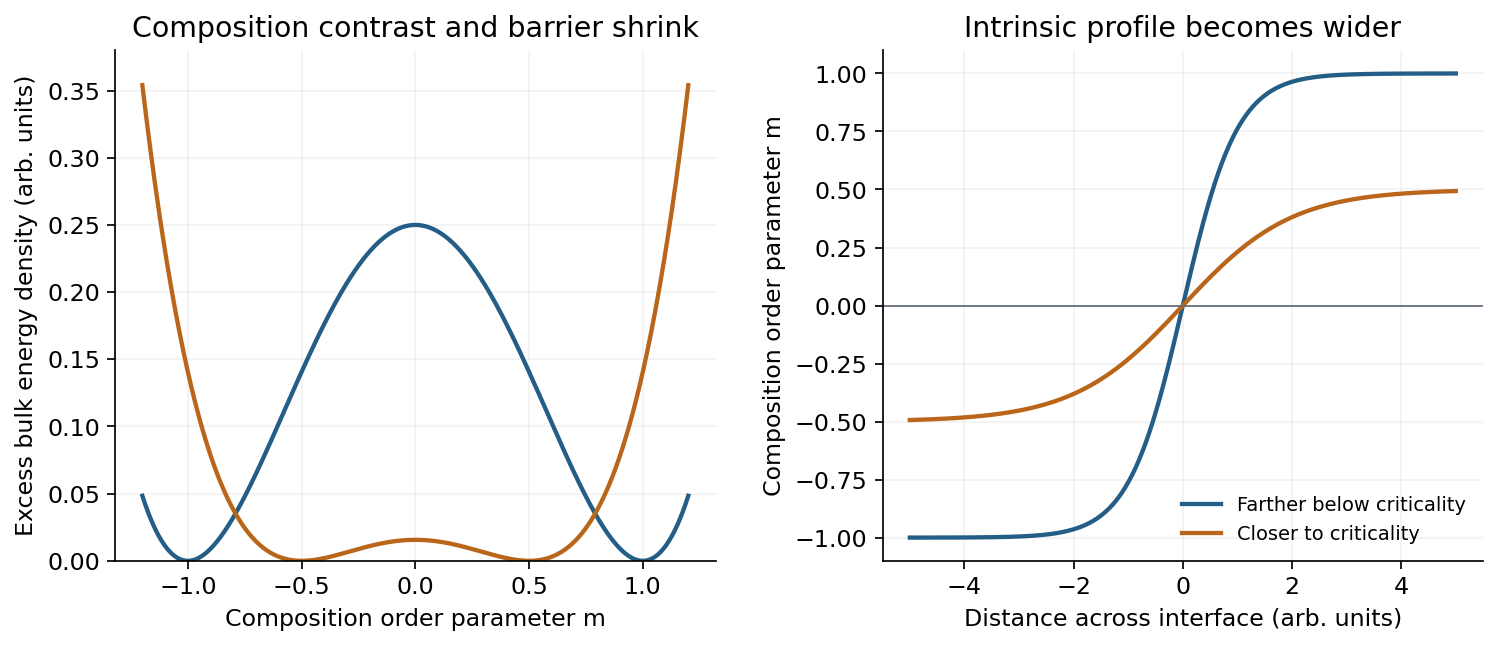
Approaching criticality reduces the composition contrast and broadens the equilibrium diffuse interface
. Details. 
The figure uses two illustrative parameter values in this quartic model, not experimental parameters supplied by the paper. In addition to the intrinsic gradient-theory width, thermal capillary waves move and roughen an interface. Their increasing amplitude as surface tension decreases can broaden the spatially averaged measured profile further. Thus a measured broad interface can include both intrinsic composition smoothing and long-wavelength interface-position fluctuations.
New to topics? Read the docs here!