A capillary wave is a wave along a fluid interface whose restoring stress is predominantly supplied by surface tension. A curved free surface requires a pressure jump by the Young–Laplace equation; increasing its corrugation also costs surface energy. In the ideal limit, inertia carries the interface through its flat position and the resulting oscillation propagates. When gravity also contributes appreciably, use the combined gravity-capillary wave model. Within the capillary wave regime, shortening a ripple makes it travel faster. [ref]
https://davidtong.org/pdfs/teaching/fluid-mechanics/fluids3.pdf. David Tong, Fluid Mechanics, §4.1.3: the capillary restoring pressure
The laser-diffraction measurement of capillary waves below turns this mechanism into a test: set the frequency, measure the wavelength independently with light, and ask whether the dispersion relation follows. The theory is useful both for predicting how ripple wave packets separate and for inferring surface tension from their motion.
A gravity-capillary wave has restoring contributions from both gravity and surface tension. Consider an initially resting, horizontally unbounded liquid layer of constant depth , with uniform mass density , incompressible flow, inviscid flow and irrotational flow. The upper gas exerts constant pressure and has negligible inertia. Assume a clean interface with constant surface tension : no surfactant stresses, imposed current or wind. The wave amplitude must satisfy and , so linearized boundary conditions apply. Deep water means , rather than a particular depth in metres. [ref]
https://www.ocw.mit.edu/courses/18-354j-nonlinear-dynamics-ii-continuum-systems-spring-2015/6163837c5efa5d6ed969e535ec8f890c_MIT18_354JS15_lectureNotes.pdf. Brenner, Peacock, Stocker, Reis and Dunkel, MIT Nonlinear Dynamics II, §23.1, pp. 105–106
Let be the undisturbed free surface, with liquid below it. Potential flow gives a velocity potential with , and incompressible flow gives the Laplace equation. The linearized kinematic boundary condition for a free-surface graph and the Unsteady Bernoulli equation, including gravity and the Young–Laplace equation, giveHere is the interface displacement; the signed small-slope pressure jump is . A wave crest has , so its capillary pressure is positive. Choose a right-travelling Fourier mode of positive wavenumber and angular frequency :The factor decays into the deep liquid, satisfies the Laplace equation, and makes at . Substituting in the dynamic boundary condition leavesThis derivation displays the two restoring contributions with the same sign. Dimensional analysis also checks the result: has units , so both and have units . [ref]
https://www.ocw.mit.edu/courses/18-354j-nonlinear-dynamics-ii-continuum-systems-spring-2015/6163837c5efa5d6ed969e535ec8f890c_MIT18_354JS15_lectureNotes.pdf. MIT Nonlinear Dynamics II, §23.1, equations (547)–(551): boundary conditions and dispersion
At finite depth, a flat impermeable bottom at requires . Replacing by the normalized vertical factor makes the surface ratio . Eliminating the mode amplitudes then givesThus the same model supplies its own depth check: use the deep-water formula only when is sufficiently close to one for the required accuracy. For example, reduces by about relative to deep water, while reduces it by about . These percentages are calculations from this factor. [ref]
In deep water the phase velocity magnitude follows a wave crest, while the group velocity magnitude follows the wave envelope of a narrow wave packet. Differentiating the positive-frequency dispersion relation givesFor , the surface gravity wave limit has . For , the deep-water capillary-wave dispersion relation has : a wave crest slips backward relative to the faster wave envelope, even while both advance. Neither speed is the oscillating fluid element's own velocity. [ref]
There is a particularly neat coincidence at the crossover. Differentiate : its unique minimum is at , exactly where the restoring terms are equal. ThereforeFor the stipulated parameters in capillary length, the minimum is . At , direct substitution gives , and . This short wavelength is capillary dominated, but its group velocity is still slightly below the pure-capillary ratio because gravity has not vanished.
Zhu, Miao, Xu and Cao's 2007 experiment drove a triangular metal frame electromagnetically with a sinusoidal generator. In a roughly -deep, temperature-regulated pool, it produced nearly plane capillary waves. A laser illuminated the surface obliquely; the moving ripples acted as a reflection diffraction grating. One split beam monitored laser stability, while a CCD recorded diffraction orders on a screen away. An air-supported optical table reduced ambient vibration. [ref]
https://www.eg.bucknell.edu/~phys310/skills/papers/paperX_full.pdf. Zhu et al., Measurement of the dispersion relation of capillary waves by laser diffraction, American Journal of Physics 75 (2007), §II.A, p. 896; DOI 10.1119/1.2750379
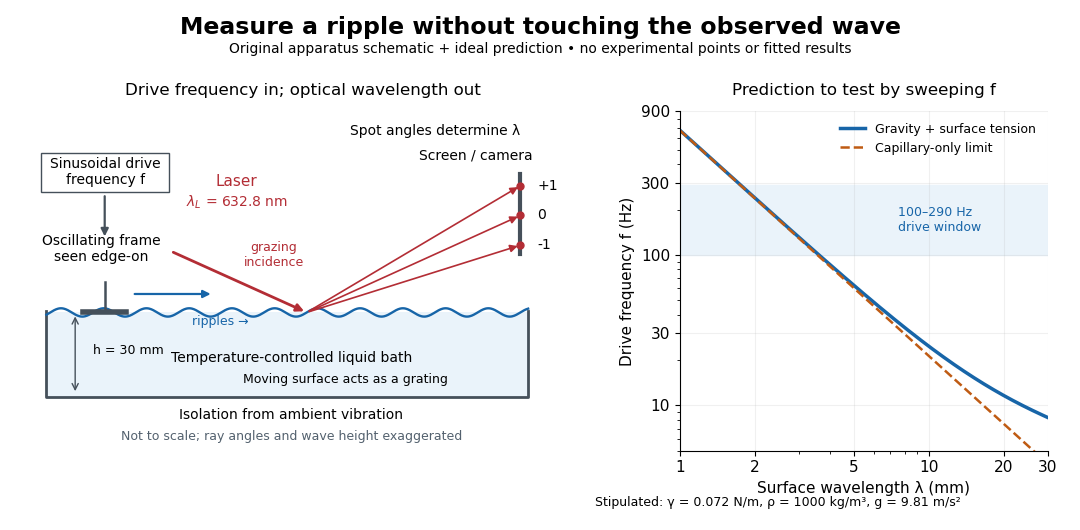
The frequency sweep was – in steps, using distilled water and kerosene at . For each setting they averaged at least three measurements of first-order spot separation. Known optical geometry and the grating equation yielded ; generator readings yielded . Agreement with the predicted log–log slope tests the capillary law, and its intercept gives surface tension if mass density is known. The authors identify surface contamination as a major error source; noncontact optical detection reduces additional disturbance. [ref]
https://www.eg.bucknell.edu/~phys310/skills/papers/paperX_full.pdf. Zhu et al., §§II.B–III, equations (6)–(8), pp. 897–898
The optical measurement can be understood from the grating equation. Let be the laser wavelength, the incident grazing angle above the mean surface, and the outgoing grazing angle of diffraction order , with the sign of chosen so thatThus calibrated spot positions determine outgoing angles, which determine the ripple wavelength , independently of the mechanical dispersion relation. This optical geometry treats the surface as a reflection diffraction grating at the laser wavelength. [ref]
The inferred surface tension in the full deep-water model isThis formula makes useful experimental controls explicit. Measure mass density at the sample's temperature; check depth with ; keep the driven wave amplitude small enough that ; and distinguish from angular frequency . For the stipulated parameters, the – window corresponds to calculated wavelengths about – and – at . Depth corrections are negligible here, but the gravity contribution is about – of the capillary contribution. These are ideal predictions, not digitized results from the experiment.
Omitting gravity would infer , biasing surface tension upward. In the capillary limit, the differential estimate also shows why careful spot-spacing calibration matters. A clean surface and weak viscosity are modeling assumptions: appreciable damping, surfactant stresses or large wave amplitudes call for additional physics. The experiment tests the short-wave regime; its drive window does not establish the crossover or the long-wave surface gravity wave limit.
For a capillary wave on deep water with surface tension and density , the dispersion relation isIts group velocity is in the direction of the wavevector.
If an initially flat one-dimensional surface receives velocity on and zero velocity elsewhere, its linear capillary-wave response is
Along , if , the stationary wavenumber obeys . The one-dimensional stationary-phase formula then givesOnly the integrated initial velocity survives in this long-wave far field.
For a conserved scalar order parameter, a sinusoidal interface perturbation of wavenumber creates a harmonic chemical-potential field extending a distance into each phase. Surface tension then produces a relaxation rate proportional to .
Articles by others on the same topic


Capillary waves are small surface waves that occur on the interface of a fluid, primarily driven by surface tension. They are typically generated when a disturbance, such as wind or a small object, disturbs the surface of a liquid, leading to oscillations. The wavelength of capillary waves is generally short, typically on the order of a few centimeters, and they have periods that range from a fraction of a second to several seconds.