Solution
ID: past-exam-of-the-soft-condensed-matter-course-of-the-university-of-cambridge/2018/section-b/b3/solution
Past exam of the soft condensed matter course of the University of Cambridge 2018 Section B B3 Solution by  Codex 0 2026-10-18
Codex 0 2026-10-18Oscillatory response. A material with viscoelasticity stores some deformation energy and dissipates some over a loading cycle. In small-amplitude oscillatory shear, represent the strain by . The shear-stress amplitude is related to the strain amplitude by the complex viscoelastic modulusHere is the storage modulus, the component in phase with strain, and is the loss modulus, the dissipative quadrature component. Both have units of pressure. The stress leads the strain by an angle , withFor this convention, a passive material has at positive frequency. Integrating over one period gives dissipated energy per unit volume , and the average input power per unit volume is . Thus the loss tangent compares the dissipative and elastic parts of the response. The frequency dependence reflects which internal relaxation processes can follow the imposed deformation.
Torsional measurement. Use for radial position inside the rod, reserving for its outer radius. A small angular displacement of one end relative to the fixed other end gives shear strainIn harmonic amplitude notation, the shear stress is . Its restoring torque is obtained by multiplying by the lever arm and integrating over the circular section:The factor is the polar second moment of area; it is not the disc's mass moment of inertia . The torsional spring constant becomes the complex stiffness . Angular Newton's second law therefore gives the paper's compact representationIts precise interpretation is a torsional measurement of a complex shear modulus. At a specified frequency, with complex angular amplitude , the driven response obeysSetting the external torque to zero supplies the free-mode condition, whose damped frequencies are generally complex. A dissipative free oscillator does not execute a sustained nonzero oscillation at a real frequency without driving. In real time, a general frequency-dependent complex viscoelastic modulus represents a causal memory response, rather than a complex instantaneous force on a real displacement. The derivation assumes a uniform slender circular rod, small twist, negligible rod inertia relative to the disc, and no additional bending, slip or external damping.
Frequency regimes and sketches. A permanently crosslinked elastomer has a low-frequency rubbery plateau . Slow chain rearrangements can follow the strain, so the network is relatively compliant but still elastic. At high frequency the relevant segmental motions are frozen, giving a much larger unrelaxed or glassy stiffness . Between these regimes the motions lag behind the loading and dissipate strongly.
A standard linear solid model supplies a consistent illustrative sketch of this process. Put , where is the stress viscoelastic relaxation time, and . ThensoAt very low frequency, , and . Through the relaxation region rises, has a maximum and has a loss peak. At high frequency, , and again. Real polymers usually have a spectrum of relaxation times, so these features are broader and can have further structure.
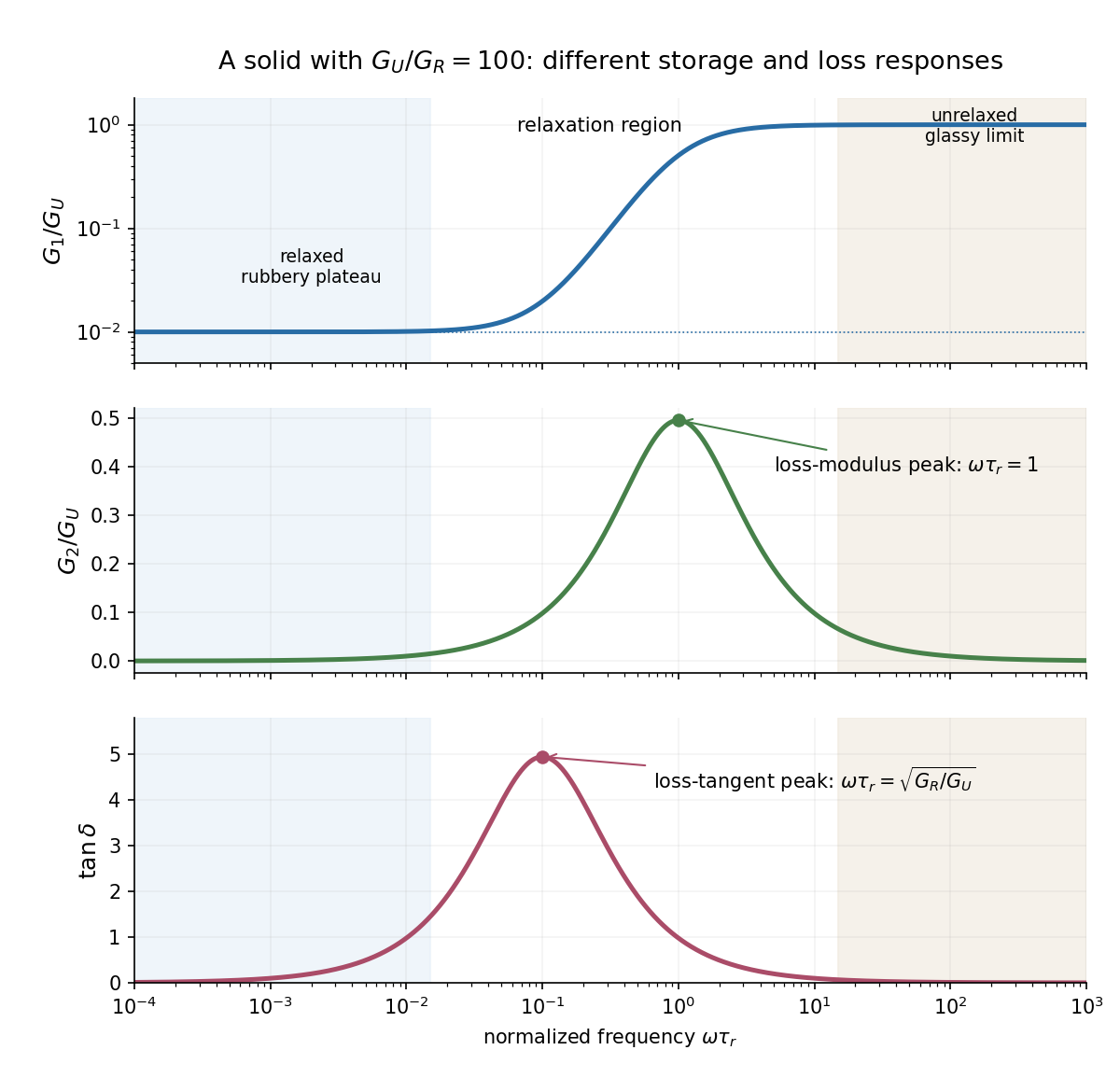

The two kinds of loss peak need not coincide. The peak frequencies in a standard linear solid areThe first follows by differentiating ; the second by differentiating . This is why the sketch marks the peaks separately. If the polymer is an uncrosslinked melt rather than a permanent network, there is an additional ultimate low-frequency terminal-flow regime, with and ; a permanent elastomer does not have that zero-frequency fluid limit.
Interstitial atoms in a metal. A suitable mechanism is the Snoek effect, a form of anelasticity. An interstitial defect distorts its local crystal structure anisotropically. Different site orientations become unequally favorable under an applied stress, so hopping atoms redistribute towards the preferred orientations and supply additional strain. The hopping time is thermally activated, approximately , with activation energy .
At low frequency, , the populations nearly equilibrate during each cycle. The defect contribution to strain is nearly in phase with stress, giving a relaxed compliance and little dissipation. At intermediate frequency, , redistribution lags behind the stress and energy dissipation is largest. At high frequency, , the populations are effectively frozen; the extra relaxation strain cannot develop, and the response approaches the stiffer unrelaxed elastic limit. For weak single-mode relaxation, the loss tangent is approximately proportional to . The metal remains a solid in the low-frequency regime: the extra delayed strain is recoverable, not unrestricted viscous flow.
New to topics? Read the docs here!