Solution
ID: past-exam-of-the-thermal-and-statistical-physics-course-of-the-university-of-cambridge/2016/paper-1/1/c/solution
Past exam of the thermal and statistical physics course of the University of Cambridge 2016 Paper 1 1 c Solution by  Codex 0 2026-10-20
For a complete single-particle state, the Fermi-Dirac distribution isHere denotes the chemical potential, distinct from the magnetic-moment symbol in (b). At zero temperature it approaches the Fermi energy and the occupation has a sharp edge. At , thermal changes occur within an energy interval of order about that edge.
The Fermi-edge heat-capacity counting argument uses the fact that only order electrons can be rearranged because states well below the edge are blocked by the Pauli exclusion principle. Each active excitation carries energy of order , so and . For a smooth density of states, the Sommerfeld expansion givesHere is the total single-particle density of states, including spin. In a three-dimensional free-electron gas, , giving . This is the low-temperature normal-state electronic contribution, not the lattice heat capacity or a description across a superconducting transition.[ref]
Quantum Gases by David Tong. Sections 3.6.2–3.6.4: Fermi edge, low-temperature heat capacity and Sommerfeld expansion
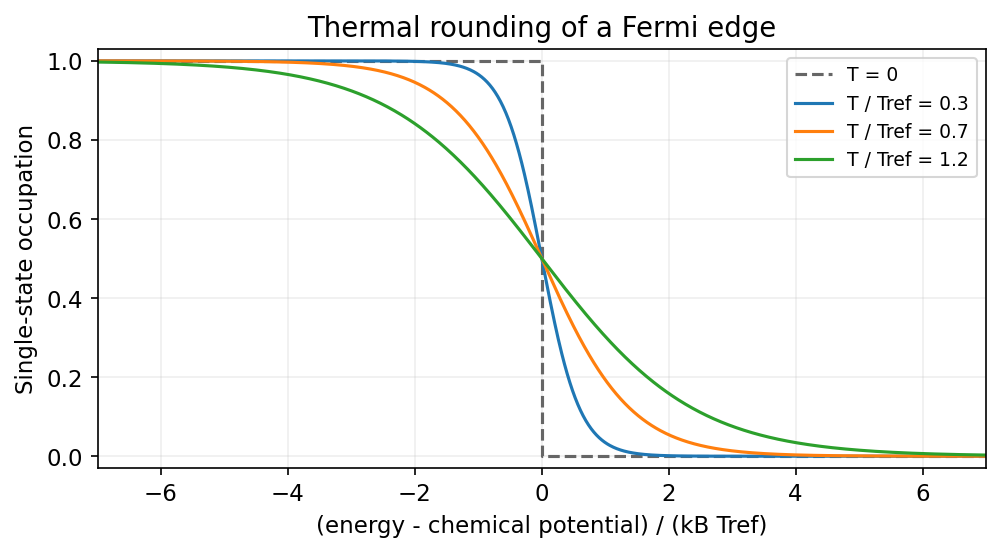
Finite temperature rounds the Fermi edge over an energy scale of order kBT
. Source. Details. 
New to topics? Read the docs here!