Perfect elimination ordering
ID: perfect-elimination-ordering

A perfect elimination ordering of a finite simple graph is a permutation of its vertices such that each set of later graph neighboursis a clique. Thus is a simplicial vertex in the remaining induced subgraph . Empty and one-vertex sets satisfy the clique condition automatically. The order here is the order of deletion: goes first.
The characterization is powerful: a finite simple graph is a chordal graph if and only if it has a perfect elimination ordering. For one proof outline, the earliest vertex of an induced cycle of length at least four would have two later graph neighbours on that graph cycle that are not adjacent, contradicting the clique condition. Conversely, every nonempty chordal graph has a simplicial vertex, and every induced subgraph of a chordal graph is a chordal graph; repeatedly deleting such a vertex supplies the ordering.[ref]
In the square-plus-diagonal chordal graph above, is a perfect elimination ordering, with later graph neighbourhoods , , , and . Starting instead with fails: its graph neighbours do not form a clique, because is absent. Thus even a chordal graph can have a poor elimination ordering.
For a larger example, join three triangles along shared edges, usingThe exact graph neighbourhoods are , , , , and . The ordering has later graph neighbourhoods , , , , and , all cliques; this certifies that the graph is a chordal graph without enumerating its graph cycles. Its maximal cliques , , form a junction tree in that order, with intersections and .
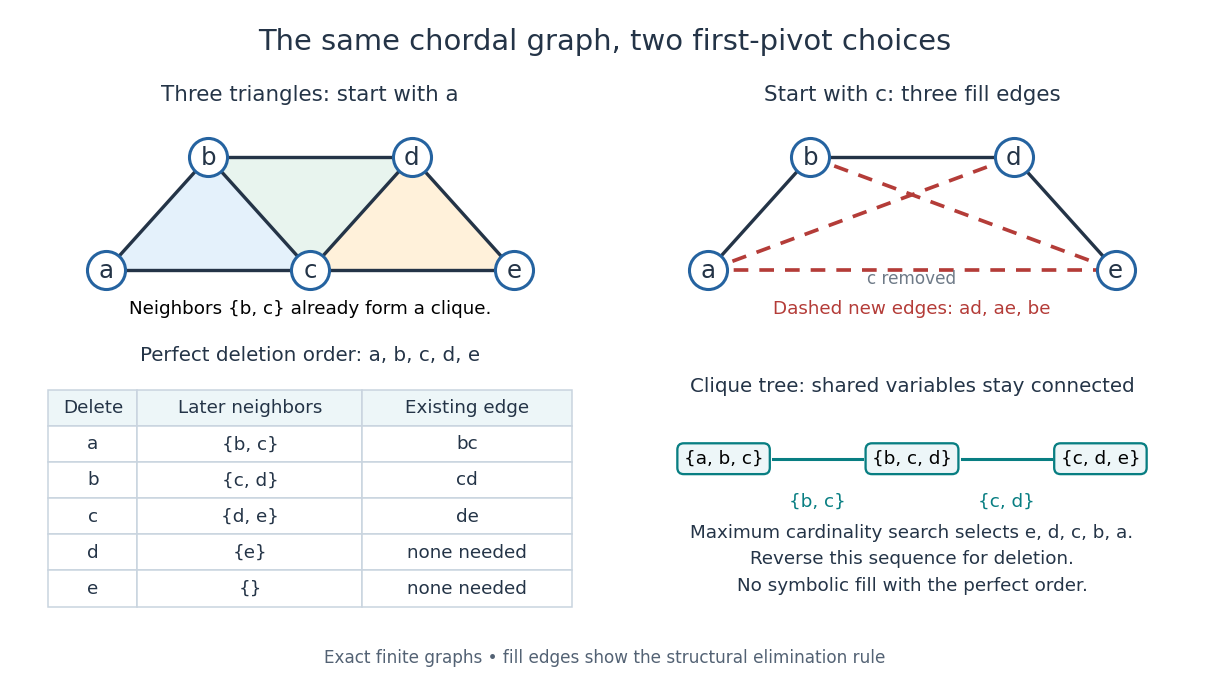
A perfect elimination ordering removes three overlapping triangles without fill-in; choosing the central vertex first adds three edges
. Details. 
To find an ordering, maximum cardinality search starts with all scores zero, repeatedly selects an unselected vertex of largest score, and increases each unselected graph neighbour's score by one. Reverse the selection order to obtain a candidate perfect elimination ordering. For the three-triangle graph, one valid selection sequence is , with scores at selection ; reversing it gives the displayed deletion order. On a chordal graph every tie choice works. On an arbitrary graph, test the resulting later graph neighbourhoods for the clique condition to recognize chordal graphs. Suitable adjacency lists, score buckets and a linear-time verification method give recognition.[ref]
The deletion rule also explains sparse Gaussian elimination. For a symmetric positive-definite matrix whose matrix graph is , eliminating pivot applies the Schur complement updateOnly pairs of remaining graph neighbours of can acquire new off-diagonal entries. A perfect elimination ordering already has all those edges, so Cholesky decomposition creates no symbolic fill-in. Positive definiteness ensures nonzero pivots in exact arithmetic. Special numerical cancellation can suppress predicted entries, and floating-point rounding affects their values.[ref]
Chordal Graphs and Semidefinite Optimization by Lieven Vandenberghe and others. §9.1; equation 9.2; Theorem 9.1
In the three-triangle graph, deleting first instead connects every pair in and adds exactly . The graph was already a chordal graph; the extra fill-in comes from the ordering.One further reward is optimal graph coloring. Process a perfect elimination ordering backwards and give each vertex the smallest positive color absent from its already colored graph neighbours. Those graph neighbours form a clique, so this greedy algorithm uses at most the clique number colors; any clique of that size requires at least that many. In the three-triangle graph, coloring gives colors , so both the chromatic number and the clique number are three. Every maximal clique also occurs among : take its earliest vertex and use maximality. The same ordering therefore supports graph coloring, maximal clique extraction and sparse computation.
Historically, Donald J. Rose, Robert E. Tarjan and George S. Lueker's 1976 paper connected graph elimination to symmetric sparse matrices and gave a search-based algorithm for finding a perfect elimination ordering when one exists. Its abstract distinguishes a minimal elimination ordering from a minimum one: removing avoidable fill-in does not by itself minimize the total number of added edges.[ref]
New to topics? Read the docs here!