Periodic heat and transport comparison
ID: periodic-heat-and-transport-comparison

Use dimensionless and , the periodic domain , and the same initial conditionWith zero PDE source term, compare the heat equation and the transport equation . Their exact solutions areEach cosine satisfies , so the heat equation reduces its amplitude according to . The superposition principle combines the constant and two Fourier modes. The transport equation shifts the argument of the entire profile. Both formulas meet the initial condition and matching periodic boundary conditions exactly.[ref]
https://web.stanford.edu/class/math220b/handouts/heateqn.pdf. Stanford Math 220B heat-equation notes, periodic boundary conditions
At , the heat amplitudes are approximately and : the small ripples disappear much sooner than the broad variation. The transport equation retains amplitudes and , shifting the profile right by one unit with wraparound. Both preserve spatial average , but only the heat equation approaches the uniform profile. This gives diffusion its usefulness for smoothing uneven temperatures, while the transport equation models a profile carried by a flow. The signed profile can represent a scaled temperature deviation.
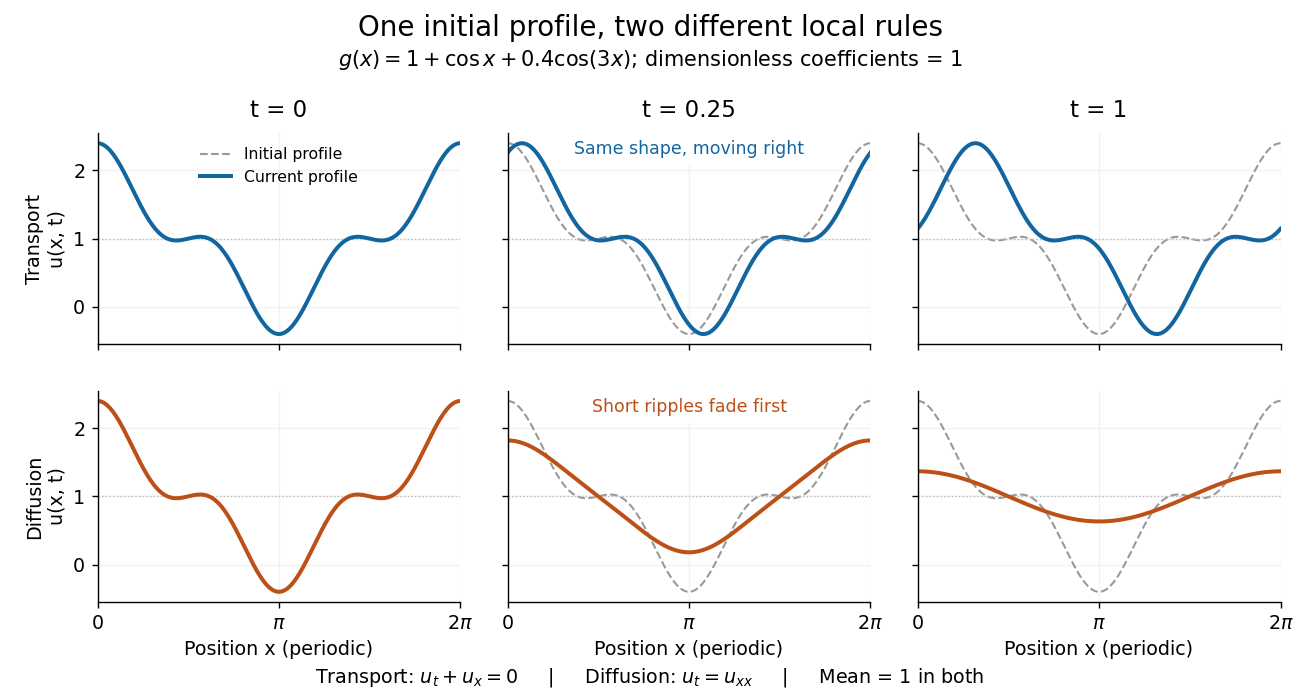
Exact evolution of one periodic profile: transport translates while diffusion preferentially removes short wavelengths
. Details. 
To restore units, let physical position be and time be . For , the dimensionless coefficient is , with measured in length squared per time. For , it is , with measured in length per time. Both plotted coefficients equal one when and . Thus the example compares specified models on the same scales, rather than identifying diffusivity with velocity.
New to topics? Read the docs here!