Planar rotational diffusion
ID: planar-rotational-diffusion

For free planar turning with constant , no imposed torque and negligible inertia, model an unwrapped angle by the stochastic differential equationHere is standard one-dimensional Brownian motion, with increment variance , and brackets denote expected values over repeated realizations. The angular variance is conventionally reported in . “Unwrapped” means recording accumulated turns continuously, rather than resetting the angle at each revolution. Directly subtracting wrapped camera angles creates artificial jumps; for an unmarked ellipsoid the wrapping period is , and resolving successive turns additionally requires sufficiently frequent images.
For a planar arrow , the orientational autocorrelation isFor an unoriented planar axis, use an autocorrelation unchanged by replacing either endpoint angle by that angle plus :The same thus gives arrow and axis correlation times and , respectively, where a correlation time here is the lag at which the relevant curve reaches . A short explanation is enough: has a Gaussian distribution of variance , so its characteristic function gives . The integer selects what the observable can distinguish; it does not change the underlying angular spreading.
For an original numerical example, choose . After , the angular variance is and its root mean square displacement is , although the mean displacement is zero. The planar arrow autocorrelation is , while the planar axis autocorrelation is . Calling both “the orientation correlation” without specifying the observable would hide a factor of four in decay rate.
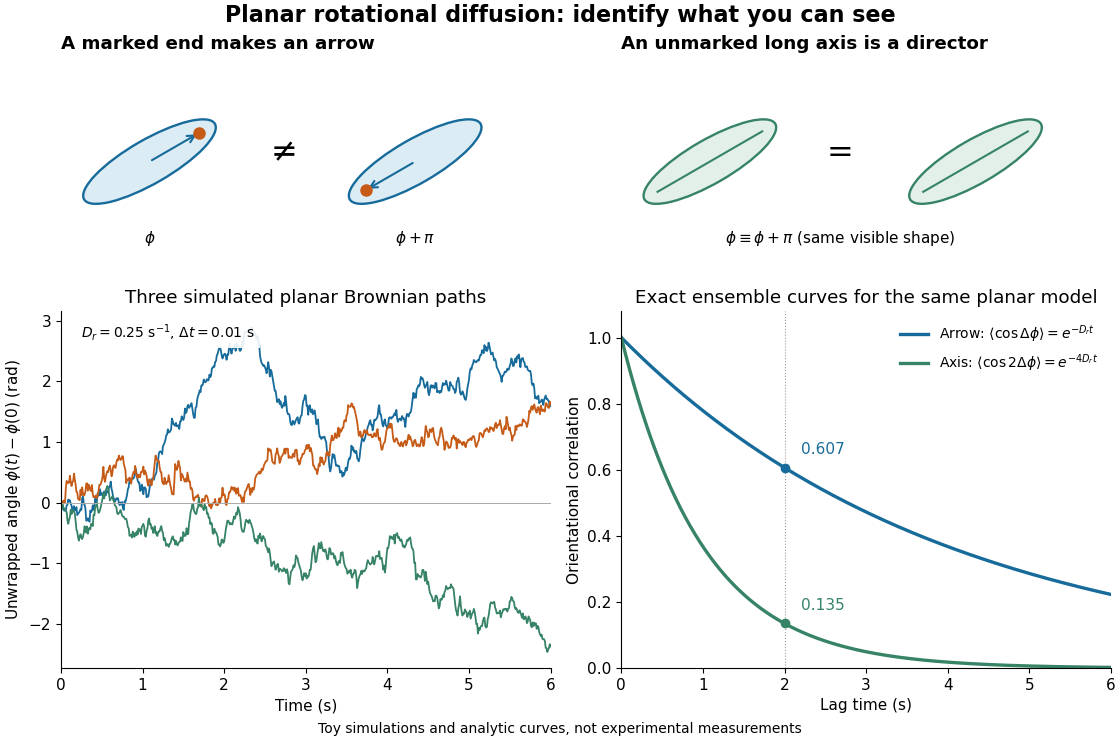
Planar rotational diffusion: arrows, unoriented axes and loss of angular memory
. Original schematics, three simulated Brownian motion angle paths and exact ensemble autocorrelation curves for the chosen . The paths use independent Gaussian distribution increments of variance with . The curves are model predictions, not fits to these three paths or experimental measurements. Both curves concern planar turning; neither is the three-dimensional unit-vector law. Details.
New to topics? Read the docs here!