Rotational diffusion is the random change of a particle's rigid body orientation through Brownian motion. A suspended ellipsoid can turn while its centre hardly moves; translational diffusion instead spreads its position. Random molecular collisions supply fluctuating torques as well as forces. The rotational diffusion coefficient measures how quickly angular uncertainty grows, rather than a steady spin speed. Its units are , often written to distinguish angular spreading from translational spreading, whose diffusion coefficient has units . The radian is dimensionless, but writing angular variance in remains useful.
First identify what the image can reveal. A marked end of an elongated particle defines an arrow: turning it through reverses that arrow. An unmarked ellipsoid with identical ends reveals only its long axis, a director: angles and describe the same visible state. An unmarked perfect sphere has no visible rigid body orientation at all. Tracking its centre cannot measure its rotational diffusion; a surface mark or another identifiable internal direction is needed.
This distinction makes rotational diffusion useful: it measures how long a particle remembers its pointing direction. For an elongated particle, turning also changes which laboratory direction is easiest for translational diffusion. Randomization of rigid body orientation can therefore erase directional preferences in the observed displacement, even though the particle's shape has not changed.
For free planar turning with constant , no imposed torque and negligible inertia, model an unwrapped angle by the stochastic differential equationHere is standard one-dimensional Brownian motion, with increment variance , and brackets denote expected values over repeated realizations. The angular variance is conventionally reported in . “Unwrapped” means recording accumulated turns continuously, rather than resetting the angle at each revolution. Directly subtracting wrapped camera angles creates artificial jumps; for an unmarked ellipsoid the wrapping period is , and resolving successive turns additionally requires sufficiently frequent images.
For a planar arrow , the orientational autocorrelation isFor an unoriented planar axis, use an autocorrelation unchanged by replacing either endpoint angle by that angle plus :The same thus gives arrow and axis correlation times and , respectively, where a correlation time here is the lag at which the relevant curve reaches . A short explanation is enough: has a Gaussian distribution of variance , so its characteristic function gives . The integer selects what the observable can distinguish; it does not change the underlying angular spreading.
For an original numerical example, choose . After , the angular variance is and its root mean square displacement is , although the mean displacement is zero. The planar arrow autocorrelation is , while the planar axis autocorrelation is . Calling both “the orientation correlation” without specifying the observable would hide a factor of four in decay rate.
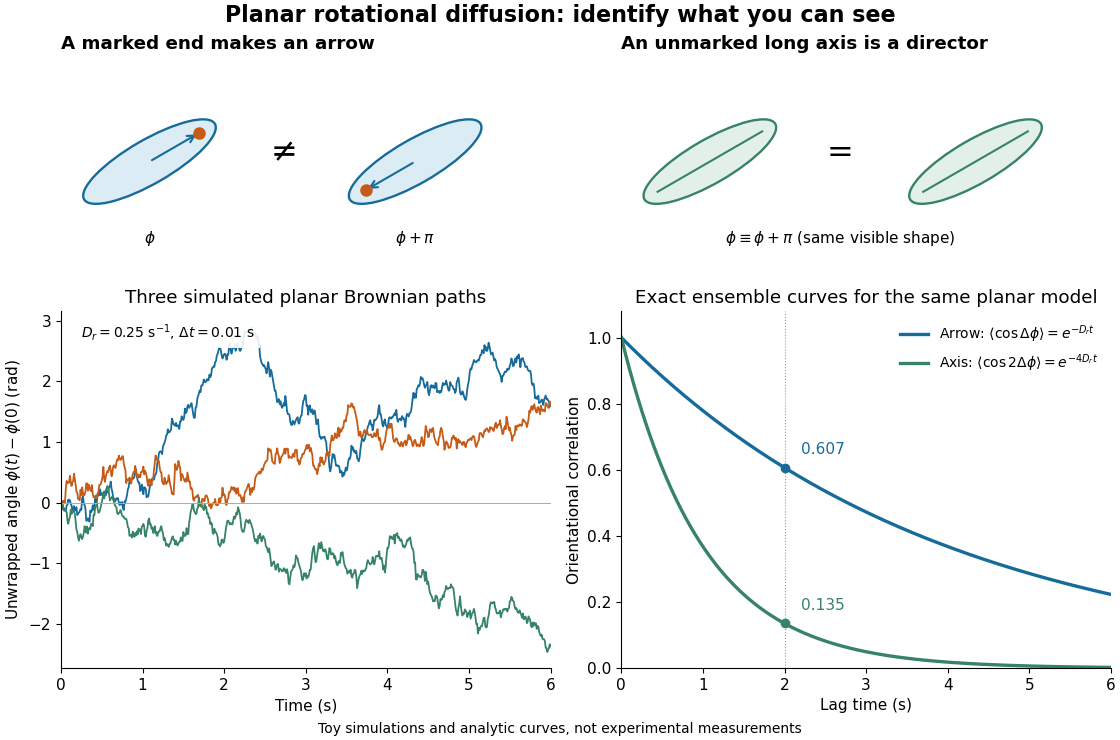
Planar rotational diffusion: arrows, unoriented axes and loss of angular memory
. Original schematics, three simulated Brownian motion angle paths and exact ensemble autocorrelation curves for the chosen . The paths use independent Gaussian distribution increments of variance with . The curves are model predictions, not fits to these three paths or experimental measurements. Both curves concern planar turning; neither is the three-dimensional unit-vector law. Details.
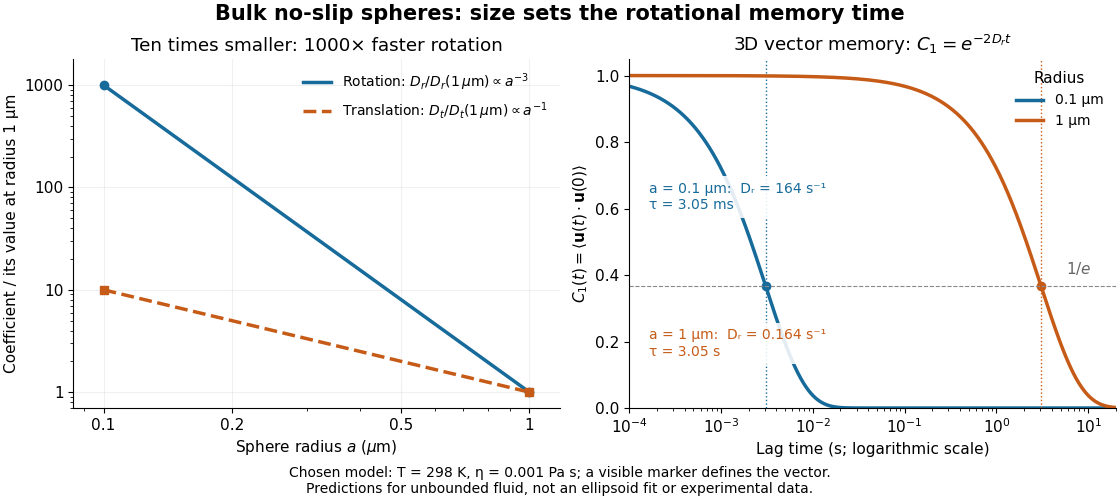
For isotropic turning in three dimensions, the tip of a marked unit vector wanders over the unit sphere. Its probability density function obeys the orientational Fokker-Planck equationHere is the Laplace-Beltrami operator on the unit sphere. The factor two follows from the sphere surface derivative identities: , so each mean vector component decays at rate . This is a different orientation space from the circle of planar rotational diffusion, whose corresponding rate is . For the same illustrative and , this three-dimensional autocorrelation is .
One unit vector records a pointing direction, not every aspect of a rigid body's rigid body orientation: rotation about that vector remains unspecified. Also, requires an identifiable arrow. An unmarked ellipsoid's long axis alone does not supply one, and projecting a three-dimensional trajectory onto a camera plane does not automatically produce the planar model.
For a sphere of radius in an otherwise stationary, unbounded Newtonian fluid with dynamic viscosity , impose the no-slip boundary condition and the slow-flow assumptions of Stokes flow. The resisting torque on a rotating sphere in Stokes flow is , where is its angular velocity and . Thermal rotational diffusion at absolute temperature then givesHere is the Boltzmann constant; the translational expression is the Stokes–Einstein relation. The ratio has units of inverse length squared, so comparing the numerical values of and without their units is meaningless. At fixed temperature and dynamic viscosity, decreasing radius tenfold increases a thousandfold but only tenfold. This strong size dependence explains why small particles can lose directional memory extremely quickly.
Choose and as illustrative model inputs. Using gives and the following predictions:These are bulk three-dimensional sphere calculations, explicitly not a fit to the confined ellipsoid experiment below. Walls, nonspherical shape and departure from the no-slip boundary condition can change rotational resistance. A visible surface mark is still necessary to read the sphere's turning in an image, even when its rotational diffusion coefficient is well defined physically.

In 2006, Yilong Han and colleagues dispersed plastic ellipsoids in water inside a thin glass cell, using a very dilute suspension to limit particle interactions. A camera on an optical microscope recorded 30 frames per second. Image analysis extracted centre positions and long-axis angles, with reported angular resolution about . Their shape supplied the observable axis. Reflected interference colours calibrated cell thickness; nearly constant particle interference colour checked vertical wandering. One tracked particle had dimensions in an gap. Angular displacement variance grew linearly with lag; displacement resolved along the particle's axes and in the laboratory showed how turning washes out translational anisotropy. These are observations of confined particles: walls alter drag, and slight out-of-plane tumbling affected positional resolution. They do not establish the bulk sphere formula. The paper's Figure 1A–B shows simulations; Figure 1F shows a measured trajectory.[ref]
Brownian Motion of an Ellipsoid by Yilong Han and others. Han et al., Brownian Motion of an Ellipsoid, Science 314 (2006), pp. 626–628; Figures 1D–F and 2A–B: apparatus, angular readout, dilution and height checks, angular variance and translational crossover
For interpreting such images, the director distinction is essential: identical ends give an angle modulo . A continuously unwrapped trace can follow small successive turns, but it does not make the ends physically distinguishable. The invariant planar axis autocorrelation is , and its decay determines through . Separately measuring position and rigid body orientation is what makes the connection between translational anisotropy and loss of angular memory experimentally accessible.
Articles by others on the same topic
There are currently no matching articles.