
Quadratic drag has magnitude proportional to the square of the relative speed and points opposite to the relative velocity.
For an isotropic model of a body of fixed shape, let denote its relative velocity through the distant fluid, with . A constant positive resistance givesHere density , reference area and drag coefficient are held fixed over the modeled range of relative speeds. The vector formula makes the direction explicit: the drag force on the body opposes its motion relative to the fluid, and vanishes at . For a general body, orientation and other flow conditions can affect the drag coefficient; treating it as a constant requires a regime in which that is an adequate approximation. [ref]
https://www1.grc.nasa.gov/beginners-guide-to-aeronautics/drag-coefficient/. NASA Glenn Research Center, Drag Coefficient, Air Viscosity and Compressibility Effects
Compare two distinct models at a chosen relative speed . A linear drag model has , while a constant-coefficient quadratic drag model has . At their drag force ratios are two and four respectively.
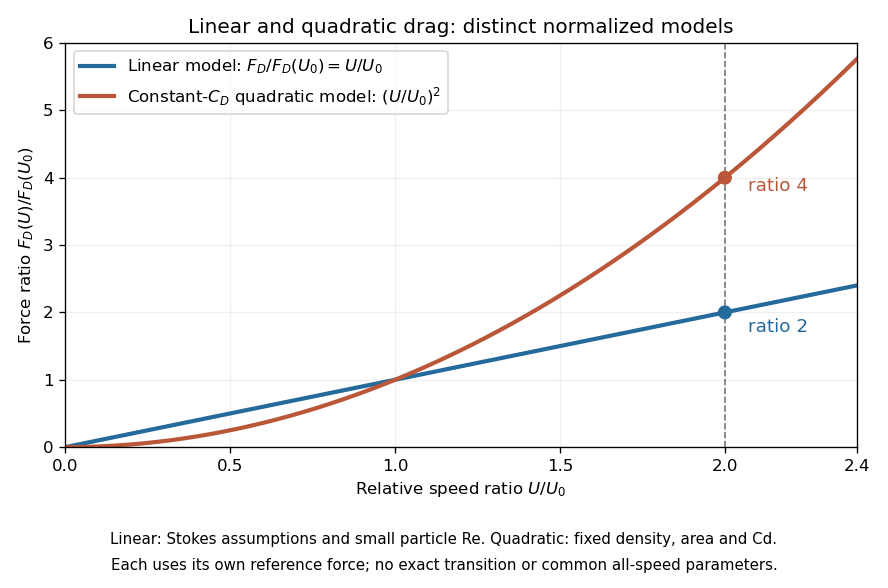

This distinction matters when estimating terminal velocity or trajectories such as descent from rest under quadratic drag: doubling relative speed increases the resistance much more strongly in the quadratic drag model. An approximately constant drag coefficient can occur in another Reynolds number regime; its use must be justified there. Conversely, substituting the creeping-flow sphere coefficient into recovers linear drag, so writing this general formula does not make the resistance quadratic. Neither approximation should be extended across all Reynolds numbers.
New to topics? Read the docs here!