The drag coefficient measures a drag force against a specified scale of force. Let be the body's velocity relative to the distant, undisturbed fluid, and let be its relative speed. For fluid density , drag force magnitude and reference area , defineThe drag coefficient is a dimensionless quantity: the denominator has units of force. The reference area must be reported with it. For a sphere of radius , the usual choice is the frontal area . Choosing its entire surface area instead divides the reported drag coefficient by four for the same physical drag force. Comparing coefficients without comparing their reference areas can therefore be misleading. [ref]
https://www1.grc.nasa.gov/beginners-guide-to-aeronautics/drag-coefficient/. NASA Glenn Research Center, Drag Coefficient, definition and Determining Value for Drag Coefficient
For a rigid sphere in steady flow through an unbounded Newtonian fluid with constant dynamic viscosity , incompressible flow and the no-slip boundary condition, the creeping-flow limit requires the diameter-based particle Reynolds number . The Stokes drag law gives . Substitution into the definition with gives the short derivationThus the drag coefficient is neither necessarily constant nor bounded above by one. The formula containing still describes linear drag here, because the drag coefficient varies as . The relation is the leading small-Reynolds number approximation, not a measured curve valid at every Reynolds number. [ref]
https://farside.ph.utexas.edu/teaching/336L/Fluid/node142.html. Richard Fitzpatrick, Axisymmetric Stokes Flow Around a Solid Sphere, equations 10.126 and 10.129
For a worked example, stipulate dynamic viscosity , density , radius and relative speed . Within the stated Stokes drag law assumptions,Doubling the relative speed with all other parameters fixed gives and : the predicted drag force doubles to . Falsely holding the drag coefficient at would instead quadruple the drag force. Both particle Reynolds numbers remain small, so the comparison is within the creeping-flow approximation.
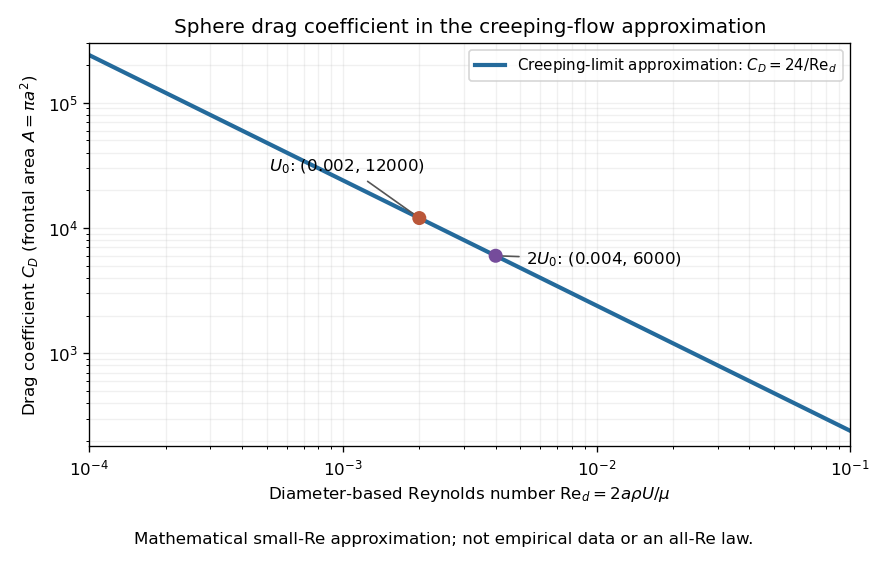

The useful idea is to separate the force scale from the dependence on geometry and flow conditions. A drag coefficient can help compare experiments, but changing Reynolds number can change the coefficient itself; NASA Glenn explicitly stresses matching the relevant flow conditions. The elegant cancellation above also exposes a common mistake: a drag coefficient definition does not by itself impose a quadratic drag law.
Articles by others on the same topic
There are currently no matching articles.