
A measurement in quantum mechanics turns a quantum state preparation into a classical outcome, such as a detector label. Two questions must be distinguished: how likely is each outcome, and what quantum state remains conditional on that outcome? A positive operator-valued measure answers the first; a quantum instrument answers both. This distinction is useful whenever a measured system participates in a later experiment, including quantum state tomography and measurement-based quantum feedback.
For a density operator , the Born rule gives , where the are positive operators satisfying . Here is the identity operator, and denotes the trace. Positivity makes every nonnegative; completeness makes their sum one. For a pure state, and . A projective measurement is the special case in which the are orthogonal projections onto mutually orthogonal subspaces.
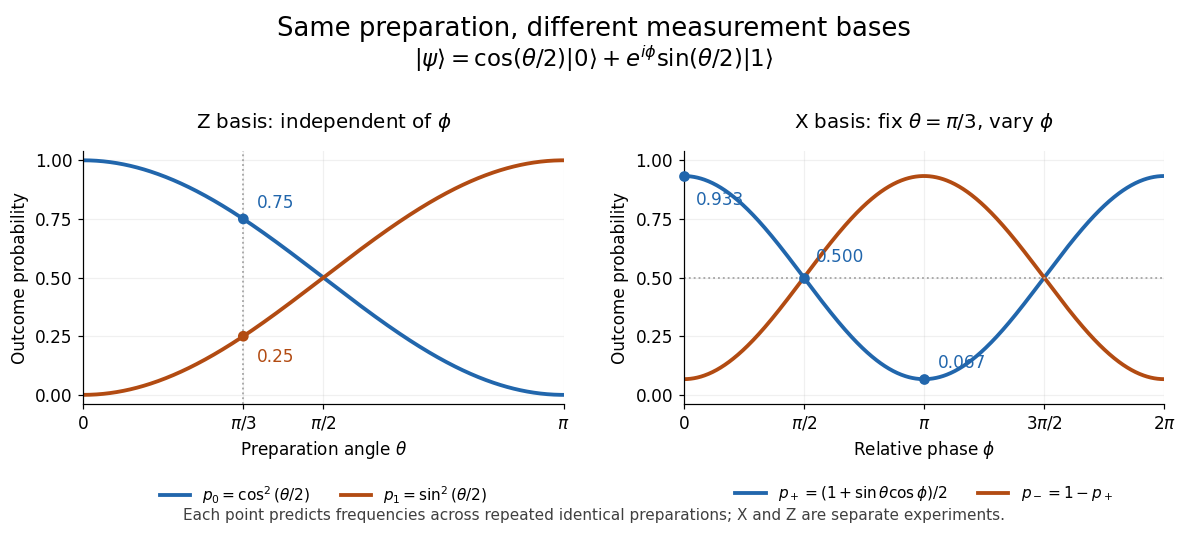
For a qubit, choose the computational basis and write a normalized pure state, up to global phase, asThe angle is a relative quantum phase; at the poles it does not distinguish states. Measuring the Pauli matrix reports for label zero and for label one, withThese probabilities describe repeated identical preparations. They do not assign a hidden, pre-existing value to every possible measurement basis.
The Born rule grew out of Max Born's 1926 work on quantum scattering: squared probability amplitudes determine the relative frequencies of scattering outcomes. Born explained this statistical interpretation again in his 1954 Nobel lecture. This probability law does not by itself select a post-measurement state. [ref]
https://doi.org/10.1007/BF01397477. Born, 1926 collision paper
; [ref]https://www.nobelprize.org/uploads/2018/06/born-lecture.pdf. Born, Nobel lecture, 1954, pp. 261–262
.

Quantum measurement is a fundamental process in quantum mechanics that involves the interaction between a quantum system and a measurement device, resulting in the extraction of information about the system's state. The act of measurement has significant implications for the behavior of quantum systems, distinguishing it from classical measurements. Key concepts related to quantum measurement include: 1. **Superposition**: Before measurement, a quantum system can exist in multiple states simultaneously (a superposition).
New to topics? Read the docs here!