
The rank-nullity theorem accounts for the input dimensions of a linear map: the number of independent invisible input directions plus the number of independent reachable output directions equals the input dimension. For over a field, with finite-dimensional domain of a function ,Here is the nullity, and is the rank of a linear map. The kernel lives in the input vector space, while the image of a linear map lives in the output vector space. For an -by- matrix of matrix rank , the formula is : the number of columns counts input coordinates. [ref]
Linear Algebra Done Right by Sheldon Axler (4th edition). Sheldon Axler, Linear Algebra Done Right, fourth edition, §3B: fundamental theorem of linear maps
For a computed example over the real numbers, takeThe kernel is and the image of a linear map is . Each has dimension one, so the two input dimensions split as . The vector can be writtenThe second summand is undetectable: . The picture uses the standard dot product to choose a visible direction perpendicular to the kernel; this is a convenient geometric choice, not an extra hypothesis of the rank-nullity theorem.
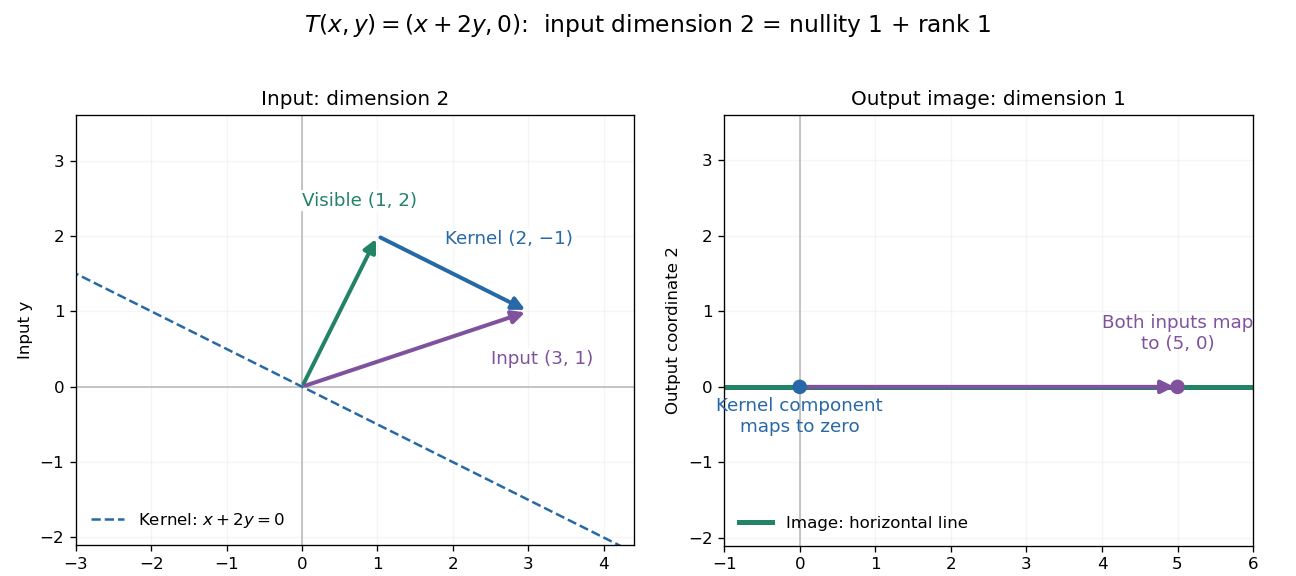
Two input dimensions split into one visible direction and one kernel direction
. For , the input splits into and . Both and map to , while the kernel component maps to zero. The horizontal output line is the entire image of a linear map. Details.This explains a practical tradeoff in a linear system. If , every other input with output is for . The nullity therefore counts independent freedom in an existing solution; the rank counts independent reachable output directions. In the example, has all solutions , while has none. The cokernel records this failure of reachability.
For an -by- matrix, injectivity requires matrix rank , and surjectivity requires matrix rank . When , these conditions differ. For example, with has rank one and nullity two, because . The input accounting is , although only one of two output directions is reached.
Proof outline: extend a basis of the kernel to a basis of . Every output is a linear combination of because the vanish under . If a linear combination of the is zero, the corresponding combination of the lies in the kernel; linear independence of the full basis forces all its coefficients to vanish. Thus the added basis vectors give a basis of the image of a linear map. Counting them proves the formula.


The Rank-Nullity Theorem is a fundamental result in linear algebra that relates the dimensions of different subspaces associated with a linear transformation. Specifically, it applies to linear transformations between finite-dimensional vector spaces.
New to topics? Read the docs here!