
In ideal SEC pore access, geometric exclusion changes the fraction of pore liquid a solute can occupy. Diffusion permits entry into and exit from accessible pores; the through-flow chiefly transports the sample between packing particles. A hydrodynamic radius is a useful size descriptor, but actual pore entry also depends on shape and pore geometry. A flexible polymer coil is not a rigid ball with a perfectly sharp entry diameter.
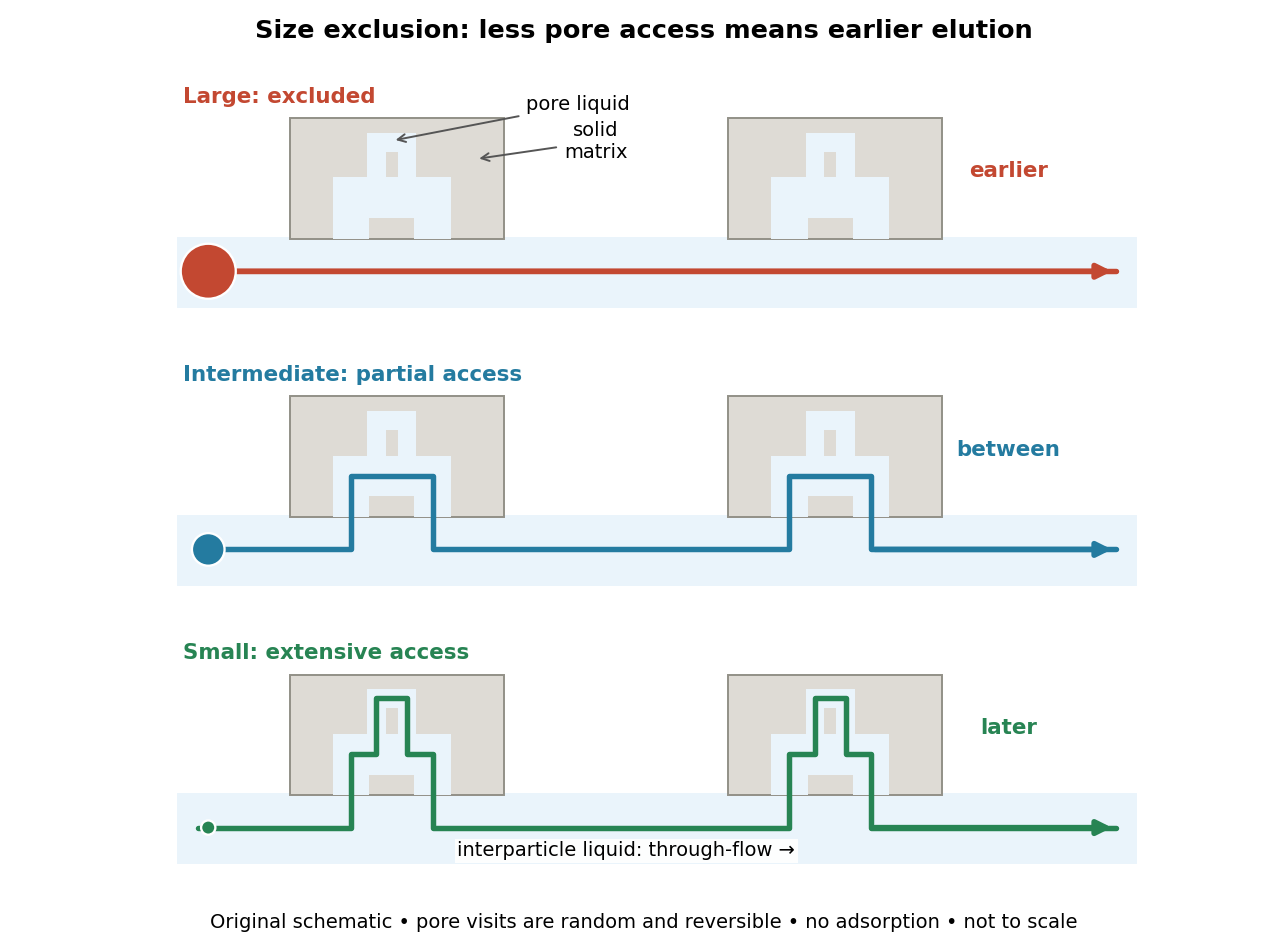

The extra delay is best understood as extra accessible storage, rather than a prescribed longer streamline. Pore visits are reversible and random. An entirely excluded species samples the SEC void volume; a sufficiently small nonbinding species samples the SEC total accessible liquid volume. Intermediate species lie between these limits. Larger hydrodynamic size generally means earlier elution within the column's SEC fractionation range.
New to topics? Read the docs here!