Why do methane, ammonia, and water have different shapes when each central chemical atom is surrounded by eight valence electrons? The answer separates the positions of atomic nuclei from the electron domains used in a VSEPR model.
Molecular geometry describes the three-dimensional arrangement of the atomic nuclei in a molecule, including bond lengths and bond angles. For a larger molecule, a shape name often describes just the neighbours of one central chemical atom. A Lewis structure records connections and electron bookkeeping; its flat layout does not fix molecular geometry.
In the VSEPR model, electron pair geometry includes both bonding electron domains and lone pairs, whereas molecular geometry counts only the chemical atoms. In methane, four bond pairs and no lone pairs give tetrahedral molecular geometry. In ammonia, three bond pairs and one lone pair give trigonal pyramidal molecular geometry. In water, two bond pairs and two lone pairs give bent molecular geometry. All three use the same ideal tetrahedral electron pair geometry; this does not make their actual bond angles equal. See Flowers, Theopold, Langley and Robinson, Chemistry 2e, §7.6: electron-pair and molecular geometries.
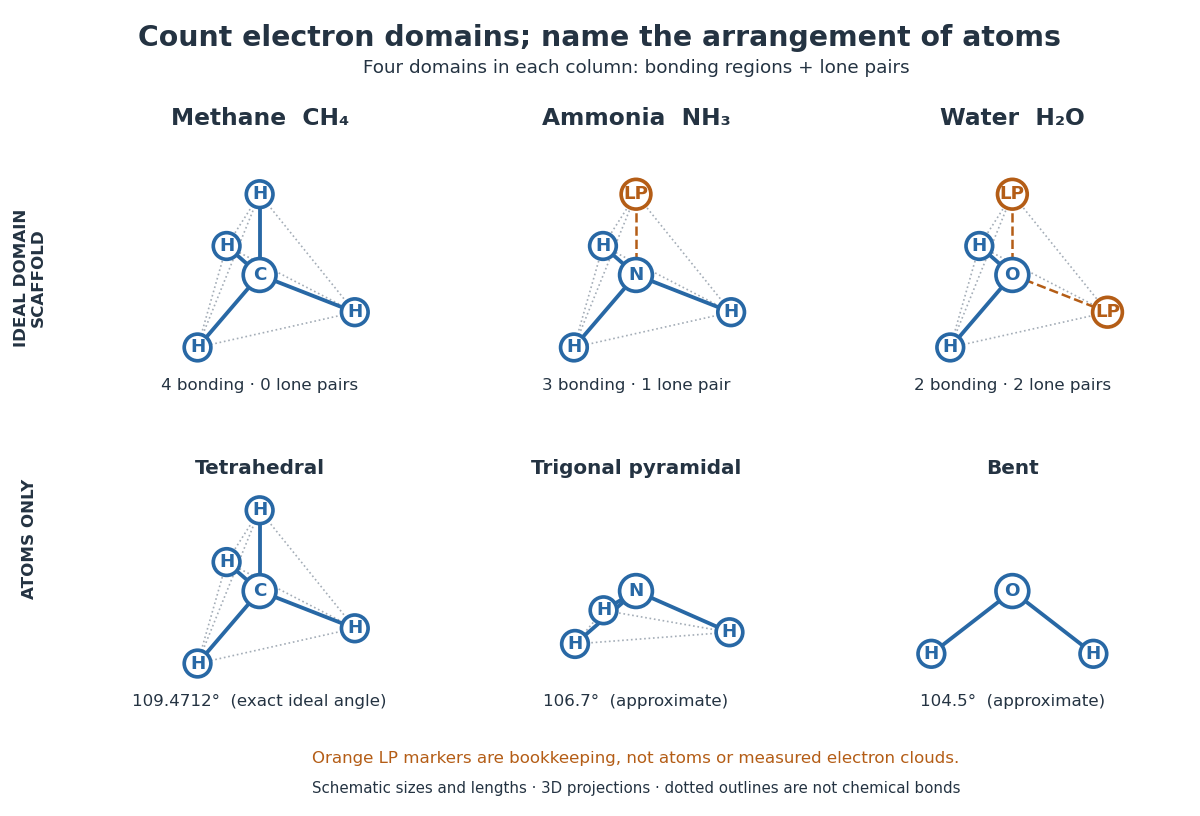
A static drawing also needs a physical interpretation. The atomic nuclei undergo oscillations; an arrangement at a minimum of potential energy and an experimentally averaged arrangement need not have identical bond lengths or bond angles. This distinction matters when comparing measurements with quantum mechanics calculations; see the IUPAC Gold Book: experimental bond-length conventions. Gas electron diffraction gives a concrete route from a laboratory signal to molecular geometry rather than inferring shape from a drawing alone.
Articles by others on the same topic


Molecular geometry refers to the three-dimensional arrangement of atoms in a molecule. It describes the shape of the molecule formed by the positions of the bonded atoms and the angles between them. Understanding molecular geometry is crucial in chemistry because it influences properties such as polarity, reactivity, phase of matter, color, magnetism, biological activity, and many other characteristics of molecules.