Slowly varying function
ID: slowly-varying-function

A positive measurable function is slowly varying at infinity iffor every fixed . It has regular variation of index zero. “Slowly” concerns relative change under multiplication of the argument; it does not mean that the function must be bounded, have a small derivative, or converge to a finite value.
Every positive constant is a slowly varying function. So are , and for any fixed real number , on . Indeed,The first grows without bound, the second tends to zero, and the constant does neither. Another unbounded example is :This function can grow much faster than while retaining regular variation of index zero.
Even convergence is unnecessary. The bounded functionoscillates between and . It is nevertheless a slowly varying function: the change in the argument of the sine under isand the Lipschitz continuity of the sine makes the logarithm of the ratio tend to zero. The sequences and give the two values and for every nonnegative integer , so there is no limit at infinity.
Contrast this with , which is positive and bounded but is not a slowly varying function. Fix . Along its rescaling ratio is ; along the ratio is . The persistent oscillations prevent even a limit for this one fixed rescaling. It is not regularly varying with any finite index either.
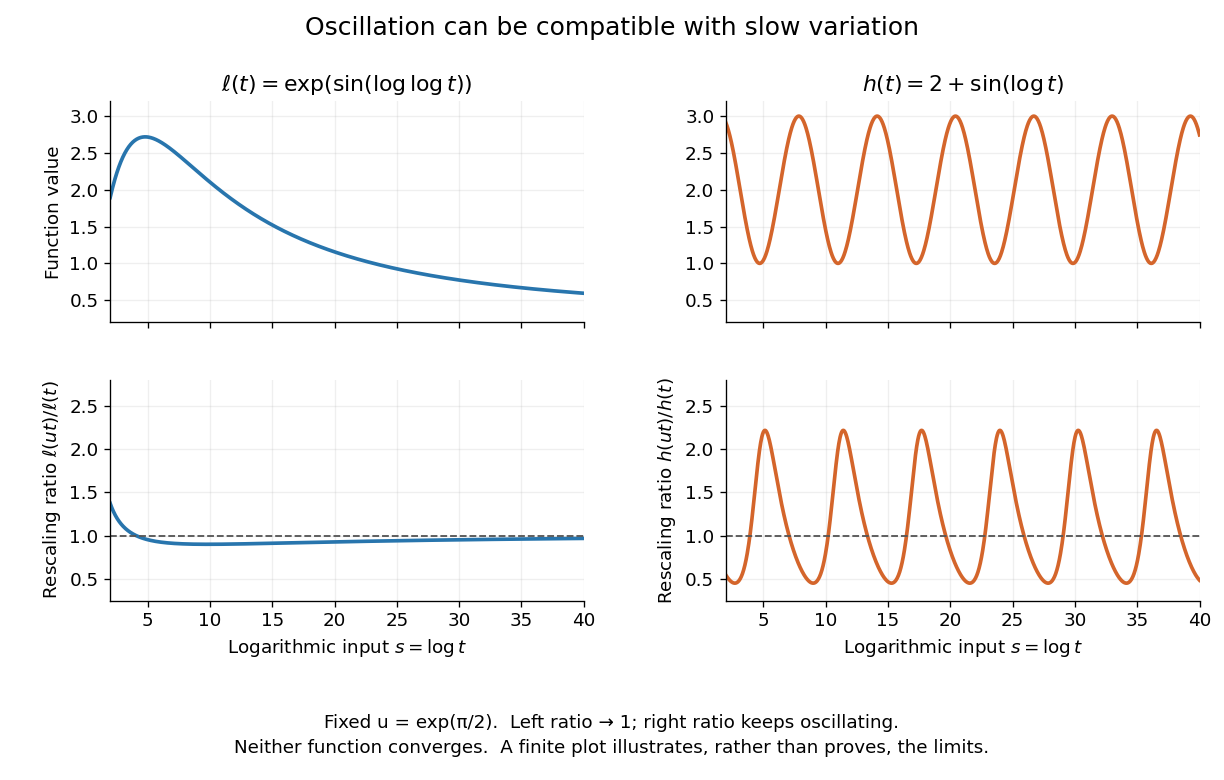
Two bounded oscillating functions: logarithmic rescaling makes one ratio approach one, while the other keeps oscillating
. The horizontal coordinate is , and the fixed rescaling is . The displayed range illustrates the formulas; the limiting claims follow from the arguments in the text. Details.The useful distinction is whether a fixed proportional change of input eventually produces a negligible proportional change of output. A slowly varying function can therefore preserve the scaling exponent of a power law while changing its magnitude substantially. The decomposition in regular variation explains why a logarithmic factor can matter in numerical estimates without changing the limiting exponent.


A "slowly varying function" is a concept from asymptotic analysis and number theory that refers to a function that grows very slowly compared to a linear function as its argument tends to infinity. More formally, a function \( L(x) \) is said to be slowly varying at infinity if: \[ \lim_{x \to \infty} \frac{L(tx)}{L(x)} = 1 \] for all \( t > 0 \).
New to topics? Read the docs here!