Spin expectation value
ID: spin-expectation-value

For spin one-half, choose the normalized spin eigenstates with . The spin one-half along an axis pure state in the plane isIts norm is one because the two eigenstates are orthogonal and . Applying the Born rule to a projective measurement givesConsequently the expectation value, second moment, and variance areAt , the outcome probabilities are and , the mean is , and the variance is . Every individual outcome remains . At , the mean is zero and the variance is maximal, . At either pole, one outcome has probability one and the variance vanishes.
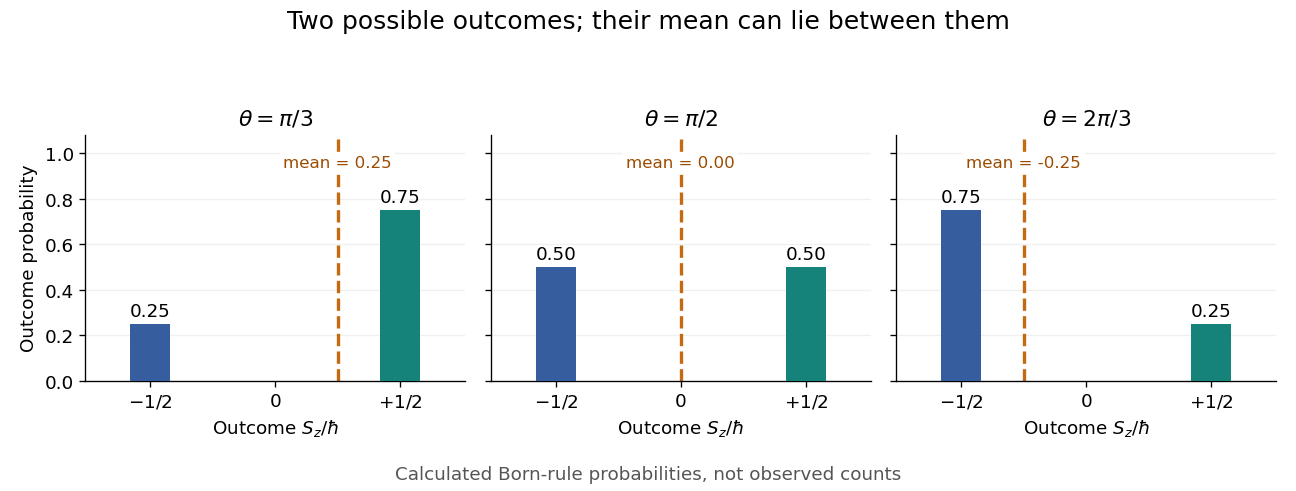
Spin expectation value between the two possible outcomes
. Original calculated Born rule distributions at three preparation angles. Bar heights are outcome probabilities; the dashed orange line marks the expectation value, whose horizontal position is usually not an allowed outcome. Spin values are expressed in units of the reduced Planck constant. No bars represent experimental observations. Source. Details.
The diagonal mixed state has the same probabilities, expectation value, and variance as . It is nevertheless a different quantum state for : the displayed pure state has , while has . A single component's mean does not reveal all relative quantum phases or establish purity of a density operator.
New to topics? Read the docs here!