Standard Young tableau
ID: standard-young-tableau

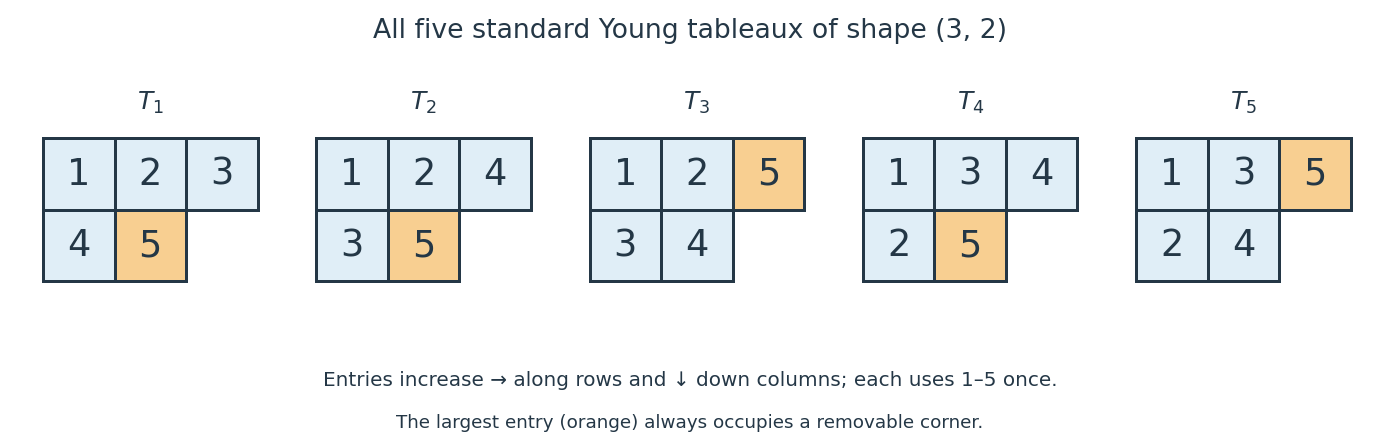

A standard Young tableau of shape is a Young tableau that uses exactly once and strictly increases left to right along every row and top to bottom down every column. Formally, a bijection is standard whenwhenever the indicated cells belong to the Young diagram. We write for the set of such fillings and for its cardinality.
For , the five standard Young tableaux are listed below, with each pair giving the top row followed by the bottom row:There are no others: the upper-left entry must be , and choosing the two bottom-row entries fixes both increasing row orders. Of the six choices of two entries from , only bottom row fails, because its would lie below . Hence by direct enumeration, independently of the hook-length formula.
The cells occupied by form a Young diagram: every cell above or to the left of an occupied cell has a smaller label. Consequently a standard Young tableau is equivalently a path from the empty shape to in the Young branching graph, adjoining one addable node of a Young diagram at each step. For , the successive shapes areConversely, number the cell added at step by to recover the standard Young tableau. This path interpretation also makes a standard Young tableau a linear extension of a partially ordered set defined by the row and column requirements; see Stanley's Algebraic Combinatorics, Chapter 8, on tableaux and paths in Young's lattice.
The usefulness goes beyond counting: the standard polytabloid basis of a Specht module over the complex numbers is indexed by , so . Each of the five pictured standard Young tableaux therefore labels one basis element of the irreducible representation of the symmetric group , whose dimension over the complex numbers is five. The filled diagrams index the basis; the actual vectors are polytabloids. The hook-length formula computes this dimension without listing all the standard Young tableaux.
New to topics? Read the docs here!