Strictly proper scoring rule
ID: strictly-proper-scoring-rule

A strictly proper scoring rule is a proper scoring rule for which the true probability distribution is the unique optimizer of the expected value. Equivalently, any different admissible probability distribution gives strictly larger expected loss. For probability density functions, two densities that agree almost everywhere represent the same probability distribution. Ordinary propriety permits ties: the constant reward is a proper scoring rule, because every report ties, but it is not a strictly proper scoring rule and elicits no information.
Strict propriety concerns expectation, not guaranteed success on each observation or each realized dataset. With the stipulated Bernoulli distribution , suppose the outcome is . The honest report then has Brier score loss , while has loss . The logarithmic loss similarly gives losses and . The honest forecast loses this comparison on that draw, which occurs with probability in the stipulated statistical model.
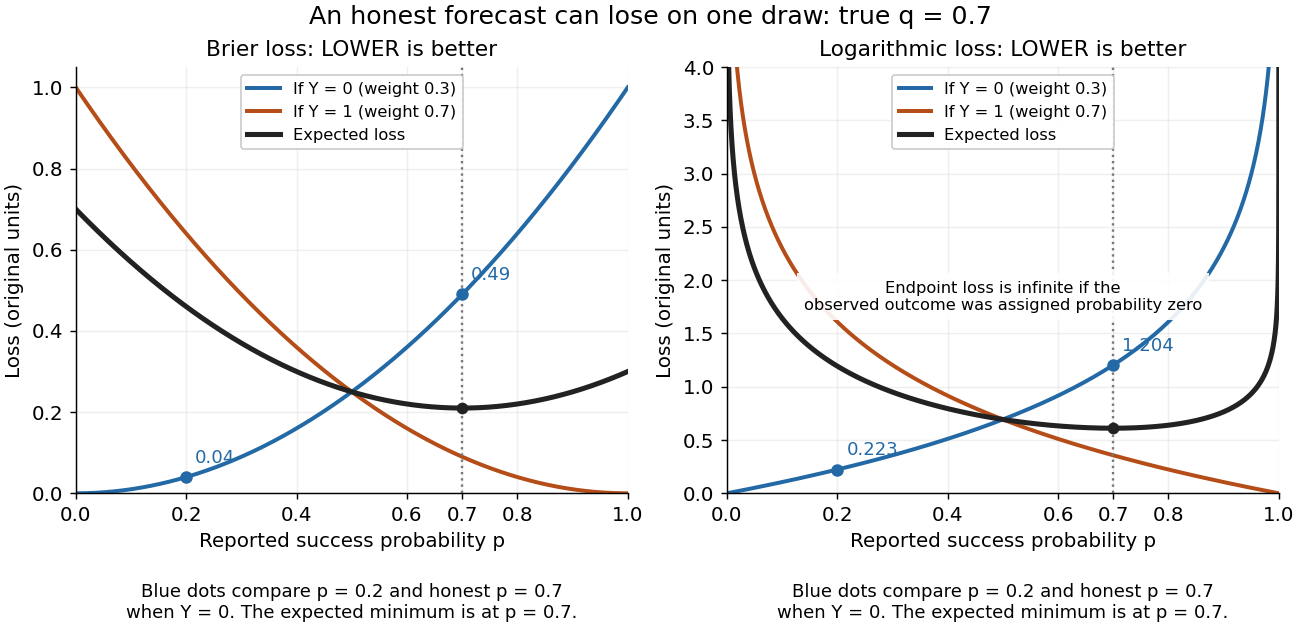
Individual outcomes can favor a different report even though the expected Brier score and logarithmic loss are uniquely minimized at
. Details. 
The loss curves favor , and the loss curves favor . Their weighted average, with weights and , favors . Choosing a report after observing would use information unavailable at forecast time. Even an average loss on a finite dataset can rank an honest forecast below a competing forecast through outcome variation; strict propriety guarantees the ranking in expected value under the specified information and true predictive distribution.
New to topics? Read the docs here!