Strongly universal hash family
ID: strongly-universal-hash-family

A strongly universal hash family makes every ordered pair of outputs equally likely: for distinct inputs and arbitrary specified outputs ,Thus the two outputs are independent random variables, each with the uniform distribution on a finite set. Adding the equal ordered pairs gives collision probability , so the family is also a universal hash family.
Here is a completely enumerable example. In the finite field , take the affine functions , using modular arithmetic modulo . Choose and as independent random variables, each with the uniform distribution on a finite set of all five finite field elements , including . There are equally likely hash functions. For , the ordered pair is . For instance gives ; gives . Every prescribed occurs exactly once, at .
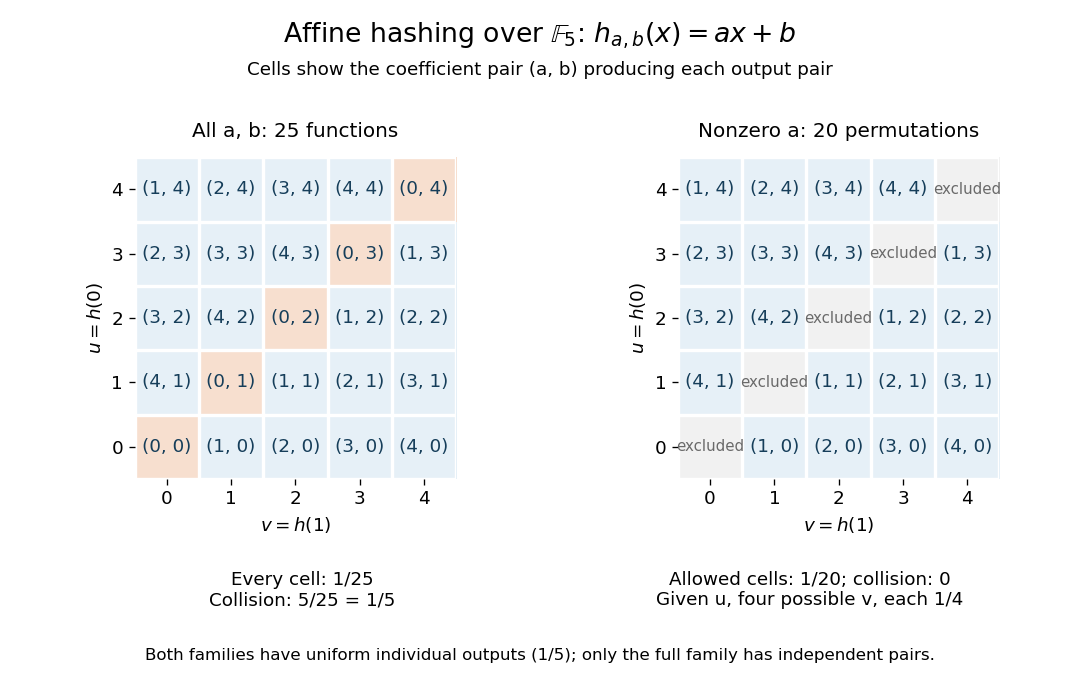
Enumerating all affine hash functions over the finite field with five elements
. Each cell shows the unique coefficient pair (a,b) producing the displayed outputs at 0 and 1. Removing a = 0 deletes the diagonal and leaves dependent outputs despite uniform individual values. Details.
Each row contains five choices, so each individual output has probability . Each cell has probability , and the five diagonal cells give collision probability . For any distinct , the same conclusion follows from and : a nonzero finite field element has a unique inverse. This is the beauty of the construction: two small random coefficients provide exact pair balance without choosing five unrelated values.
The example uses equal-sized input and output sets to make every choice visible; it illustrates the family definitions rather than compression. In a larger input set, a hash function cannot avoid all collisions into five buckets. What a universal hash family controls is the fraction of its members that collide on each fixed pair, rather than the existence of any collision anywhere.
Restricting to leaves permutations with zero collision probability for distinct inputs. Individual outputs remain uniform, but given , the four values other than each have conditional probability and has zero. Hence these outputs are not independent random variables: this is a universal hash family but not a strongly universal hash family. Finally, the full -member example contains five constant functions, with immediately visible collisions. Its pair guarantee concerns a random choice of hash function, and makes no claim of cryptographic collision resistance.
New to topics? Read the docs here!