
Synchronous rotation means one prograde turn about the body's own axis per orbital period, measured against fixed directions in an inertial frame. This spin-orbit resonance approximately describes the Moon's synchronous rotation toward Earth. [ref].
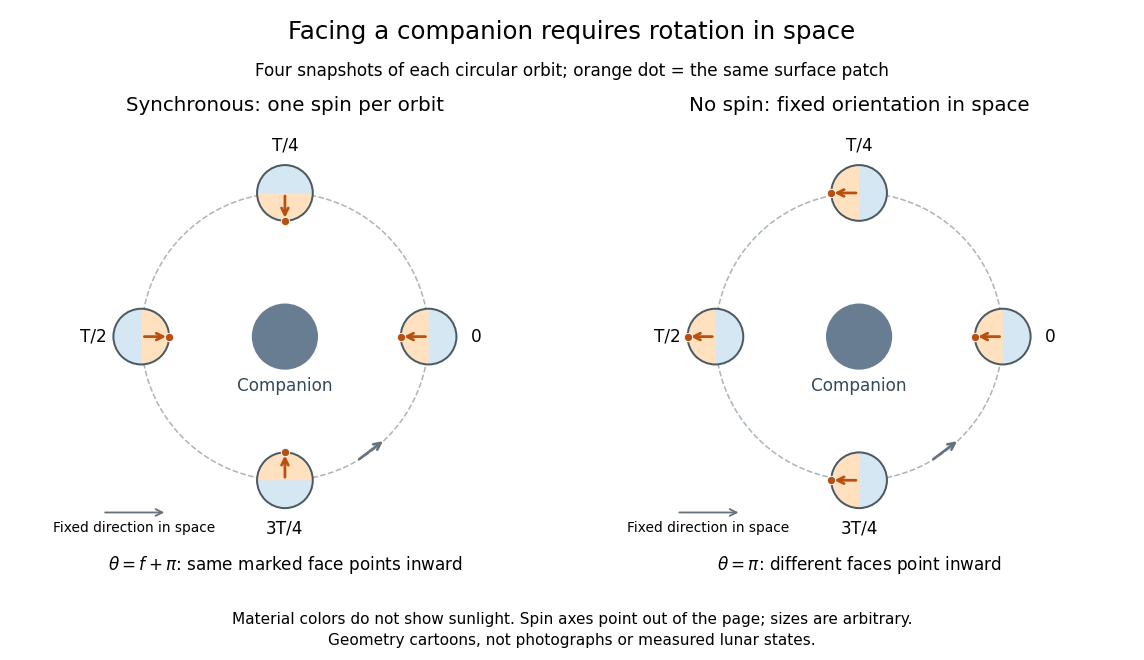

The striking geometric idea is that one turn in space can keep one face toward the companion: a fixed orientation in the frame turning with the orbit is a changing orientation in an inertial frame. This distinction helps us predict illumination: a synchronously rotating exoplanet orbiting its illuminating star can have persistent day and night hemispheres, whereas the Moon, synchronized to Earth, receives changing illumination from a different body, the Sun.
New to topics? Read the docs here!