The Moon is Earth's natural satellite. Its synchronous rotation keeps approximately the same near side of the Moon facing Earth, while both the near side of the Moon and the far side of the Moon experience sunlight and darkness. See illumination of a synchronously rotating moon for the geometry. [ref].
The near side of the Moon is the hemisphere directed approximately toward Earth. Libration changes the exact visible boundary, so synchronous rotation does not mean that an observer always sees precisely the same hemisphere.
The far side of the Moon is the hemisphere directed approximately away from Earth. “Far” describes the direction to Earth; it does not describe illumination by the Sun. The far side of the Moon experiences both sunlight and darkness during the lunar phase cycle. [ref].
A lunar phase is the appearance of the sunlit portion of the Moon as seen from Earth. Outside a lunar eclipse, the distant Sun illuminates approximately one hemisphere of the Moon, but an observer sees a changing overlap of that hemisphere with the hemisphere facing Earth. The lunar phase therefore changes even though synchronous rotation keeps approximately the same near side of the Moon facing Earth. [ref].
The cycle runs through new Moon, waxing crescent, first quarter, waxing gibbous, full Moon, waning gibbous, last quarter and waning crescent. “Waxing” means that the lunar illuminated fraction is increasing; “waning” means it is decreasing. A crescent has less than half its apparent disk sunlit, and a gibbous lunar phase has more than half. First and last quarter each show half a disk: “quarter” refers to progress around the cycle, rather than a quarter of the disk being lit. [ref]
https://aa.usno.navy.mil/data/MoonFraction. US Naval Observatory: disk fractions and waxing versus waning
.An instructive circular orbit model puts Earth at the origin, the Sun far away along , and the Moon at . The sunward position , , gives new Moon; the opposite position , , gives full Moon. Counterclockwise motion gives first quarter at and last quarter at . The Sun's direction is fixed during this snapshot of the cycle. Every small globe in the orbital view is illuminated on its half; the adjacent apparent disks are separate views from Earth, rather than globes viewed from above.
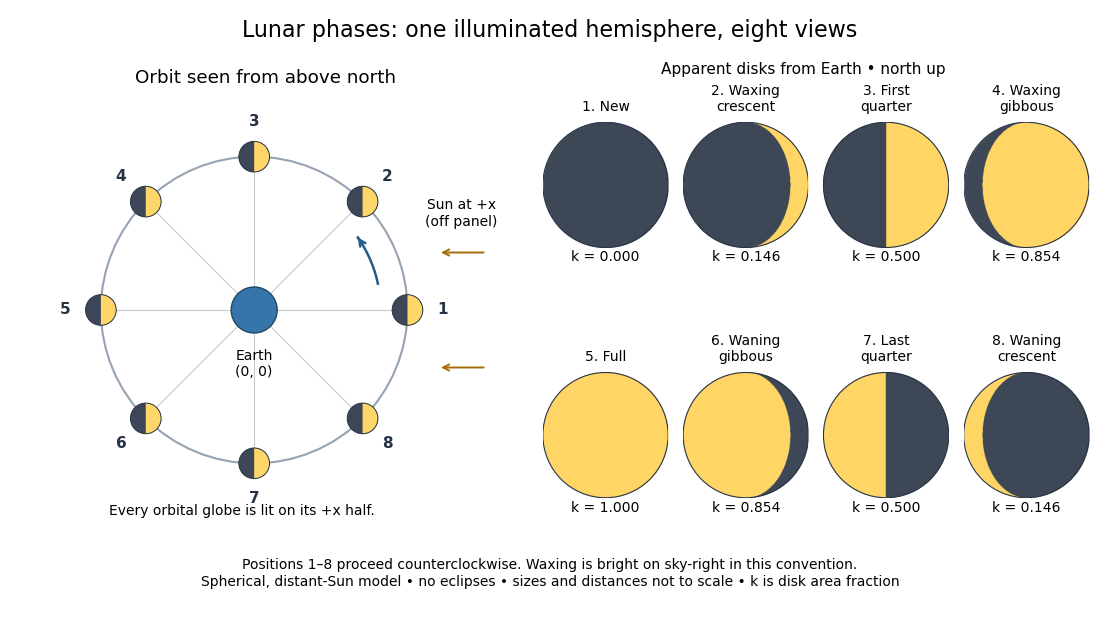
The disk views choose north up, with the upward direction perpendicular to the orbital plane. In this convention waxing lunar phases are bright on the right and waning lunar phases on the left. Local horizon orientation and viewing from different locations on Earth can rotate the apparent disk; its lit edge always points toward the projected direction of the Sun. The lunar illuminated fraction is unaffected by this rotation.
The useful angle is the phase angle , with the Sun, the Moon and the observer at Earth's center: its vertex is at the Moon. Full Moon has , quarter has , and new Moon has in the ideal model. By contrast, the elongation has its vertex at Earth. For a distant Sun, its rays are parallel, soHere is the lunar illuminated fraction: a fraction of projected disk area, not a fraction of the Moon's total surface area or its received radiant flux relative to full Moon. The phase angle and unsigned elongation each lie between and , so either alone gives the illuminated amount without distinguishing waxing from waning. The orbital direction resolves that ambiguity.
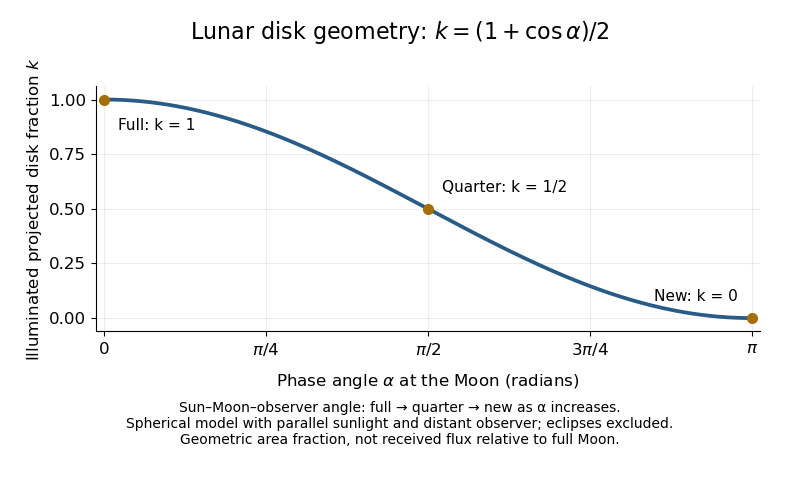
The lunar illuminated fraction has an elegant geometric derivation. Model the Moon as a sphere of unit radius and view it along the direction. Take the Sun's unit direction to be . A visible surface point above apparent disk coordinates has . Direct illumination requires the outward normal's dot product with the sunward direction to be positive. The day-night terminator therefore obeys . At a fixed , set ; the visible day-night terminator is , and the illuminated strip extends from to the right edge . Integrating its width givesThe integral is the area of half a unit circle. Thus a three-dimensional visibility problem reduces to a circle's area and a cosine. The derivation assumes parallel sunlight, a distant observer and a sphere, and ignores a lunar eclipse. Real observed brightness additionally depends on surface scattering of light and observing geometry, so does not promise half the full-Moon radiant flux.
For a worked example, elongation gives phase angle and : a crescent with of its apparent disk sunlit. At elongation , the phase angle is and : a gibbous lunar phase. At , . In each case the same occurs once while waxing and once while waning in the ideal cycle.
Ordinary lunar phases are not caused by Earth's shadow. A lunar eclipse occurs only when the Moon actually enters that shadow near full Moon. The orbital inclination of the Moon is about relative to Earth's orbital plane around the Sun; most full Moons pass above or below the shadow. This is why full Moon does not imply a lunar eclipse every month. [ref]
https://science.nasa.gov/moon/eclipses/. NASA: lunar eclipses and the Moon's roughly five-degree orbital tilt
.The phase cycle is a synodic month, about days, whereas the Moon's orbital period relative to distant stars is a sidereal month, about days. During one sidereal month, Earth advances around the Sun, so the Moon must move farther to repeat the sunward alignment. For coplanar circular orbits traversed in the same direction, subtract their mean motions: , with . HenceUsing and gives , consistent with the mean synodic month of days. After one sidereal month, the sunward direction has advanced about ; catching up takes about more days. These are mean-period estimates: orbital eccentricity and changing geometry make individual synodic months vary. [ref]
https://eclipse.gsfc.nasa.gov/SEhelp/moonorbit.html. Fred Espenak, NASA: sidereal and synodic months and varying lunations
. [ref]https://nssdc.gsfc.nasa.gov/planetary/factsheet/earthfact.html. David R. Williams, NASA: Earth's sidereal orbital period
.The lunar phase is also a practical clock for observing. Full Moon is opposite the Sun and rises roughly at sunset; first quarter is about a right angle from the Sun and is convenient in the evening, while last quarter is convenient before dawn. These are rough guides, not exact rise-time predictions for every place and season. [ref]. Historically, repeated lunar phases provided the month in lunar calendars, while half-lit disks gave Aristarchus of Samos a way to infer astronomical distances. [ref]
https://eclipse.gsfc.nasa.gov/SEhelp/moonorbit.html. Fred Espenak, NASA: lunations and lunar calendars
.The astronomical phase angle is the angle at an illuminated body between the directions to its light source and to its observer. For a lunar phase it is the Sun–Moon–observer angle at the Moon, rather than the elongation measured at Earth. A small phase angle gives a nearly full apparent disk in the spherical model.
Elongation is the apparent angular separation of a celestial body from the Sun, measured at the observer. For a lunar phase, the elongation is the Sun–Earth–Moon angle; in the distant-Sun approximation it is supplementary to the phase angle. A given unsigned elongation can occur on either side of the Sun in the sky.
The lunar illuminated fraction is the directly sunlit projected area of the apparent lunar disk divided by its total projected area. For a sphere with parallel sunlight and a distant observer, outside a lunar eclipse, it is , with phase angle at the Moon. It measures geometry rather than the fraction of full-Moon radiant flux. [ref]
https://aa.usno.navy.mil/data/MoonFraction. US Naval Observatory: definition of the illuminated disk fraction
.A sidereal month is the Moon's orbital period relative to distant stars, about days. It is shorter than the synodic month because the sunward direction changes as Earth travels around the Sun. The lunar spin period associated with synchronous rotation matches the sidereal month in the mean. [ref].
A synodic month is the synodic period of the Moon relative to the Sun, about days on average. A lunation is commonly measured from one new Moon to the next. Actual lunations vary, so the constant-speed relation derived in lunar phase is useful for understanding the mean cycle rather than predicting exact dates. [ref]
https://eclipse.gsfc.nasa.gov/SEhelp/moonorbit.html. Fred Espenak, NASA: the synodic month and lunation
.Aristarchus of Samos used the half-lit Moon to estimate the relative distances of the Sun and Moon. In the spherical illumination model a half-lit disk means phase angle , so the Sun–Moon–Earth triangle is right-angled at the Moon. Keeping the Sun at a finite distance, let and be the distances from Earth to the Moon and Sun. Then elongation at Earth givesThe elongation attributed to Aristarchus of Samos gives a ratio about , consistent with his conclusion that the Sun was between and times farther away. The example shows how lunar phase geometry becomes a distance measurement, but the ratio is extremely sensitive to an angle close to . Unlike the distant-Sun approximation, this finite triangle has elongation slightly less than at half illumination. [ref]
https://doi.org/10.5802/crphys.246. Siebren van der Werf and Tjeerd van Albada, An explanation for Aristarchus' measurement of the sun's distance, 2025
.A lunar eclipse occurs when Earth blocks some or all of the direct sunlight reaching the Moon. It requires alignment near full Moon; the orbital inclination usually carries the Moon clear of Earth's shadow. Ordinary lunar phases instead arise from viewing different amounts of the sunlit hemisphere. [ref].
Libration is the apparent rocking of a body as seen by an observer. For the Moon, longitudinal libration arises because orbital eccentricity makes its orbital angular speed vary while its spin is much more uniform: the direction to Earth advances ahead of, then falls behind, the mean facing direction. The Moon's tilted geometry also causes latitudinal libration; small actual rotational oscillations provide further corrections. Thus lunar synchronous rotation holds in the mean, rather than requiring exact instantaneous alignment. [ref]. [ref].


