Synthetic insulin-glucagon response model
ID: synthetic-insulin-glucagon-response-model

This deliberately synthetic differential equation model illustrates response direction and lag. Every plotted number is chosen for teaching; none is a biological measurement or a fitted human parameter. Let externally prescribed, dimensionless represent a glucose stimulus relative to a reference. Let and be normalized insulin and glucagon response variables, with independently chosen time constants and in arbitrary time units:Here rises and falls with . Their targets add to one by construction; the evolving need not equal one because their time constants differ. Start with and . Set from to , from to , and otherwise. Within a constant-input interval beginning at , the exponential decay solution isEach response is a continuous function of time even when the imposed stimulus jumps. The chosen starting values stay between zero and one, since each solution is a weighted arithmetic mean of its interval's starting value and target.
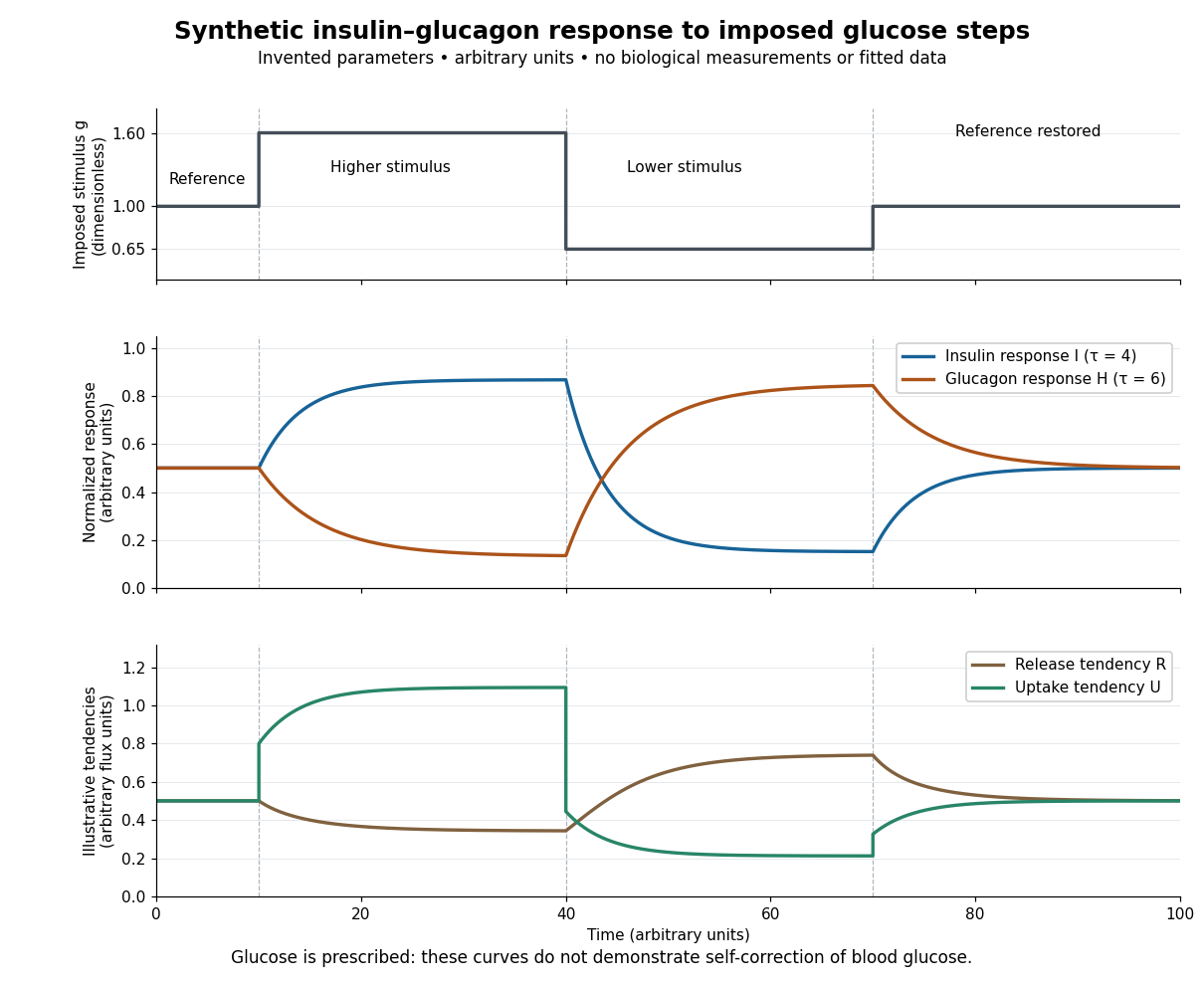

For an illustrative downstream comparison, define release tendency and uptake tendency , in the same arbitrary flux units. At the reference target, . At the high-stimulus targets, and ; at the low-stimulus targets, and . These chosen functions encode greater uptake with insulin and greater release with glucagon, moderated by insulin; they are not established enzyme kinetics. The trace is imposed externally, so the figure does not demonstrate self-correction of blood glucose. A closed model would also need a conservation of mass equation, nutrient input, finite glycogen stores, and additional tissue interactions. The qualitative restoring loops are shown separately in the insulin circuit.
New to topics? Read the docs here!