Tau-pair missing-mass teaching model
ID: tau-pair-missing-mass-teaching-model

Choose and purely for illustration. Then each parent has , and . Treat all six daughters as massless, including the charged Electron and antimuon, and generate each three-body particle decay with constant squared decay amplitude. Choose the parent direction isotropically and the two decays independently; this omits the physical production angular law and spin correlations.
The Lorentz-invariant phase space factorizes through into a two-body decay to , followed by a two-body decay of :After angular integration the first factor contributes , while the massless second factor is constant. Since , the normalized chosen density is . Drawing with uniform on implements this density. Isotropic directions, followed by a Lorentz boost for the invisible pair and another for the parent, conserve the complete four-momentum of each generated event.
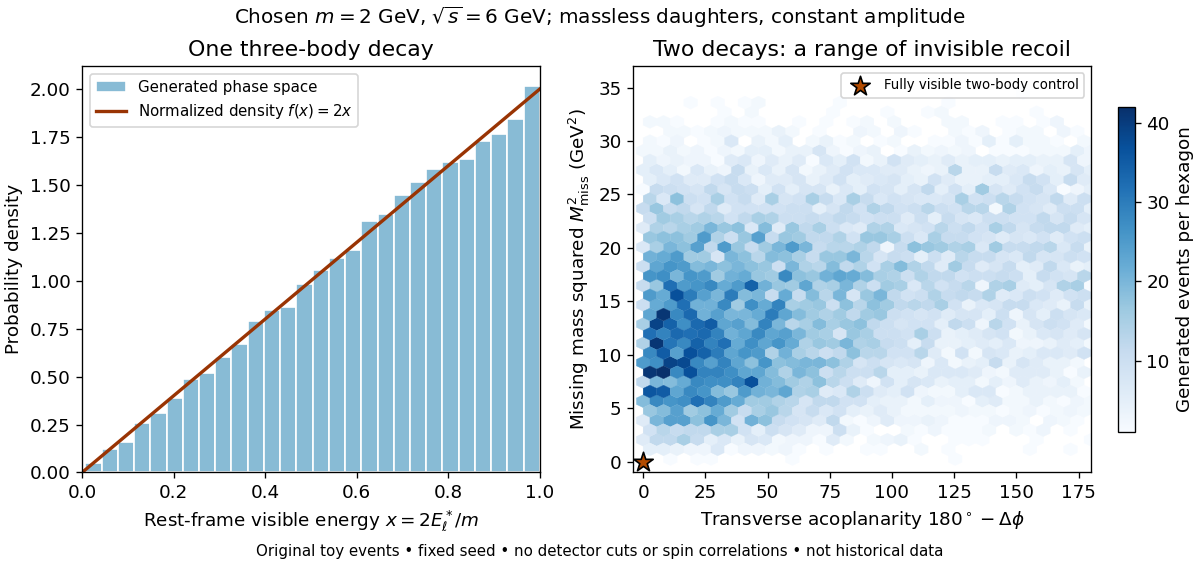

Define transverse acoplanarity by , where is the angle between the two visible momentum projections perpendicular to the beam. A fully visible two-body event with zero initial transverse momentum has and . The toy tau lepton events spread away from that point. These observables are complementary: an angular imbalance asks about directions, while the missing invariant mass also uses the visible energies and longitudinal momenta.
A Lorentz-invariant phase space density supplies allowed configurations and their geometric measure. A physical weak interaction decay amplitude reweights them and correlates spins. Consequently the plotted density is a lesson about conservation and available configurations, not a predicted experimental rate or a fit to the discovery sample. The massless charged-daughter approximation is also unsuitable near the muon rest-energy threshold.
New to topics? Read the docs here!