The weak interaction changes particle species through the charged current and also acts through the neutral current. Familiar examples include beta-minus decay and neutrino scattering. It is short-range and chiral: its W boson and Z boson couplings distinguish chirality. Above the electroweak scale it belongs to the unbroken electroweak interaction. At much lower energies, W boson exchange is approximated by the Fermi interaction.
A particularly direct window into the weak interaction is the Wu experiment: a sample with oriented nuclear spins emits Electrons preferentially toward one end of its spin axis. The comparison tests parity conservation, because spin is an axial vector and momentum is a polar vector. The polarized beta-decay angular distribution translates that geometric distinction into a measurable counting asymmetry.
In a low-energy allowed weak three-body decay, negligible final-state masses and a nearly constant effective matrix element give a fifth-power energy-release dependence. For muon decay in natural units, . This four-fermion approximation requires momentum transfers small compared with the W boson mass. Extrapolation to a heavy particle able to emit a real W changes the decay kinematics and the mass scaling, so it is not a reliable heavy-particle lifetime prediction.
A decay amplitude changing strangeness by two units requires at least two insertions of the low-energy weak interaction in the Standard Model. Each charged-current insertion can remove only one net strange quark in such a process. Both two-W boson tree topologies and loop contributions can occur; a loop is not required for every exclusive final state. At hadronic energies, the extra power of the Fermi constant, with the needed powers of an energy scale to balance units, strongly suppresses a second-order amplitude relative to a first-order one. This is distinct from Cabibbo suppression within a fixed weak order.
Parity violation means that a physical law fails to be invariant under the spatial reflection represented by the parity operator. A process and its fully inverted counterpart can then have different probabilities. For beta-minus decay with polarized parent atomic nuclei, a nonzero correlation between nuclear spin and emitted Electron momentum is such a test. Rotational symmetry alone allows this correlation: a pseudoscalar is unchanged by proper rotations but changes sign under spatial reflection.
In 1956, Tsung-Dao Lee and Chen Ning Yang examined the evidence for parity conservation in the weak interaction. Their paper, Question of Parity Conservation in Weak Interactions, distinguished an untested assumption from an established experimental result and proposed comparing Electron emission along opposite directions relative to oriented nuclear spins, explicitly considering cobalt-60. It proposed a test; it did not report the later Wu experiment.[ref]
Question of Parity Conservation in Weak Interactions by Tsung-Dao Lee and Chen Ning Yang. pp. 254–255; evidence review and “Possible Experimental Tests of Parity Conservation in beta Decays,” first proposal
The conceptual improvement is the choice of observable. An angle between two polar vectors is preserved by spatial reflection; its distribution can conceal parity violation. An angle between an axial vector and a polar vector changes to its supplement. Thus a spin-resolved directional measurement asks a different question from an unpolarized total decay rate.
The Wu experiment was performed by Chien-Shiung Wu, Ernest Ambler, Raymond Webster Hayward, Dale D. Hoppes, and Ralph Percy Hudson; its 1957 report was Experimental Test of Parity Conservation in Beta Decay. Their experiment supplied the evidence that the Lee-Yang proposal for a parity test had called for.[ref]
The Fall of Parity Photo Gallery with Short Biographies by National Institute of Standards and Technology. Experimentalists: the five named biographies; theorists: Lee and Yang
A cobalt-60 surface layer on a cerium magnesium nitrate crystal was cooled by adiabatic demagnetization; a solenoid's magnetic field polarized its atomic nuclei. An internal anthracene counter detected Electrons by particle scintillation; a light pipe carried flashes to a photomultiplier. Polar and equatorial gamma ray counters monitored nuclear polarization and effective temperature; bulk thermometry could miss surface heating.[ref]
Experimental Test of Parity Conservation in Beta Decay by Chien-Shiung Wu and others. p. 1413, Fig. 1 and apparatus paragraphs; p. 1414, demagnetization followed by vertical solenoid
Reversing nuclear polarization reversed the Electron excess; warming erased it with gamma ray anisotropy. Warm rates were field-independent. Cooling-field reversal checked remanence; poorly polarized sources checked magnetic deflection. Electrons favored the direction opposite spin.[ref]
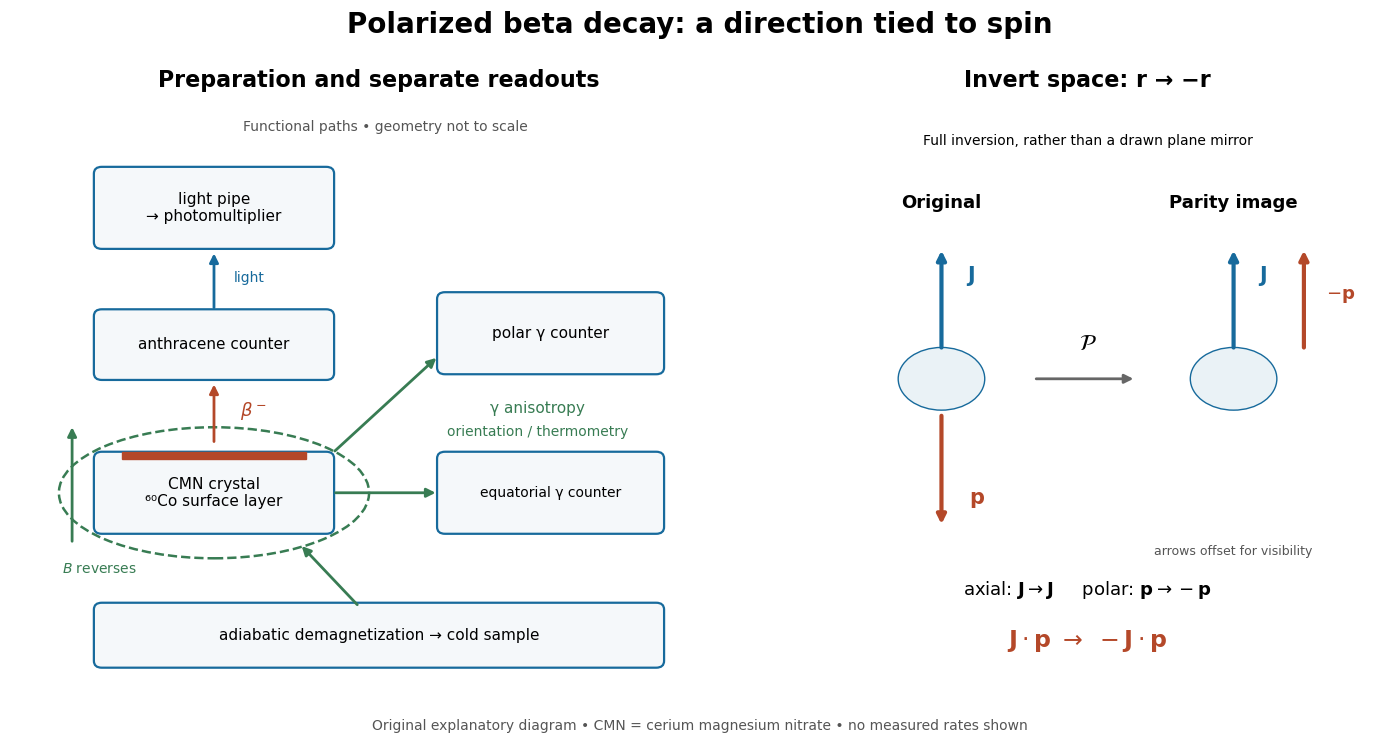
What the apparatus measures, and what spatial inversion changes
. Functional layout, with paths separated for readability. The right-hand construction inverts every spatial coordinate: a polar momentum reverses while an axial spin remains fixed. It is a geometric argument, not a second historical apparatus. Details.The gamma ray anisotropy diagnoses the preparation; the Electron asymmetry diagnoses parity violation. These are different jobs. A directionally uneven gamma ray signal alone need not violate parity conservation: a distribution even in the cosine of the angle can distinguish an axis from its perpendicular without distinguishing its two ends. The spin-momentum correlation instead distinguishes those ends.
The inference requires control of changes in detection efficiency, Electron transport and nuclear polarization. A fixed detector under spin reversal avoids physically exchanging detector positions, but still requires checks for magnetic field effects. The result establishes parity violation in this weak interaction process. A precise microscopic coupling requires more information than the existence or sign of a counting asymmetry; the following model makes that distinction explicit.
Consider a parent atomic nucleus at rest. Write its signed nuclear polarization along a fixed axis as , where is its maximal spin component. Let be the angle of the emitted Electron momentum to that axis and let . Use for the parity operator, so it is not confused with .
For an axially symmetric leading-dipole model, retain a constant and the term linear in the polarization vector . Rotational symmetry makes the directional term proportional to . Define its dimensionless coefficient as . At fixed Electron energy the relative intensity and normalized probability density function per solid angle are thereforeThe factor is the conventional separation of the speed dependence; rotational symmetry alone does not determine that dependence or . The coefficient contains the decay dynamics. This leading model omits higher angular terms and detailed recoil and radiative effects. A partially oriented higher-spin ensemble can also have alignment that is not specified by its vector nuclear polarization alone.
The unit-integral condition follows without any model of a detector:Thus has unit angular average, while the probability density function in the polar angle alone contains the Jacobian determinant factor:In particular, itself is neither a normalized probability density function in nor a detector count. Positivity on gives .
Under full spatial reflection, but . The latter follows already for orbital angular momentum from ; spin has the same axial vector transformation. Hence is a pseudoscalar, and . If parity conservation held for this model, equal probabilities for the inverted process would force . Conversely, in an unpolarized sample proves nothing about .
Integrating over the two hemispheres gives a useful original check:Choose , , and , so . Then the forward and backward hemisphere probabilities are and , and their counting asymmetry is . These are chosen teaching values, not measured values from the Wu experiment. At a single energy, the angular shape determines the product ; it cannot separately determine without a polarization calibration.
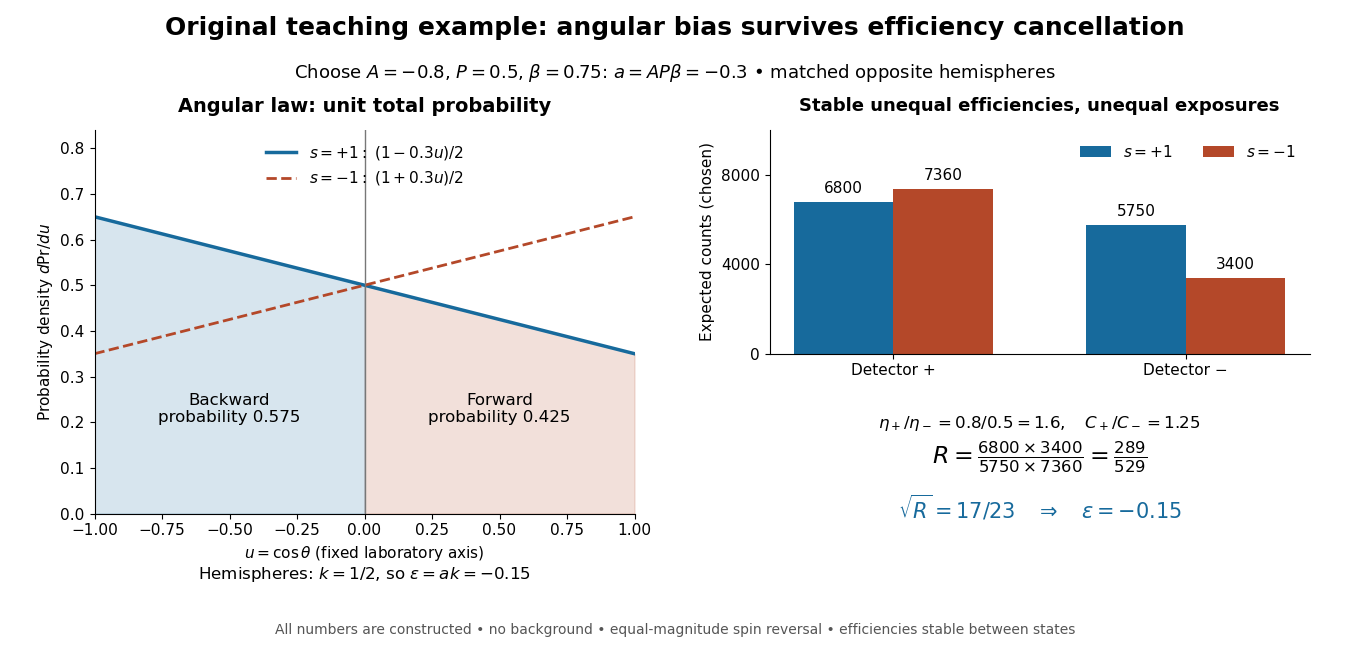
Chosen angular probabilities and detector-efficiency cancellation
. Original model with . The angular probability is distinct from a detector count; opposite hemispheres average the cosine to . Unequal efficiencies and exposures distort individual detector ratios, while a reversal cross-ratio recovers the chosen hemispheric asymmetry. All counts are constructed. Details.Consider a teaching extension with two opposite detectors, labelled and by fixed laboratory directions, and two preparation states with equal and opposite nuclear polarization. This is an original two-detector model; the historical Wu experiment used a fixed internal Electron counter with reversal.[ref]
The Reversal of Parity Law in Nuclear Physics by National Institute of Standards and Technology. Apparatus explanation and December 27 notebook: fixed beta counter, reversed solenoid current, and warming
Let describe the exposure in each state and the stable detection efficiency of detector .For matched opposite acceptances, write their common mean absolute cosine as . The four expected positive counts areThe same-state ratios each retain the unequal detection efficiencies:Dividing these ratios gives the spin-reversal cross-ratio for beta decay:Both the exposure ratio and the detection efficiency ratio cancel. The positive square root is essential: positive expected counts and make positive.
For the chosen , opposite hemispheres give , hence . Choose , , , and , with their common acceptance factor absorbed into . The four expected counts in the displayed order are , , , and . ThusThe first raw detector ratio exceeds one despite negative : detector imbalance can overwhelm the physical directional preference. Reversal separates the stable imbalance from the term that changes sign.
A detector collects a range of solid angles, not a single direction. If its nonnegative angular response is , defineIntegrating the polarized beta-decay angular distribution gives a count proportional to . For a uniform forward cone with half-angle , put . Direct integration givesThe opposite cone has mean cosine . A hemisphere gives ; a narrow cone tends to . Hence a spin-reversal cross-ratio for beta decay measures , and an acceptance correction is needed to obtain .
With unequal angular responses, let the two laboratory mean cosines be and , including their signs. Then the actual expectation iswhich reduces to the simple square only when . The cancellation of stable multiplicative detection efficiencies survives, but their angular shapes still matter. An energy-integrated response likewise averages with the accepted spectrum; a mean speed cannot in general be substituted independently of acceptance.
Additive backgrounds, unequal polarization magnitudes or detection efficiencies that change on reversal do not have the assumed factorization. For example, a reversal-dependent efficiency cross-ratio multiplies by . Background subtraction also creates statistical complications: positive expected signal counts are assumed in this derivation, whereas finite samples with Poisson distributions can contain zero counts. Taking square roots of negative background-subtracted counts is not a valid estimator. These limits explain why reversal and independent preparation checks belong together.
Processes that change individual charged-lepton family numbers are absent perturbatively in the minimal massless-neutrino Standard Model. A flavour-misaligned Higgs coupling can permit decays such as . Neutrino masses and mixing permit extremely suppressed loop effects, while additional flavour structures can give larger rates.
An operator contains three factors of . Its contribution to the mass matrix is proportional to , while its single-Higgs coupling is three times the corresponding mass-over-v contribution. With the normalization , the mass-basis coupling is . Nonzero off-diagonal coefficients permit charged-lepton flavour-violating Higgs decays.
The weak charged current couples a W boson to two members of a left-handed electroweak doublet. In the quark mass basis its flavor coefficients are entries of the Cabibbo-Kobayashi-Maskawa matrix.
If a chiral fermion triplet uses one normalized linear combination of two neutral leptons, adding the perpendicular combination as a gauge singlet completes their canonical kinetic terms. The two combinations are related to the original fields by a real orthogonal matrix. Hence their summed kinetic quadratic form is exactly that of the two original fields, with no mixed terms. The singlet carries the same chirality; no right-handed component is created for a purely left-handed massless neutrino.
The Standard Model assigns the same gauge coupling to each lepton generation in the weak charged current. Different decay rates still arise from masses and phase space. Ratios of leptonic pion decay rates cancel the common hadronic decay constant and quark mixing coefficient, isolating universality and helicity suppression. Electromagnetic radiative corrections must be included for precision comparisons to inclusive measured decay rates.
The up-type and down-type fermion mass matrices need different left-handed transformations represented by unitary matrices to diagonalize them. Their relative transformation appears in the charged weak current as the Cabibbo-Kobayashi-Maskawa matrix. The weak neutral currents remain diagonal in the minimal Standard Model, since the same-charge couplings are generation-independent. Three nondegenerate generations give three mixing angles and one physical weak CP phase after quantum field rephasings.
For two outgoing massless leptons, is transverse to . This follows from the massless Dirac equation and anticommutation of the chirality matrix with the gamma matrices. Thus the term in a pseudoscalar-to-pseudoscalar form factor does not contribute to this scattering amplitude. A nonzero charged-lepton mass spoils exact transversality and restores a mass-suppressed scalar-form-factor contribution.
The weak charged current pairs each neutrino with its corresponding charged lepton. Thus elastic muon-neutrino/electron scattering has only tree-level neutral-current exchange, while electron-neutrino and electron-antineutrino scattering also have crossed and annihilation charged-current diagrams. A contact term pairing a muon neutrino directly with an electron would violate this Standard Model flavour assignment.
A spin-zero parent decaying through a chiral weak charged current to a charged lepton and a massless neutrino cannot supply the helicities selected by a massless interaction. A charged-lepton mass insertion makes the amplitude proportional to and the decay width proportional to . A spin-one W boson does not suffer this suppression.
A spin-zero parent at rest decaying to two particles requires their helicities to be equal. Choosing particle 1 along and particle 2 along gives total projection . In negative-pion decay, the massless antineutrino has positive helicity, so the negative charged lepton must also have positive helicity. This is the suppressed component for a left-chiral weak charged current.
For the massless contact interaction with real , spin and colour averaging givesThe gamma matrix trace identities give the averaged amplitude , where . Substitute the massless Mandelstam variables and divide by . The two singlet colour contractions give factor one after final summation and initial averaging. This is a low-energy Fermi interaction result, not its high-energy extrapolation.
For a massless neutrino scattering on an unpolarized up antiquark through the Fermi interaction, . The corresponding down-quark channel has . Their difference follows from the chiral weak-current trace contraction. The parton distribution functions weight these rates in a hadron.
For massless momenta, define . The gamma matrix trace identities and the antisymmetric tensor contraction give . Reversing an antiquark's spinor order changes the momentum pairing and creates the angular factor in a weak charged-current quark scattering rate.
For the massless common vector-axial coupling at both vertices in weak charged-current quark scattering, subtracting opposite directions givesIt is undefined for . Overall rate normalization cancels. Pure vector or axial interactions have zero asymmetry, while gives its maximal coefficient. The inequality implies . This unpolarized observable does not distinguish purely left- from purely right-handed couplings applied at both vertices.
The weak neutral current couples the Z boson to a fermion without changing its electric charge. Its vector and axial-vector coefficients depend on weak isospin, electric charge, and the weak mixing angle.
The neutral current transfers no electric charge at a fermion vertex; “neutral” does not mean that every participating particle is uncharged. For example, transfers energy and momentum to an Electron through Z boson exchange. By contrast, a charged current can convert a muon neutrino into a muon, as in . Both processes conserve total electric charge. A photon also carries no electric charge, but an active neutrino has no electromagnetic charge coupling: its neutral current is a distinct weak interaction.
The experimentally useful contrast on a nucleon target iswhere is a nucleon and is an allowed final state of hadrons. The charged current makes a charged lepton available for identification; the outgoing neutrino in a neutral current leaves no bubble-chamber track. A sample of hadronic events without an identified muon therefore poses an experimental question: how many could instead be neutron interactions, or charged current events whose muon was missed? The answer requires a detector-response and background analysis, not merely an inspection for an absent line.
Gargamelle was a heavy-liquid bubble chamber at CERN. Its 1973 collaboration report, Observation of neutrino-like interactions without muon or electron in the Gargamelle neutrino experiment, by F. J. Hasert and colleagues, described hadronic events with no identified muon or Electron and evaluated rates relative to charged current events. This is evidence for a neutral current, rather than direct production or photography of a Z boson.[ref]
Observation of neutrino-like interactions without muon or electron in the Gargamelle neutrino experiment by F. J. Hasert. Physics Letters B 46 (1973), pp. 138–140, title, abstract and author list
CERN's Gargamelle account identifies the target liquid as and distinguishes hadronic events from the separate isolated-Electron signal. The latter is an antineutrino transferring momentum to an Electron, whose electromagnetic particle shower supplies visible tracks. These are different final states, not two names for one event.[ref]
Forty years of neutral currents by Cian O’Luanaigh. Forty years of neutral currents, 19 July 2013, chamber description and isolated-electron caption
A neutrino beam uses protons striking a target to produce charged pions and kaons; focusing selects parents that undergo particle decay in flight. Their neutrinos pass through shielding into the target. Scanning photographs locates vertices and classifies outgoing tracks.[ref]
Expansion prepares a bubble chamber's superheated liquid; ionization by charged secondaries seeds bubbles for photography.[ref]
The recorded light reveals bubbles, not a directly visible incoming or outgoing neutrino. Reconstructing a vertex and classifying bubble-chamber tracks connects that optical record to a hypothesis about a particle interaction.
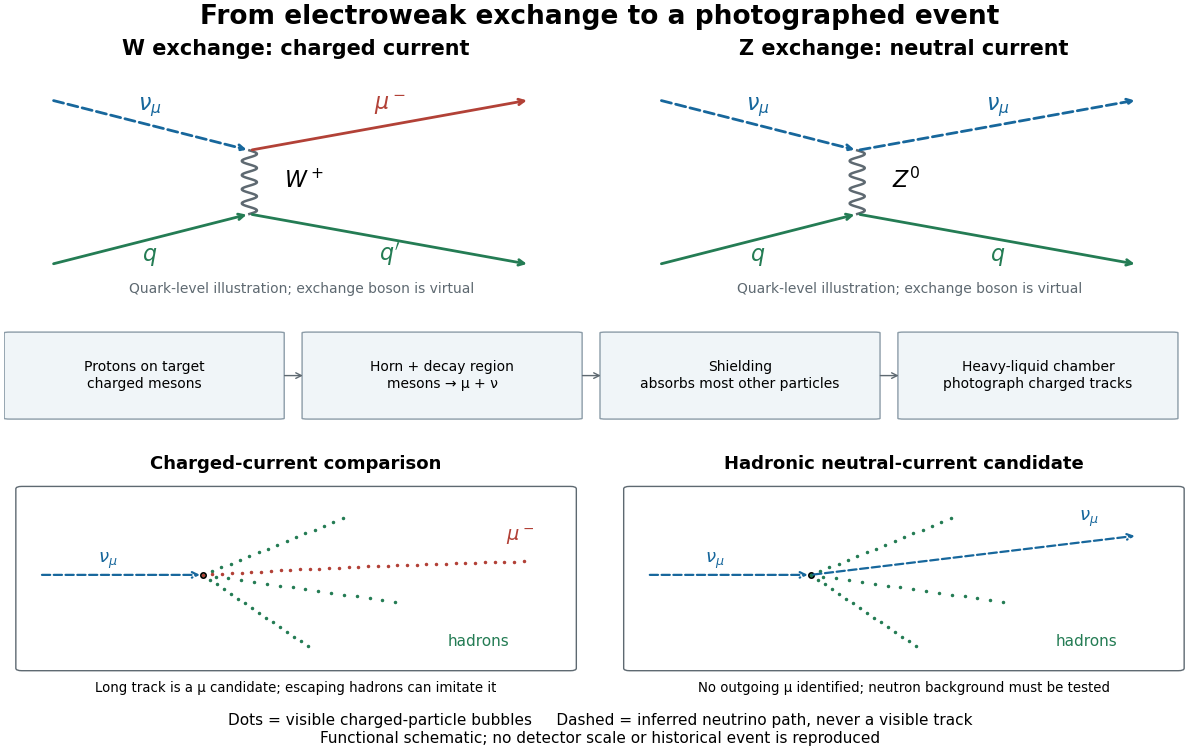
The collaboration compared samples with matched hadronic cuts. A flat longitudinal vertex distribution resembled neutrino interactions, but sideways neutrons and multi-step cascades could also flatten it. The background estimate combined visible parent-interaction/secondary-neutron pairs with a cascade calculation including surrounding material. Later proton exposures tested the predicted cascade lengths. Escaping charged hadrons could imitate muons; there was no independent perfect muon tag.[ref]
The inference combines positive evidence for an interaction with controlled alternatives for its visible final state. Shielding suppresses unwanted beam components, yet interactions in surrounding material can generate secondary neutrons; shielding alone cannot certify a neutral current. Nor does a successful neutral current search by itself establish every coupling or the Higgs mechanism. Its importance for the electroweak interaction is that the theory predicts an additional weak channel, with coupling relations that further cross section measurements can test.
For an especially simple neutral current example, scatter a muon neutrino elastically from an initially stationary unpolarized Electron:Here is the final Electron kinetic energy, is the incident neutrino energy, and is the Weinberg angle. These are electron chiral couplings in the vertex convention of neutral-current vector and axial couplings. The chosen muon neutrino elastic channel has no additional W boson exchange amplitude; the electron-neutrino elastic channel would have one. Other charged-current final states can become kinematically accessible at sufficiently high incident energies and are not part of this elastic model.
Use natural units , retain only tree-level Feynman diagrams, and take the contact limit with . Neglect Electron-mass terms relative to , radiative corrections and detector response. Then is the Fermi constant. The approximate endpoint replaces the exact elastic endpoint . The omitted leading mass-dependent interference term in is . Thus the approximation is not appropriate for arbitrarily soft neutrinos.
The shape follows from the two chiral contributions to the massless scattering amplitude. The spin sum gives terms proportional to and in Mandelstam variables; in this limit , giving the square . The two electron chiralities do not interfere when the relevant mass corrections are dropped. Replacing the neutrino by its antineutrino exchanges which coupling multiplies each kinematic term. This is the same chiral angular weighting that appears in neutrino scattering on an antiquark, now with a target whose couplings are particularly simple.
Integrating the two elementary terms givesFor an original teaching example choose , so and . This is a stipulated parameter, not a measurement of the Weinberg angle. ThenThe normalized probability density function is , not the unnormalized differential cross section. Its endpoints have ratio two, and the fraction with is . The antineutrino spectrum happens to coincide at this chosen parameter because ; this equality is not a general prediction for arbitrary Weinberg angles.
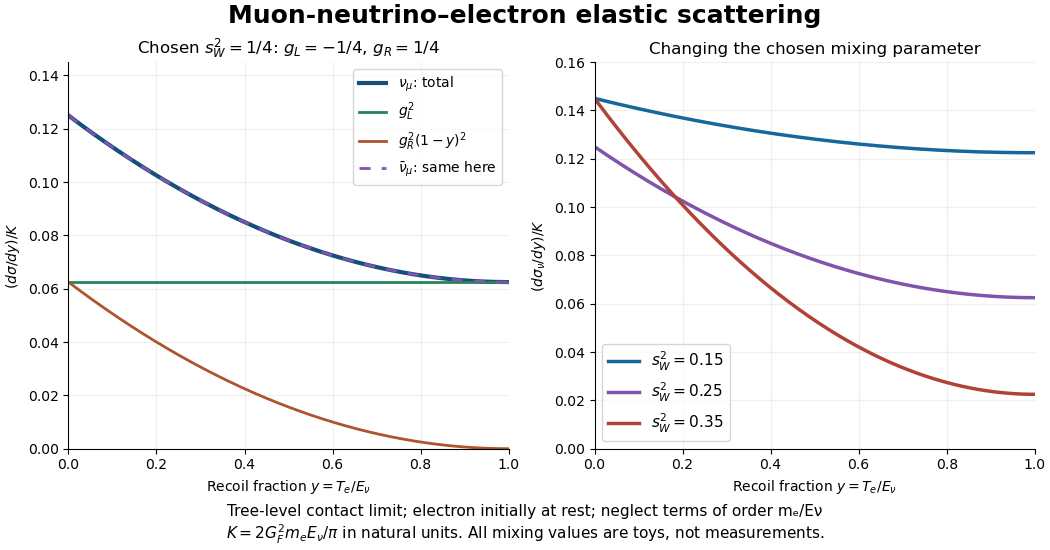
Unlike a visible Electron recoil, the scattered neutrino is unrecorded. A measured recoil spectrum must therefore be compared with incident neutrino flux, energy distribution, acceptance, detection efficiency and backgrounds. A shape or rate tests a specified theoretical model only after these experimental ingredients have been supplied.
If a neutral-current vertex has prefactor and chiral coefficients , then , with and . For one Standard Model charged lepton, ; for an active neutrino, . A prefactor instead requires doubled coefficients. Mixing these conventions creates a factor-of-four error in squared amplitudes.
A flavor-changing neutral current changes fermion flavor without changing electric charge. Such currents are absent at tree level in the Standard Model and are strongly suppressed at loop level by the Glashow-Iliopoulos-Maiani mechanism.
Unitarity of the CKM matrix cancels flavour-independent contributions to weak flavour-changing neutral amplitudes. In a quark loop, equal internal masses would give a common contribution whose off-diagonal CKM sum vanishes; unequal masses leave a suppressed nonzero amplitude. This explains why neutral kaon mixing occurs through loops rather than a tree neutral-current vertex.
The Glashow-Iliopoulos-Maiani mechanism uses the unitarity of the quark mixing matrix to cancel flavor-changing neutral-current amplitudes when equal-charge quark masses are degenerate. The remaining loop amplitudes are suppressed by quark-mass differences.
Articles by others on the same topic

The weak interaction, also known as the weak nuclear force or weak force, is one of the four fundamental forces of nature, alongside the strong interaction, electromagnetic force, and gravity. The weak interaction is responsible for several key processes in particle physics, particularly those involving the transformation of subatomic particles. Key characteristics of the weak interaction include: 1. **Range and Strength**: The weak force has a very short range, typically on the order of 0.



Explains beta decay. TODO why/how.
Maybe a good view of why this force was needed given beta decay experiments is: in beta decay, a neutron is getting split up into an electron and a proton. Therefore, those charges must be contained inside the neutron somehow to start with. But then what could possibly make a positive and a negative particle separate?
- the electromagnetic force should hold them together
- the strong force seems to hold positive charges together. Could it then be pushing opposite-charges apart? Why not? In any case this force doesn't seem to act on electrons, only quarks.
- gravity is too weak
www.thestargarden.co.uk/Weak-nuclear-force.html gives a quick and dirty:Also interesting:
Beta decay could not be explained by the strong nuclear force, the force that's responsible for holding the atomic nucleus together, because this force doesn't affect electrons. It couldn't be explained by the electromagnetic force, because this does not affect neutrons, and the force of gravity is far too weak to be responsible. Since this new atomic force was not as strong as the strong nuclear force, it was dubbed the weak nuclear force.
While the photon 'carries' charge, and therefore mediates the electromagnetic force, the Z and W bosons are said to carry a property known as 'weak isospin'. W bosons mediate the weak force when particles with charge are involved, and Z bosons mediate the weak force when neutral particles are involved.
Weak Nuclear Force and Standard Model of particle physics by Physics Videos by Eugene Khutoryansky (2018)
Source. Some decent visualizations of the field lines.