Temporal averaging in nail clippings
ID: temporal-averaging-in-nail-clippings

Temporal averaging in nail clippings is the mixing of material formed or transported at different times into one measured sample. A clipping has finite length, width and thickness. Even perfect chemical measurement of the whole sample need not resolve the timing of a short exposure.
A primary nail-growth experiment followed file marks near the proximal fold in 22 young adults over one to three months.[ref]
Growth rate of human fingernails and toenails in healthy American young adults by S. Yaemsiri and others. Abstract, Methods
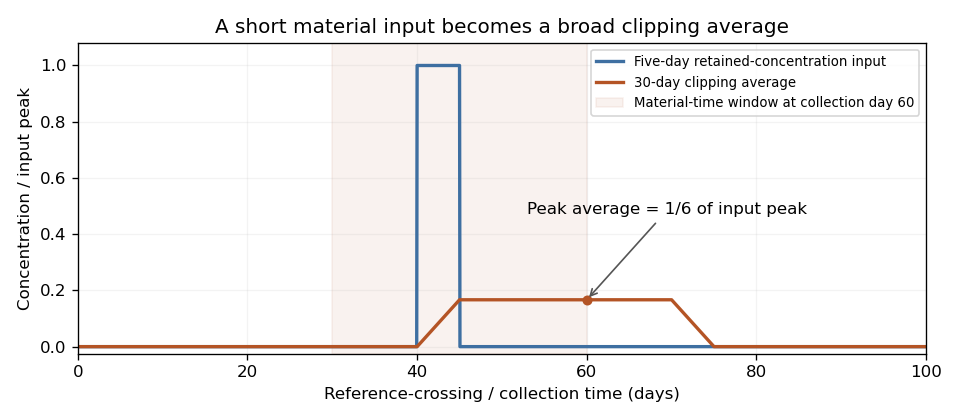
Such displacement measurements constrain the transport clock. Relating a chemical concentration to an earlier exposure requires additional assumptions about incorporation, retention and contamination.For an original ideal advection model, let material cross a reference at time with concentration , thereafter retained unchanged. At constant speed , a segment between positions and at collection time contains reference-crossing times from to . If mass per unit length is uniform, its measured concentration isThis is a shifted moving average, equivalently a convolution with a rectangular window. Its clock is reference crossing; formation in the hidden nail matrix may precede that crossing.
For a 3 mm segment at stipulated speed 0.10 mm/day, days. If a hypothetical incorporated concentration equals for only five days and zero otherwise, the largest possible clipping average is . A broad, low measured peak can therefore result from a short, high input without any chemical decay. These values illustrate the model rather than an observed exposure record.
Spatial weighting of nail-clipping exposure records becomes important when thickness, width or density varies: the average is weighted by material mass, not distance alone. Variable growth further distorts the time window. A wider segment generally mixes a longer history, while repeated analyses of the same segment improve analytical precision without shortening that history.
Record clipping extent, material orientation, collection date and how growth was measured. Comparing several separately retained segments can provide more time information than pooling them, but recovering a unique exposure history remains an inverse problem unless the transport and retention model is sufficiently constrained.

New to topics? Read the docs here!