Temporal averaging in nail clippings is the mixing of material formed or transported at different times into one measured sample. A clipping has finite length, width and thickness. Even perfect chemical measurement of the whole sample need not resolve the timing of a short exposure.
A primary nail-growth experiment followed file marks near the proximal fold in 22 young adults over one to three months.[ref]
Growth rate of human fingernails and toenails in healthy American young adults by S. Yaemsiri and others. Abstract, Methods
Such displacement measurements constrain the transport clock. Relating a chemical concentration to an earlier exposure requires additional assumptions about incorporation, retention and contamination.For an original ideal advection model, let material cross a reference at time with concentration , thereafter retained unchanged. At constant speed , a segment between positions and at collection time contains reference-crossing times from to . If mass per unit length is uniform, its measured concentration isThis is a shifted moving average, equivalently a convolution with a rectangular window. Its clock is reference crossing; formation in the hidden nail matrix may precede that crossing.
For a 3 mm segment at stipulated speed 0.10 mm/day, days. If a hypothetical incorporated concentration equals for only five days and zero otherwise, the largest possible clipping average is . A broad, low measured peak can therefore result from a short, high input without any chemical decay. These values illustrate the model rather than an observed exposure record.
Spatial weighting of nail-clipping exposure records becomes important when thickness, width or density varies: the average is weighted by material mass, not distance alone. Variable growth further distorts the time window. A wider segment generally mixes a longer history, while repeated analyses of the same segment improve analytical precision without shortening that history.
Record clipping extent, material orientation, collection date and how growth was measured. Comparing several separately retained segments can provide more time information than pooling them, but recovering a unique exposure history remains an inverse problem unless the transport and retention model is sufficiently constrained.
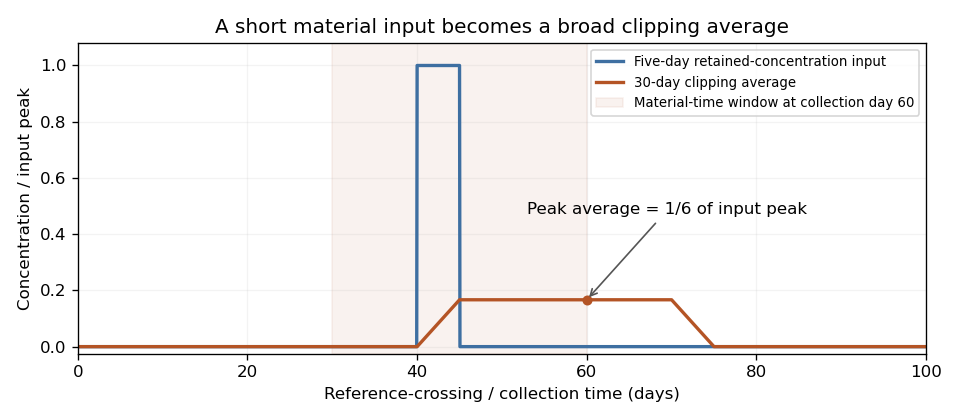
An original ideal clipping model spreads a five-day retained-concentration input across a thirty-day material window. The peak clipping average is one sixth of the input peak, even without chemical decay.
Details. 
Spatial weighting of nail-clipping exposure records determines how much each region of a clipping contributes to a pooled chemical measurement. A concentration reported per unit nail mass is a mass-weighted average. Equal lengths of nail plate need not supply equal amounts of material if width, thickness or density differs.
Let be mass per unit length at collection and the retained concentration per unit material mass. For a clipping spanning , an original ideal recovery model givesThis assumes complete, composition-independent recovery by the assay. If recovery varies spatially, the measurement equation requires that additional weighting.
For two equal-length regions with masses 1 and 3 mg and stipulated concentrations 0 and 100 units per mg, the pooled concentration is units per mg. A length-weighted average would give 50 and answer a different question. The numerical example illustrates geometry and normalization, not an observed exposure.
Mass-normalized temporal kernels for nail clippings arise when positions are converted into earlier reference-crossing times. If is the material map at collection, the normalized time weighting isAt constant advance speed and uniform line density, the kernel is rectangular, recovering temporal averaging in nail clippings. Variable material geometry or speed changes its shape. A growth experiment following file marks measures displacement over a known interval, not this entire weighting function.[ref]
A practical study retains segment orientation and measures the material amount used in each assay. Pooling several digits introduces further weights and potentially different growth histories. Wet-mass and structural-mass normalization also differ when water content changes, connecting the issue to hydration versus production in nail mass balance. Specify the denominator and material-to-time map before assigning a pooled concentration to one exposure date.
Mass-normalized temporal kernels for nail clippings assign each earlier material time its fraction of the analyzed sample's mass. They convert a finite clipping into an averaging operator on a time-dependent retained concentration. The weighting is normalized by the assayed material amount, rather than by elapsed time alone.
For an original one-dimensional advection model, let be the time when a material element crossed a defined anatomical reference, and collect at time . With spatially uniform positive advance speed ,Suppose the clipping's retained elements correspond to . Let be structural mass per unit length at collection, and assume the marker's concentration per structural mass is preserved along each element. ThenThe kernel has units of inverse time, is nonnegative and integrates to one. It can be treated mathematically like a probability density function for the reference-crossing time of material selected in proportion to its mass. This is a material-accounting interpretation, not a claim that the biological transport is random.
For a stipulated 20-day window, take line density 1 mg/mm, advance 0.10 mm/day in the earlier ten days and 0.20 mm/day in the recent ten days. The two intervals contribute 1 and 2 mg, respectively. Their kernel heights are and per day. A retained concentration of 90 ng/mg only in the earlier interval gives ng/mg; a uniform time average would give 45. A constant 30 ng/mg history gives the same sample result. Thus one pooled measurement does not identify a unique history.
A centroid date of a mass-normalized nail kernel summarizes the weighting, while the kernel's spread records its finite time resolution. Neither removes the difference between reference crossing and earlier formation in the hidden nail matrix. The primary nail-marking experiment measures displacement over observation intervals, not the complete kernel or marker retention law.[ref]
Growth rate of human fingernails and toenails in healthy American young adults by S. Yaemsiri and others. Abstract, Methods
Measuring segment mass, geometry and growth history constrains separate parts of this model.The centroid date of a mass-normalized nail kernel is the weighted mean of the reference-crossing times represented by the analyzed nail material. If is normalized so that , its centroid isAt collection time , the corresponding mean material age is . This summarizes a distribution of material times; it is not automatically the date of an exposure or the instant of formation in the nail matrix.
For an original pooled-sample example, suppose equal structural mass comes from two material-age intervals, 0–2 and 18–20 days before collection. Age density is 0.25 per day in each interval and zero between them. Their interval means are 1 and 19 days, so the mean age is 10 days. Yet no sampled material has age 10 days. A single uniform kernel over 0–20 days has the same mean age, with a very different distribution.
The age variance makes part of the difference explicit. A uniform interval of width 2 days has variance . The separated mixture therefore haswhereas a uniform 20-day interval has variance . Equal centroids do not imply equal temporal resolution.
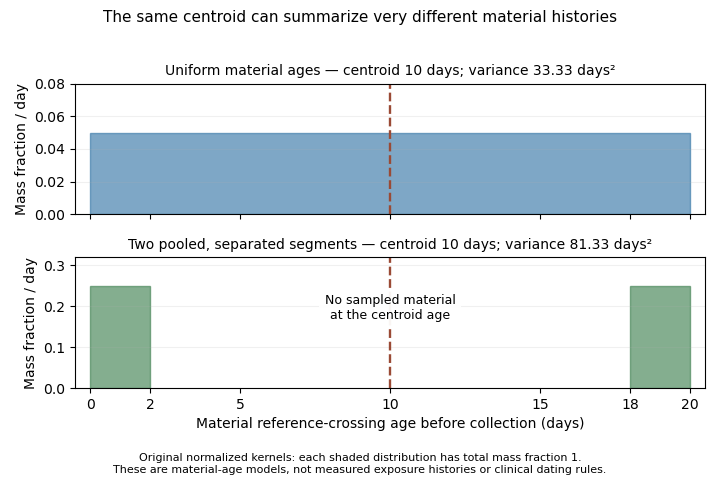
Two original material-age kernels have the same mean age but different spread and sampled intervals
. The lower kernel pools two separated segments of equal mass. Its mean age lies in a gap containing no sampled material. These are hypothetical reference-crossing ages, not observed exposure histories. Details.
The centroid has a precise averaging property. For any representative time ,It minimizes the mass-weighted squared timing discrepancy. Also, if retained concentration is affine in , its kernel average equals its value at . This equality generally fails for a nonlinear history: a quadratic averages to , not .
A primary growth experiment followed marks near the proximal nail fold over measured intervals.[ref]
Growth rate of human fingernails and toenails in healthy American young adults by S. Yaemsiri and others. Abstract, Methods
Such displacement observations help constrain the material clock. They do not establish the full kernel, marker retention or one unique exposure date. Report the reference, distributional width and pooling assumptions alongside a centroid date. Articles by others on the same topic
There are currently no matching articles.