Trigonometric function
ID: trigonometric-function

Trigonometric functions turn an angle into a coordinate or a ratio of lengths. Start at on the unit circle and rotate counterclockwise through radians: the resulting point isThe cosine records horizontal position and the sine records vertical position. This definition continues around the whole circle, including negative angles, so the signs encode direction rather than requiring a separate rule for each right triangle.
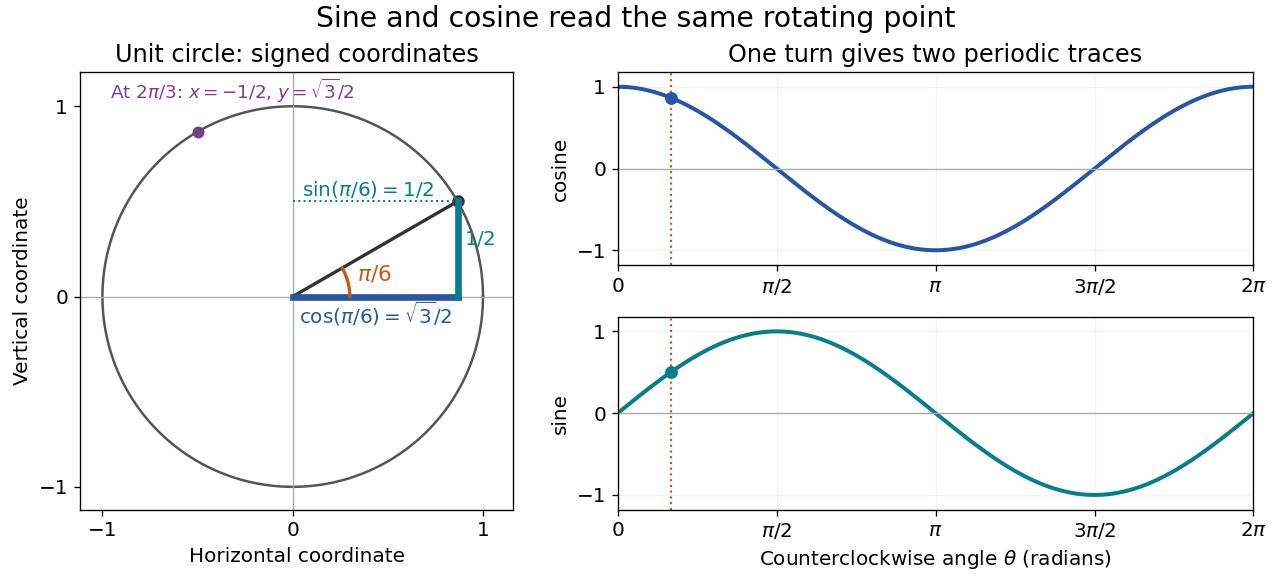

The unit circle picture explains why these functions are useful beyond measuring triangles. The two coordinates of a point rotating at constant angular speed are periodic functions. Scaling the radius to and using gives and . A circular motion becomes two simple repeating traces, connecting Euclidean geometry, simple harmonic motion, and Fourier series.
For an acute angle in a right triangle, rescaling its hypotenuse to one recovers the familiar ratios: sine is opposite side divided by hypotenuse, and cosine is adjacent side divided by hypotenuse. The tangent function is their ratio, , wherever the denominator is nonzero; the secant function, cosecant, and cotangent give the other reciprocal ratios.
The same names extend to complex numbers through the complex exponential:These definitions agree with the circle interpretation for real angles. For complex arguments, the values need not lie between and ; the literal circle-coordinate picture is restricted to real arguments. [ref]
https://dlmf.nist.gov/4.14. NIST Digital Library of Mathematical Functions, §4.14: exponential definitions and periodicity
New to topics? Read the docs here!