Two-Gaussian mixture example
ID: two-gaussian-mixture-example

Stipulate an original Gaussian mixture distribution with mixture weights , , component means , , and component variances both equal to one. These are chosen statistical parameters, with no observed sample or fitting. If is the standard normal distribution probability density function, thenIn the figure, the two colored curves are weighted probability density functions, with areas and . Adding their heights at every gives the black curve. Neither colored curve stops at a dividing line.
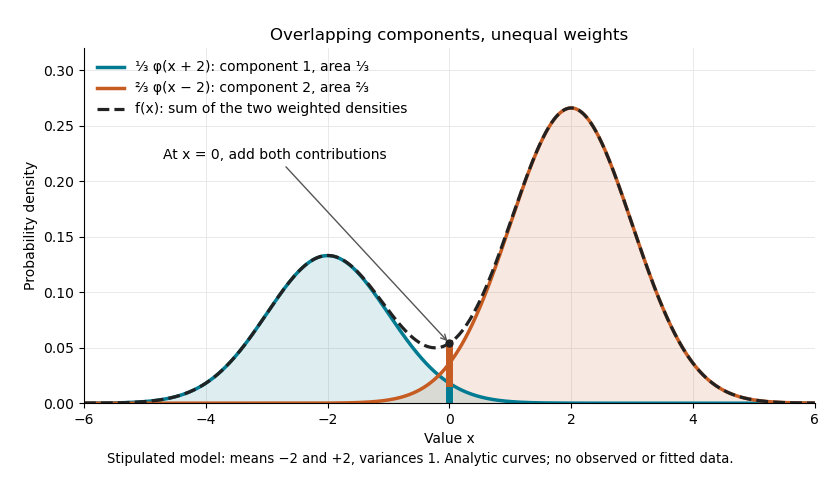

The law of total expectation and law of total variance give the total mean and variance:All of the extra variance comes from variation between component means. Equivalently, the second moment is , so the variance is .
A mixture distribution is different from a deterministic linear combination of random variables. If independent and are drawn and , then has a normal distribution with the same mean but variance , rather than . Every draw of uses both random variables. A draw from the mixture distribution instead uses , where the mixture allocation indicators are independent of and select exactly one of them. The expression for adds densities, not simultaneous random outcomes.
New to topics? Read the docs here!