Upper half-plane (complex analysis)
ID: upper-half-plane-complex-analysis

The upper half-plane is the open setIt contains precisely the complex numbers with positive imaginary part: is inside, lies on its boundary, and belongs to the lower half-plane. In the complex plane its boundary is the real line; in the Riemann sphere the boundary also includes infinity. It is a convex set, hence a simply connected domain, and the Cayley transform between the half-plane and disk makes it biholomorphic to the unit disc.
With the hyperbolic metric , the same domain becomes the Poincaré half-plane model. Its hyperbolic geodesics are vertical lines and upper semicircles whose centres lie on the real line. Under the Cayley transform, these become arcs of circles orthogonal to the unit circle, with diameters as the straight-line cases. [ref]
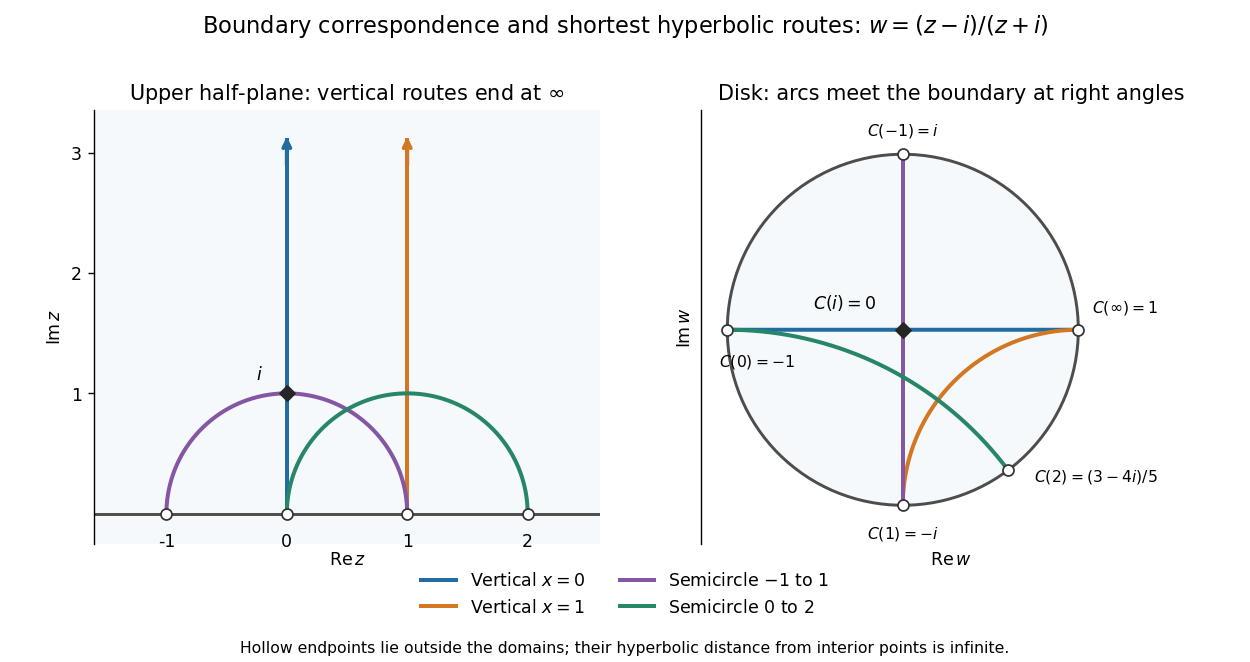
Boundary points and hyperbolic geodesics correspond under the Cayley transform from the upper half-plane to the unit disc
. Details. 
Matching colours identify each hyperbolic geodesic and its image. The vertical line through zero maps to a diameter; the vertical line through one maps to an arc ending at and . A semicircle from to also maps to a diameter, whereas the semicircle from to maps to a curved arc. Their endpoints lie on the boundary, outside the domains: the endpoints are infinitely far from interior points in hyperbolic distance.
The upper half-plane is useful because its straight boundary and explicit upper half-plane automorphisms make conformal maps and hyperbolic geometry calculable. The picture explains why shortest hyperbolic geodesic routes can look curved in Euclidean coordinates; their lengths are measured with the position-dependent hyperbolic metric.
For historical context, in his letter to Klein of 22 September 1882, Poincaré constructs a quadrilateral bounded by four circles orthogonal to a fundamental circle, and studies transformations generating repeated copies. In modern language, the sides inside that circle are hyperbolic geodesics in a disk model. The letter directly exhibits the connection between transformation groups, geometry and complex functions. [ref]
https://henripoincarepapers.univ-nantes.fr/chp/text/klein-en-1882-09-22.html. Poincaré to Klein, 22 September 1882, English translation, opening construction
New to topics? Read the docs here!