
A wing planform is the two-dimensional outline of an aircraft wing viewed from above. It is bounded by the projected leading edge, trailing edge and wing tips. A rectangular, tapered or swept wing planform can be combined with many different airfoil profiles; the outline alone does not specify the wing's thickness or airfoil camber.[ref]
Let point aft and run along the wingspan. Describe the two edges by and . Their separation is the projected local airfoil chord,The second equation computes wing area. The first retains information lost by that single area value: where the chord lies along the fore-and-aft direction.
For an original comparison, a rectangular wing with and has . A symmetric trapezoidal wing of the same wingspan, root chord and tip chord also has . Now shift both edges of each spanwise strip aft by : the local airfoil chord and wing area stay unchanged, while the wing sweep changes. This explains geometrically why even specifying wingspan, wing area and wing taper ratio does not uniquely determine a wing planform.
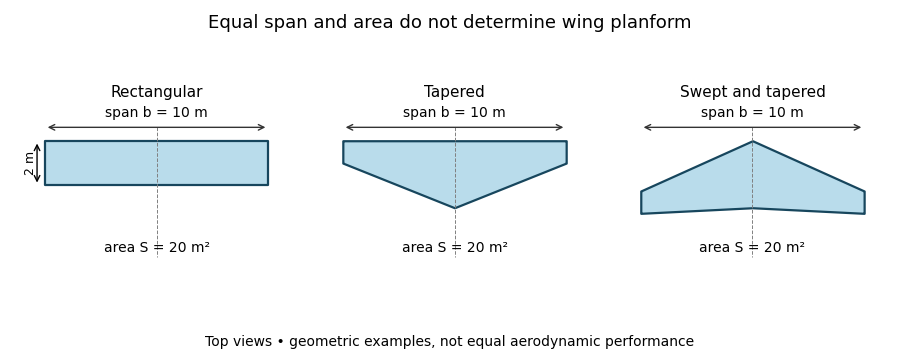
Three wing planforms with equal span and projected area
. Details. 
The construction compares geometry, not aerodynamic equivalence. The airfoil, angle of attack and three-dimensional fluid flow still matter when predicting lift and drag.
New to topics? Read the docs here!