Worked two-length tensile compliance example
ID: worked-two-length-tensile-compliance-example

The following values are stipulated arithmetic inputs, not measurements of a material. Take and lengths , . At forces , stipulate crosshead displacementsThe two different initial offsets deliberately test the use of intercepts. Linear regression of gives , andTheir reciprocal spring constants are and . The compliance-versus-length slope isso the recovered Young's modulus and machine compliance areThe corresponding apparatus spring constant is .
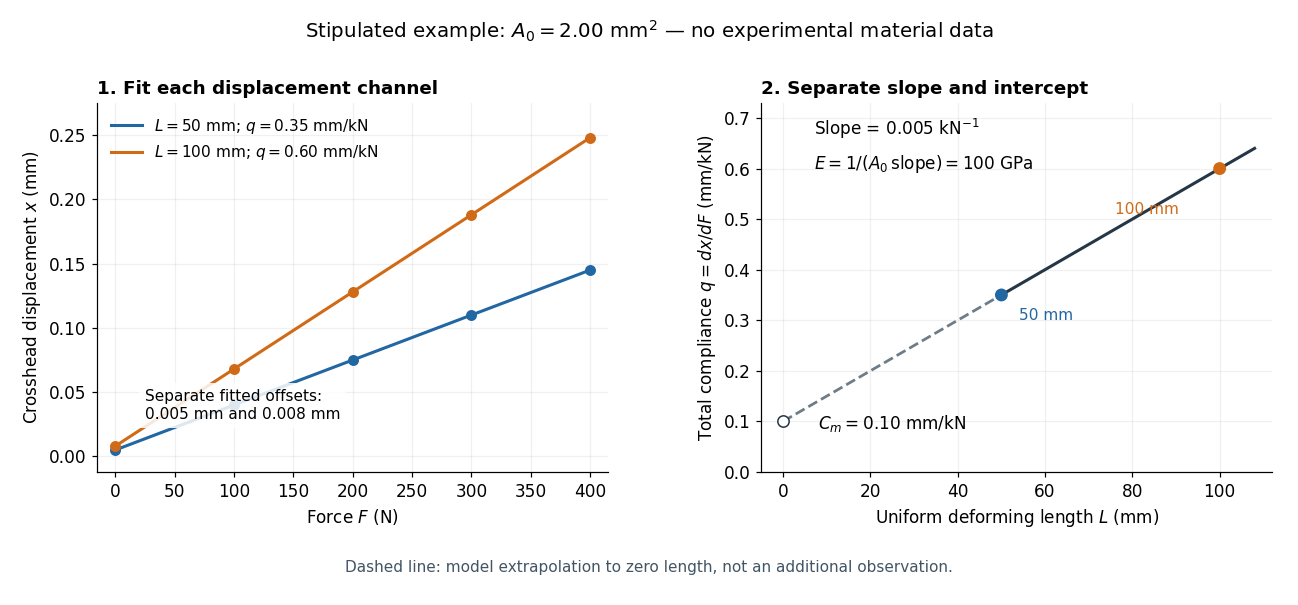
Stipulated displacement fits separate length-dependent compliance from apparatus compliance
. Original calculated example, not experimental material data. Left: independent linear displacement fits at lengths 50 and 100 millimetres retain their different offsets. Right: the line through the two compliance values has slope 1/(EA0) and intercept Cm. The dashed segment extrapolates the model to zero length; it is not a third observation. Details.
Check the reconstruction at . The machine contribution is , and the two specimen contributions are and . Adding the respective offsets gives the stipulated and . An extensometer spanning on either ideal uniform specimen would instead read extension: engineering strain , at engineering stress . Their ratio is again . Ignoring machine compliance gives apparent moduli and even after removing the offsets. No yield point or real material identity is implied by these stipulated linear inputs.
New to topics? Read the docs here!