It is quite amazing to read through books such as The Supermen: The Story of Seymour Cray by Charles J. Murray (1997), as it makes you notice that earlier CPUs (all before the 70's) were not made with integrated circuits, but rather smaller pieces glued up on PCBs! E.g. the arithmetic logic unit was actually a discrete component at one point.
The reason for this can also be understood quite clearly by reading books such as Robert Noyce: The Man Behind the Microchip by Leslie Berlin (2006). The first integrated circuits were just too small for this. It was initially unimaginable that a CPU would fit in a single chip! Even just having a very small number of components on a chip was already revolutionary and enough to kick-start the industry. Just imagine how much money any level of integration saved in those early days for production, e.g. as opposed to manually soldering point-to-point constructions. Also the reliability, size an weight gains were amazing. In particular for military and spacial applications originally.
Uploaded by the Computer History Museum. There is value in tutorials written by early pioneers of the field, this is pure gold.
Shows:
- photomasks
- silicon ingots and wafer processing
Articles by others on the same topic

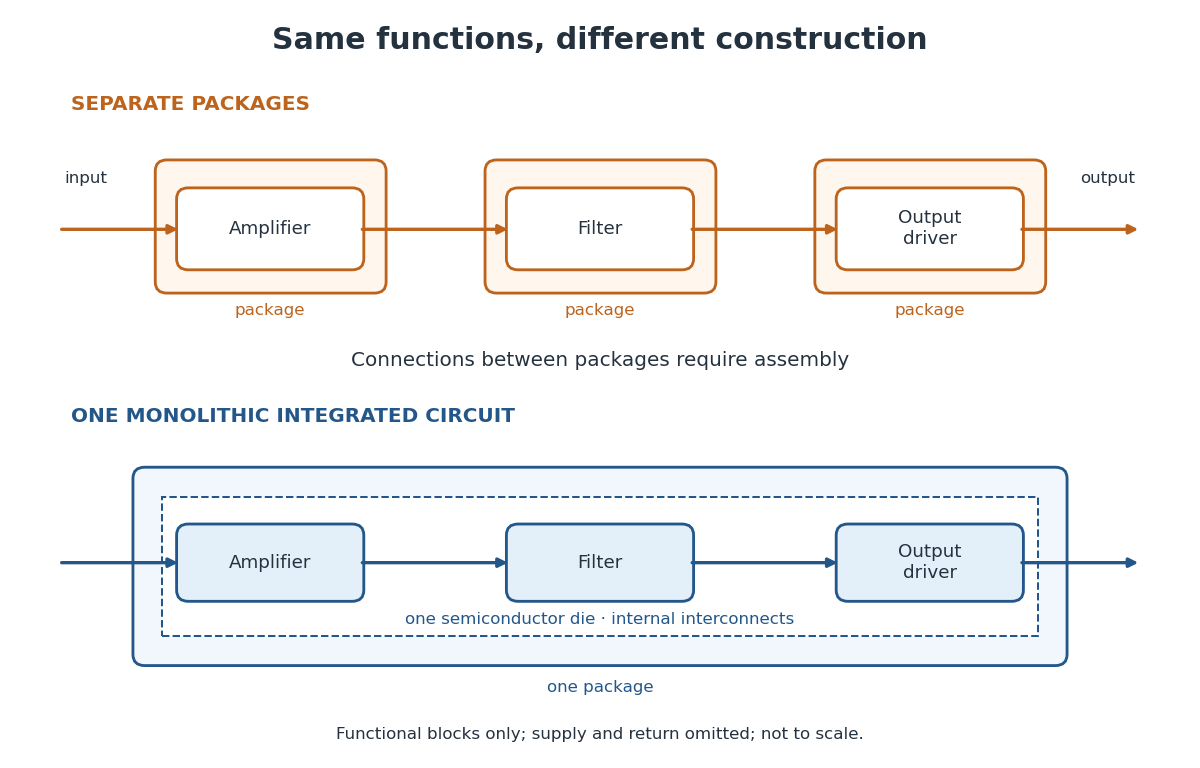
An integrated circuit combines interconnected electrical circuit elements in a fabricated structure. A monolithic integrated circuit forms its elements in or on one piece of semiconductor, rather than merely putting separately manufactured components into one enclosure. Transistors supply control in electronic amplifiers; resistors and capacitors can supply bias and timing. Jack St. Clair Kilby's patent describes making such functions from a common semiconductor body with compatible fabrication steps.[ref]
Miniaturized electronic circuits by Jack St. Clair Kilby. Description, opening statement of the invention and discussion preceding Figs. 1–5a
The useful change is to fabricate connections and functions together. Shrinking an enclosure still leaves individual parts to position and join. Integration makes their relative arrangement part of a repeatable fabrication pattern. The distinction is functional as well as geometric: one small piece can implement a whole electrical circuit, while its external terminals expose only the connections needed by its surroundings.