
Past exam of the mathematics course of the University of Cambridge 2010 ia Paper 3 6D Solution Created 2026-09-24 Updated 2026-10-14
The finite-group Lagrange theorem states that divides for every subgroup , since the disjoint left cosets all have size . In particular, the order of an element divides the group order.
If and , the cyclic subgroup has order greater than one and dividing , so it has order . Therefore every group of prime order is cyclic.
Let now be abelian of order . If an element has order , it generates , giving . Otherwise every nonidentity element has order . Choose and , which is possible because . Commutativity makesa group homomorphism. If and , choose with . Then , a contradiction. Hence and then . The homomorphism is injective and both groups have order , so it is an isomorphism. This proves the abelian group of prime-square order classification:Here denotes the dihedral group of order twelve, as specified in the paper: the hexagon's rotation through has order six. The possible cycle types in are the identity, three-cycles and double transpositions, of orders one, three and two. It has no element of order six. A group isomorphism preserves element orders, so
Past exam of the mathematics course of the University of Cambridge 2010 ia Paper 3 5D ii Created 2026-09-24 Updated 2026-09-24
Past exam of the mathematics course of the University of Cambridge 2010 ia Paper 3 5D i Created 2026-09-24 Updated 2026-09-24
Past exam of the mathematics course of the University of Cambridge 2010 ia Paper 3 4C Solution Created 2026-09-24 Updated 2026-10-14
In polar coordinates, the curve is the logarithmic spiral , . It starts at and winds counterclockwise outwards through one and a half turns. It crosses the horizontal axis atThe following original sketch uses representative positive values; changing rescales it and changing changes its rate of expansion.
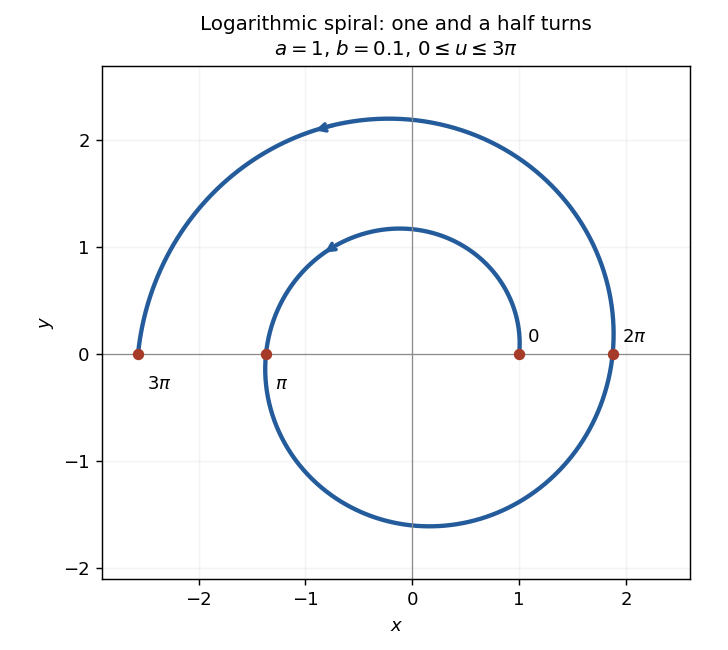
Logarithmic spiral over one and a half counterclockwise turns
. Details. Differentiate the coordinates:Hence . Integrating the arc length element gives, for ,For a negative endpoint parameter the length between and zero uses the absolute value of the final factor.
A second differentiation givesThe numerator is positive, so the absolute value in the PDF's curvature of a plane curve formula leaves it unchanged. ConsequentlyThe speed is , and therefore . Thus the requested elapsed time isThis travel time at reciprocal-curvature speed is independent of because the growing arc length per unit angle is exactly matched by the growing speed.
Past exam of the mathematics course of the University of Cambridge 2010 ia Paper 3 3C Solution Created 2026-09-24 Updated 2026-10-14
Write . The first two components have no dependence, and the third component is zero. The only possibly nonzero component of the curl isThus wherever the field is defined.
The disk spanning lies away from the excluded axis: the distance from its center to that axis is . The field is continuously differentiable on a neighborhood of that disk. The Stokes theorem therefore givesThis value is independent of the choice of orientation.
For , take the counterclockwise orientation viewed from positive . Put , . Then , so the line integral isClockwise orientation gives ; no orientation is printed for this curve. There is no contradiction with the Stokes theorem: its usual spanning disk intersects the axis where the field is undefined, so the differentiability hypothesis fails. This is a curl-free vector field with nonzero circulation around the excluded axis; local angular potentials cannot be combined into a single-valued global potential.
Past exam of the mathematics course of the University of Cambridge 2010 ia Paper 3 2D Solution Created 2026-09-24 Updated 2026-10-14
Compose permutations from right to left. Tracking the images gives , , and , soTwo transpositions give sign of a permutation , proving that this element belongs to the alternating group .
Its conjugacy class consists of all double transpositions. Conjugation merely relabels the letters, so no other cycle type can occur. Conversely, choose a permutation relabelling the two pairs into any desired two pairs. If is odd, replace it by : the transposition centralizes , so this replacement is even and gives the same conjugate. Thus every double transposition is reached by conjugation inside .
The complete list of fifteen elements, grouped by their fixed letter, isThere are five choices of fixed letter and three pairings of the other four letters, confirming the conjugacy class size .
Past exam of the mathematics course of the University of Cambridge 2010 ia Paper 3 1D iii Created 2026-09-24 Updated 2026-09-24
Past exam of the mathematics course of the University of Cambridge 2010 ia Paper 3 1D ii Created 2026-09-24 Updated 2026-09-24
Past exam of the mathematics course of the University of Cambridge 2010 ia Paper 3 1D i Created 2026-09-24 Updated 2026-09-24
Past exam of the mathematics course of the University of Cambridge 2010 ia Paper 3 12C Solution Created 2026-09-24 Updated 2026-10-14
For a spherically symmetric potential, the Poisson equation for Newtonian gravity becomesIntegrate from the center, excluding any additional point mass there. The boundary condition is as , soThis derives the enclosed-mass form of the spherical shell theorem from the differential equation. Outside the mass, integrating gives ; the conventional zero at infinity sets .
For the dyadic shells, multiply their constant mass density by their spherical volumes. The th shell contributesSumming the geometric series yieldsAt radius , the enclosed shells are exactly those with ; a boundary itself contributes no mass. ThusDividing by givesThese dyadic spherical shells with inverse-radius density scaling have the same field magnitude at each shell boundary, although the field varies inside an individual shell. Finally, outside the planet,with zero potential at infinity; without that convention an arbitrary additive constant remains.
Past exam of the mathematics course of the University of Cambridge 2010 ia Paper 3 11C Solution Created 2026-09-24 Updated 2026-10-14
For a bounded volume with piecewise smooth boundary and a continuously differentiable vector field on a neighborhood of its closure, the divergence theorem stateswhere is the outward unit normal.
The boundary here consists of a paraboloid cap over the unit disk, a cylindrical wall of height one, and the bottom disk. Their joined surface enclosesThe cap meets the wall at , and the wall meets the base at . The sketches show each boundary piece and their closed union.
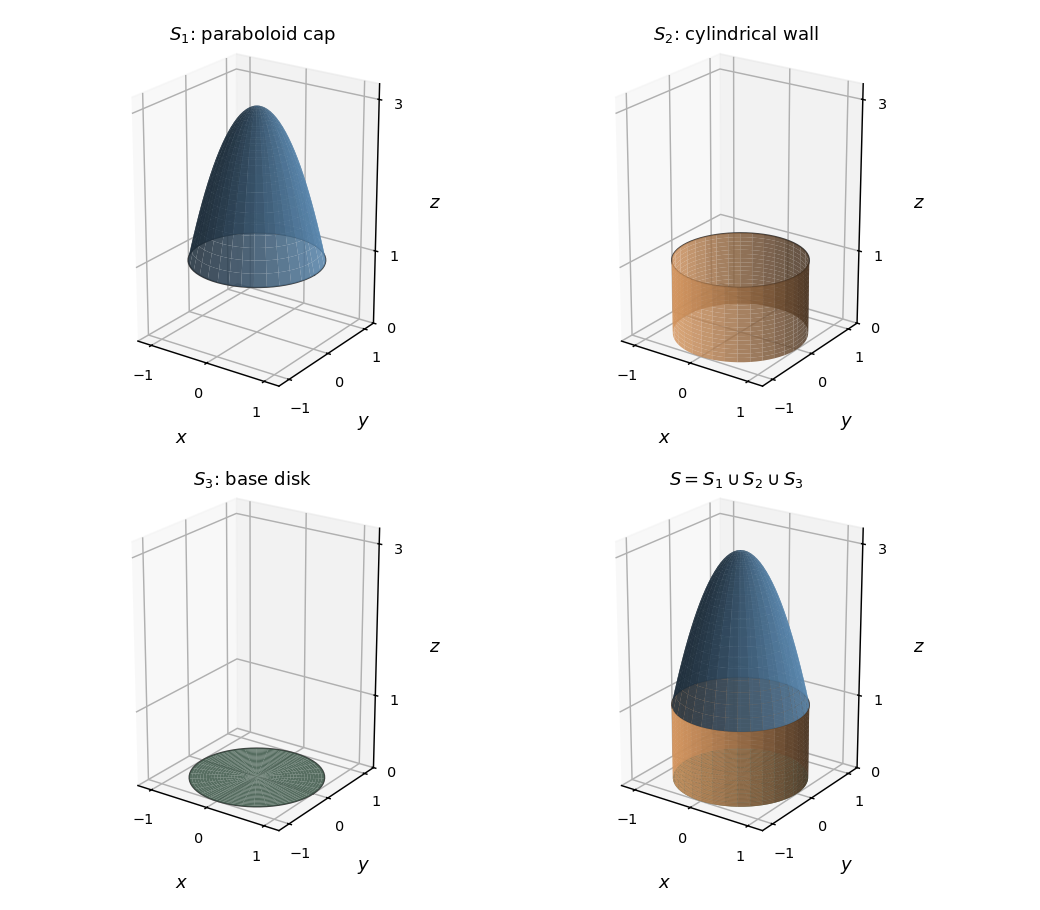
Paraboloid cap, cylindrical wall, base disk, and their closed union
. Details. Differentiate the field components to find the divergence:The volume is invariant under reflecting or , so odd-integrand cancellation by reflection removes both odd-power contributions. The outward flux equals the volume:The corners between the three pieces are permitted by the piecewise smooth boundary hypothesis.
Past exam of the mathematics course of the University of Cambridge 2010 ia Paper 3 10C Solution Created 2026-09-24 Updated 2026-10-14
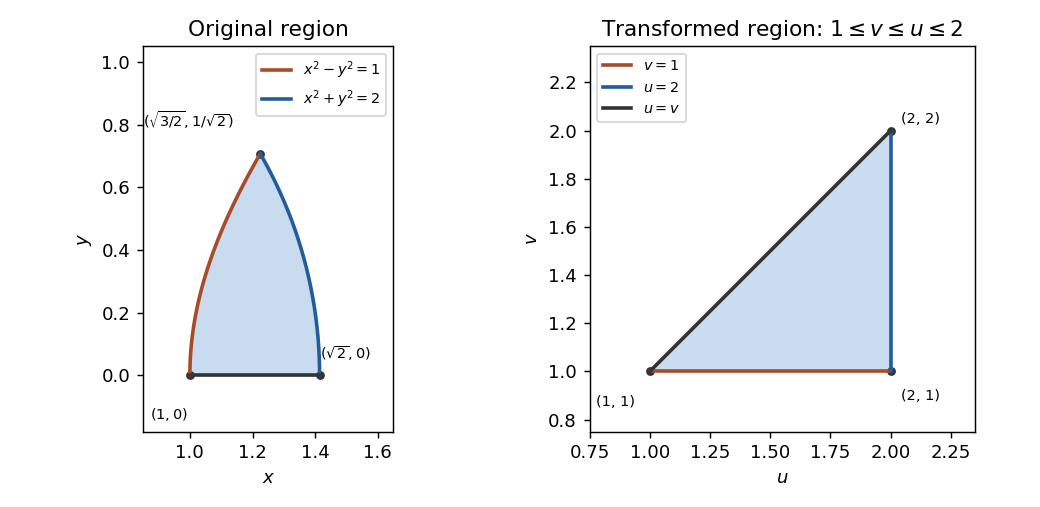
For a one-to-one continuously differentiable change of variables with nonzero Jacobian determinant in the interior, the change of variables formula isThe absolute value is necessary even if the transformation reverses orientation.


Past exam of the mathematics course of the University of Cambridge 2010 ia Paper 2 9F c Created 2026-09-24 Updated 2026-09-24
Past exam of the mathematics course of the University of Cambridge 2010 ia Paper 2 9F b Created 2026-09-24 Updated 2026-09-24
Past exam of the mathematics course of the University of Cambridge 2010 ia Paper 2 9F a Created 2026-09-24 Updated 2026-09-24
Past exam of the mathematics course of the University of Cambridge 2010 ia Paper 2 8A c Created 2026-09-24 Updated 2026-09-24
Past exam of the mathematics course of the University of Cambridge 2010 ia Paper 2 8A b Created 2026-09-24 Updated 2026-09-24
Past exam of the mathematics course of the University of Cambridge 2010 ia Paper 2 8A a Created 2026-09-24 Updated 2026-09-24
Past exam of the mathematics course of the University of Cambridge 2010 ia Paper 2 7A c Created 2026-09-24 Updated 2026-09-24
Past exam of the mathematics course of the University of Cambridge 2010 ia Paper 2 7A b Created 2026-09-24 Updated 2026-09-24
There are unlisted articles, also show them or only show them.