
Past exam of the mathematics course of the University of Cambridge 2010 ia Paper 4 7E c Created 2026-09-24 Updated 2026-09-24
Past exam of the mathematics course of the University of Cambridge 2010 ia Paper 4 7E b Created 2026-09-24 Updated 2026-09-24
Past exam of the mathematics course of the University of Cambridge 2010 ia Paper 4 7E a Created 2026-09-24 Updated 2026-09-24
Past exam of the mathematics course of the University of Cambridge 2010 ia Paper 4 6E Solution Created 2026-09-24 Updated 2026-10-14
The Fermat little theorem states that if is a prime number, then for every integer . Equivalently, for , .
To prove it when , multiplication by permutes the nonzero residues . Indeed, implies , and the Euclid lemma implies in this range. Multiplying all these residues givesNone of the factors of is divisible by , so the factorial has a modular inverse. Cancelling it proves , hence . When , the latter identity has both sides zero, completing the proof.
For an odd prime number , the numbers are coprime. The Fermat little theorem gives , and consequentlyThese exponents are distinct, so infinitely many are obtained.
Write the repdigit with copies of asIf , choose to be any positive multiple of . Then has a modular inverse modulo , so . Division by cannot be used modulo ; instead gives , so for every . If , every is divisible by . ThusThe separate treatment of accounts for the prime factor of the geometric-sum denominator.
Past exam of the mathematics course of the University of Cambridge 2010 ia Paper 4 5E Solution Created 2026-09-24 Updated 2026-10-14
For the Fibonacci addition formula, use mathematical induction on , with the assertion applying to every . At , . If the formula holds for some and all , apply it at and use the Fibonacci number recurrence:This is the assertion at , completing the mathematical induction. ThusTaking gives the doubling identity
For the Lucas numbers, , and . For , both expressions for earlier Lucas numbers are available, andHence . The separate check matters because the defining expression for was given separately.
The Euclidean algorithm and the Fibonacci number recurrence give, for ,Repeating reduces to ; the case is immediate. Therefore .
For , , so a common divisor of divides both and . Since are coprime, Bézout's identity gives integers with . Multiplying by shows . Conversely any common divisor of and divides . Including , this proves the stronger greatest common divisor identity
Past exam of the mathematics course of the University of Cambridge 2010 ia Paper 4 4B Solution Created 2026-09-24 Updated 2026-10-14
Choose the two inertial frames to have coincident origins at , and let the origin of have . The Lorentz transformation isHere is the Lorentz factor. Along the particle's trajectory, , soDividing gives the relativistic velocity-addition formulaThe denominator is positive because . Direct algebra yieldssince both factors in the numerator are positive. Consequently : a subluminal velocity remains subluminal in every such inertial frame.
Past exam of the mathematics course of the University of Cambridge 2010 ia Paper 4 3B Solution Created 2026-09-24 Updated 2026-10-14
With no electric field, the Lorentz force is . The equation from Newton's second law and its first integral areThe cyclotron frequency is ; the sign of specifies the sense of rotation. Since , the initial data giveThe component equations are , and . For , differentiating the first givesSolving this linear differential equation and then using givesThe perpendicular projection is a circle of radius centred at , the guiding centre. The velocity parallel to the magnetic field stays constant, producing helical motion in a uniform magnetic field.
When , this simplifies toThus the trajectory is a helix about the axis, with radius and axial advance per complete revolution in increasing time. Its projection moves clockwise when viewed from positive for . If it is a circle; if it is a straight line along the axis.
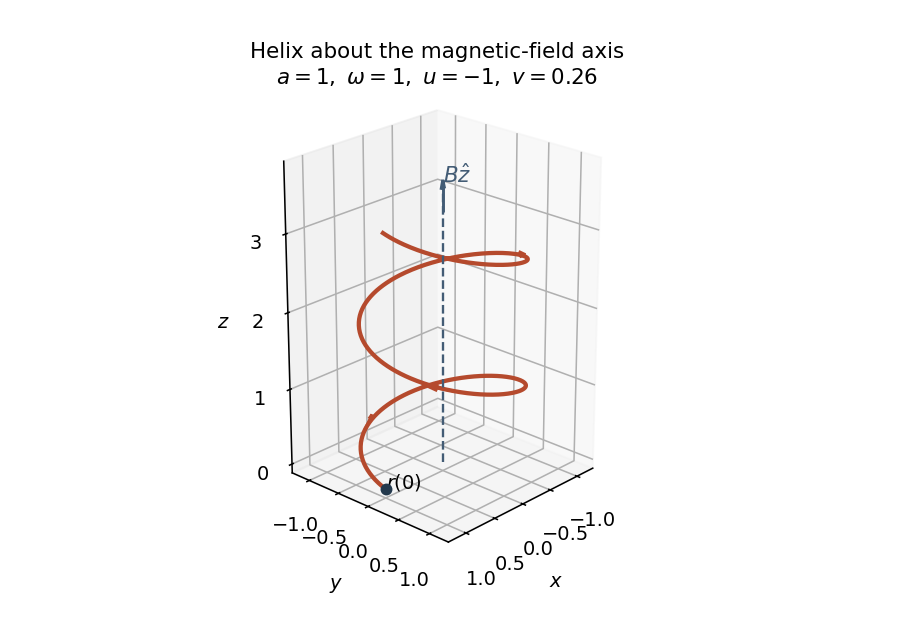

For , the Lorentz force vanishes and the solution is instead , also the limit of the general formula. The special condition then forces .
Past exam of the mathematics course of the University of Cambridge 2010 ia Paper 4 2E b Created 2026-09-24 Updated 2026-09-24
Past exam of the mathematics course of the University of Cambridge 2010 ia Paper 4 2E a Created 2026-09-24 Updated 2026-09-24
Past exam of the mathematics course of the University of Cambridge 2010 ia Paper 4 1E b Created 2026-09-24 Updated 2026-09-24
Past exam of the mathematics course of the University of Cambridge 2010 ia Paper 4 1E a Created 2026-09-24 Updated 2026-09-24
Past exam of the mathematics course of the University of Cambridge 2010 ia Paper 4 12B Solution Created 2026-09-24 Updated 2026-10-14
Let be the magnitude of the incident particle's momentum. The relativistic energy-momentum relation givesThe stationary particle contributes rest energy and zero momentum. Conservation of four-momentum therefore gives equal photon energies . A photon has momentum magnitude , so if the two momentum vectors meet at angle ,Substitution gives the angular relation for two-photon electron-positron annihilation, whose derivation depends only on the stipulated equal rest masses and equal photon energies:All energies and the angle here are in the laboratory inertial frame.
For perpendicular photon trajectories, and hence . Since with Lorentz factor ,For the small-speed limit, set and . The angle formula impliesUsing therefore gives , soAt zero incident speed the momenta are equal and opposite, so , consistent with the expansion.
Past exam of the mathematics course of the University of Cambridge 2010 ia Paper 4 11B Solution Created 2026-09-24 Updated 2026-10-14
Work in an inertial frame, take all masses to be constant, and assume the internal forces obey the pairwise relation from Newton's third law . For the angular momentum result, also assume these pair forces are central, so is parallel to and its pair torque vanishes. The equations from Newton's second law areSumming them and pairing the internal forces gives
About a fixed point , define the total angular momentum and external torque byDifferentiation produces no velocity term because . Grouping internal terms into pairs givesEach final cross product is zero by centrality, proving . Equal and opposite internal forces give momentum conservation when the total external force is zero, but do not in general make their internal torques cancel; the central-force assumption supplies that extra step.
Let and let the centre of mass be , so . For an arbitrary moving reference point , the same differentiation givesTaking , the extra term is . Therefore the corresponding angular momentum about the centre of mass satisfiesIts definition using velocities relative to agrees with the one above, since makes . Thus this result remains true even when the centre of mass accelerates.
Finally take the common mass to be and , with constant . About either a fixed point or the centre of mass,The angular-momentum equation becomes . Multiplying by the integrating factor gives , hence the angular momentum decay under uniform linear drag isThe common mass and common drag coefficient ensure that the same decay factor applies to every term.
Past exam of the mathematics course of the University of Cambridge 2010 ia Paper 4 10B b Created 2026-09-24 Updated 2026-09-24
Past exam of the mathematics course of the University of Cambridge 2010 ia Paper 4 10B a Created 2026-09-24 Updated 2026-10-14
Past exam of the mathematics course of the University of Cambridge 2010 ia Paper 3 9C c Created 2026-09-24 Updated 2026-09-24
Past exam of the mathematics course of the University of Cambridge 2010 ia Paper 3 9C b Created 2026-09-24 Updated 2026-09-24
Past exam of the mathematics course of the University of Cambridge 2010 ia Paper 3 9C a Created 2026-09-24 Updated 2026-09-24
Past exam of the mathematics course of the University of Cambridge 2010 ia Paper 3 8D Solution Created 2026-09-24 Updated 2026-10-14
For each , conjugation sends a subgroup to , a subgroup of the same order and hence still proper. Identity conjugation fixes every subgroup, andThese verify the group action laws.
The stabilizer subgroup of for this conjugation action is its normalizer . Since , the orbit-stabilizer theorem gives the number of distinct conjugates asAll these conjugate subgroups contain the identity, so counting that element only once givesThe last inequality uses the properness of , so . There is therefore an element outside this union, which is not conjugate to any element of . This proves that conjugates of a proper subgroup do not cover a finite group, including the case .
Past exam of the mathematics course of the University of Cambridge 2010 ia Paper 3 7D Solution Created 2026-09-24 Updated 2026-10-14
By transitivity, choose with . If , thenThus . This proves the conjugation assertion directly from the transitive group action.
For the complex special linear group in dimension two, the Möbius transformation of a matrix acts by , with . It fixes infinity exactly when , so its stabilizer subgroup isWe distinguish the cases to avoid dividing by a vanishing coefficient.
If , infinity is not fixed, and the finite fixed points solveNeither root is the pole : substituting that value gives . The fixed-point set is thereforewith the two entries coinciding when the discriminant is zero. The discriminant identity uses .
If and , the fixed points are . If , and , only infinity is fixed. If , and , the determinant condition gives and every point is fixed. Both central matrices induce the identity Möbius transformation.
Every case has a fixed point, because a quadratic over the complex numbers has a root. The action is transitive: any finite is sent to infinity byand infinity already needs no change. Applying the first argument to a fixed point proves every element of is conjugate to an element of .
There are unlisted articles, also show them or only show them.