
Shortest-seek-time-first disk scheduling 2026-10-31
Serve the pending request whose track is nearest to the current head position, with an explicit tie rule when necessary. This minimizes the next seek distance, rather than the total distance of every future request; a continuing stream of nearby requests can starve a distant request.
SCAN disk scheduling 2026-10-31
Sweep in one direction, servicing requests encountered in track order, continue to the physical endpoint, and then reverse. A calculation must state the initial direction and whether movement after the final requested service is included. LOOK disk scheduling instead turns around at the last pending request in that direction.
LOOK disk scheduling 2026-10-31
Sweep in one direction through pending requests, reversing at the last pending track rather than travelling to the disk's physical endpoint. It shares the directional sweep of SCAN disk scheduling but can avoid movement into an empty end region.
Seek distance 2026-10-31
Total absolute track displacement along a head route . Include physical turnaround points in the route if the scheduling policy visits them, even if they do not service a request.
Hydrograph 2026-10-31
A hydrograph records discharge against time at a fixed location. A nonlinear kinematic wave can steepen an upstream increase into a sharp front; longitudinal diffusion or additional storage rounds the resulting rise.
absolute convergence of a Dirichlet series depends only on the real part of its variable. The set of real parts giving convergence is upward closed by the comparison test. If that set is nonempty and not all of the real line, its finite infimum is the abscissa: every larger real part gives convergence, and every smaller real part gives divergence. Boundary convergence is a separate question.
Let satisfy for . The Abel summation formula gives when , since its finite-sum boundary term tends to zero. Split this integral into blocks . For every , the estimate holds uniformly on . Each block is an entire function, by differentiation under the finite-range integral on compact sets. The Weierstrass M-test makes their sum locally uniformly convergent and therefore holomorphic; multiplication by preserves holomorphy.
This proof distinguishes uniform convergence of the block sum on a whole half-plane from local uniform convergence after multiplication by . The latter is all that holomorphy needs. In particular, a bound gives a holomorphic continuation of the reciprocal Riemann zeta function to this half-plane and excludes zeta zeros there, with the pole at one treated by cancellation.
Let be a closed linear subspace of a real Hilbert space, and let for a symmetric bounded bilinear form that is nonnegative on the ambient space and coercive on . Then has a unique minimizer on every closed affine subspace . If , the midpoint belongs to and the parallelogram law gives . Coercivity on makes the minimizing sequence Cauchy; completeness and continuity give a minimizer. The vanishing first variation is for all . Two minimizers differ by with , so coercivity gives uniqueness. This proves the symmetric existence theorem directly, without invoking the Lax-Milgram theorem.
For the point interaction in a second-order differential equation on , use homogeneous Dirichlet boundary conditions. The unperturbed Green function iswith a positive unit derivative jump at . Whenever ,To derive this rank-one operator correction, move the delta coefficient to the right-hand side and apply the unperturbed inverse: . Setting determines and gives the formula. Its denominator vanishes exactly at Dirichlet resonance for a point interaction.
The kernel is symmetric. It is continuous at and , satisfies when , and satisfies away from the source. When , the single combined condition is . These are the transmission conditions for a delta coefficient, including a source at the interaction.
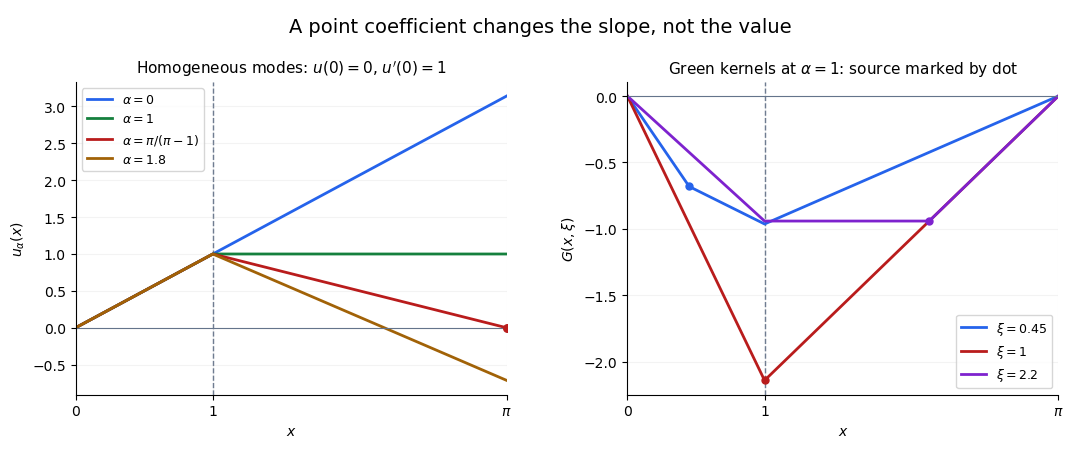

For , consider the self-adjoint differential operator with and . The homogeneous solutions and satisfy the left and right zero Dirichlet boundary conditions. Their Wronskian is , and . Thus the displayed Dirichlet Green function is continuous, zero at both endpoints, and has unit flux jump .
The right solution has a double zero, . Consequently is integrable at for fixed interior when , even though itself is not integrable there. The endpoint zero of the Wronskian causes no loss of this construction because the weighted Wronskian stays nonzero. This illustrates the need to retain the integrating factor when constructing a Green function at a singular endpoint.
For on with zero endpoint values, the displayed Green kernel is positive and symmetric. Each side solves the homogeneous equation; the kernel is continuous at and its first derivative has jump . Hence . Integrating against a forcing function solves . For the indicator of the right half-interval, the value at zero is , obtained by integrating over . The derivative-jump sign changes if the operator is written with the opposite overall sign.
Group extension by a duplicate carrier 2026-10-31
If a group has carrier and a disjoint set is in bijection with , identify with , sending the original carrier to . Transporting the direct-product multiplication gives a larger group operation that agrees exactly with the old one on . A maximal partial group on a fixed carrier universe therefore has complement of cardinality strictly below its own, using cardinal comparability.
Tonelli existence theorem 2026-10-31
For a scalar fixed-endpoint problem on a bounded interval, suppose the continuous integrand is convex in and satisfies , where is nonnegative convex and . If there is one admissible absolutely continuous function of finite energy, a global minimizer exists in .
The lower bound gives uniform integrability of derivatives in a minimizing sequence. Fixed endpoint values then give boundedness and equicontinuity of the functions. Extract uniform convergence of the functions and weak convergence of their derivatives; the limit retains the endpoint values. Convexity in the derivative gives weak lower semicontinuity of convex gradient energies, so the limit attains the infimum. Strict convexity of the full integrand on a convex admissible class additionally gives uniqueness.
For with endpoint values zero and one, the zero-penalty minimizer has infinite derivative penalty. Use instead. The mismatch is at most , while the derivative penalty is . Balancing and by gives an upper energy bound of order . Nonnegativity then proves convergence of minimum energies to zero. This is a recovery construction; no claim of a matching lower asymptotic constant is needed.
Lavrentiev phenomenon 2026-10-31
A Lavrentiev gap is a strict change in an infimum when the admissible regularity class is restricted, despite retaining the same endpoint values. For example with has value zero at the absolutely continuous function . Every Lipschitz competitor has a uniform positive lower energy bound. Indeed its ratio to starts at zero, so let be its first crossing of . Before that point, . Holder inequality givesThus . This proves a gap directly. The example's integrand lacks a uniform superlinear lower bound along its zero set; it illustrates the admissible-class issue rather than by itself furnishing a counterexample under stronger coercivity assumptions.
Lewis number Created 2026-10-31 Updated 2026-11-05
The ratio of thermal diffusivity to molecular or solutal diffusivity . In coupled heat equation and solute diffusion equation similarity problems, the thermal coordinate becomes times larger in the solute complementary error function profile. This follows by substituting the thermal coordinate into , giving . The definition must specify the direction of this ratio because reciprocal conventions occasionally occur.
Description logic concept 2026-10-31
A unary description interpreted as a subset of the domain. Atomic names can be combined using the constructors of the chosen description logic.
Description logic role 2026-10-31
General concept inclusion 2026-10-31
An axiom requiring every instance of the description logic concept to be an instance of . It holds throughout the domain, not just at named individuals.
TBox 2026-10-31
A collection of terminological axioms, including general concept inclusions, constraining the meanings of description logic concepts and description logic roles.
There are unlisted articles, also show them or only show them.