
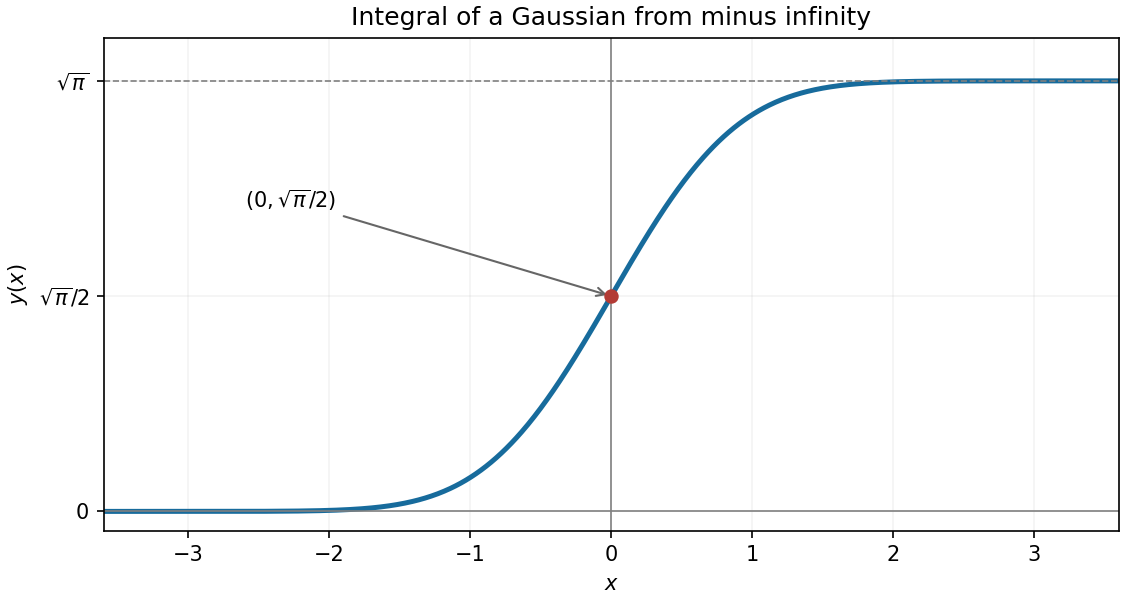
The fundamental theorem of calculus gives , so the graph is strictly increasing. Its second derivative is : it curves upward for and downward for , with an inflection point at zero.
By the Gaussian integral and the evenness of its integrand,Thus the only axis intersection is ; there is no finite -axis intersection because the integral is strictly positive for every finite . The error function gives .

The traversal fixes the orientation of the vector area as half the cross product of the edges and :Its Euclidean norm is the area of the triangle, and its direction follows the right-hand rule.
There are unlisted articles, also show them or only show them.