
For , the denominator is positive, so the function graph has the same sign as . Its crossings of the horizontal axis areEach crossing is genuine because the derivative there is . Near zero, , so ; the origin is excluded and is not a crossing. The oscillations alternate sign and decay towards zero as , with absolute value at most .
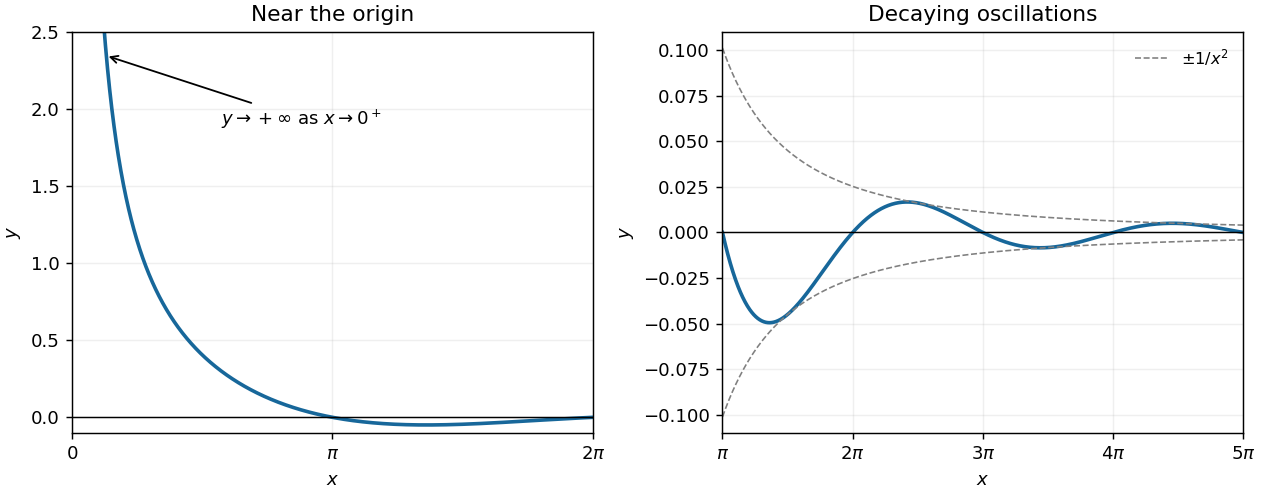

The product rule givesFor , the derivative is positive before and negative after . Also and as . Thus the global maximum on the requested range is
The original PDF puts both in the exponent in the second equation. Since the exponential function is injective, gives . Put , so . The first equation then givesThus , so and . The unique real solution of the simultaneous equations is
Completing the square under the square root gives . Thus the equation is , and the definition of absolute value gives . Hence
There are unlisted articles, also show them or only show them.