
Upper shadow Created 2026-09-24 Updated 2026-10-03
The upper shadow of isAmong families of fixed size, an initial lexicographic segment minimizes its upper shadow.
Lower shadow Created 2026-09-24 Updated 2026-09-24
Uniform set family Created 2026-09-24 Updated 2026-09-24
Intersecting family Created 2026-09-24 Updated 2026-10-14
A family of sets is intersecting when every two of its members have nonempty intersection.
Entropy bound for pairwise-union tuples Created 2026-09-24 Updated 2026-09-24
Let be random subsets of a common ground set. If every pairwise union takes values in a fixed family of sets of cardinality at most , then Shearer's inequality and the fact that a pair of bits with prescribed OR has at most three possibilities give
Union-closed family Created 2026-09-24 Updated 2026-09-28
Characteristic vector of a set Created 2026-09-24 Updated 2026-10-14
Total order Created 2026-09-24 Updated 2026-09-24
A total order is a reflexive, antisymmetric, transitive relation in which every two elements are comparable.
Partially ordered set Created 2026-09-24 Updated 2026-10-14
A partially ordered set, or poset, is a set equipped with a reflexive, antisymmetric and transitive binary relation.
Pair Created 2026-09-24 Updated 2026-10-14
A pair is a collection of two objects. An ordered pair records which object is first, whereas an unordered pair does not.
An ordered pair is a pair with distinguished first and second positions; an unordered pair does not record those positions.
Set intersection Created 2026-09-24 Updated 2026-10-14
The intersection keeps exactly the set elements common to both sets:Membership in an intersection therefore uses logical conjunction (AND). For and , the only shared member is , so . The Venn diagram in set union shades only the overlap for this operation.
An intersection is useful when every requirement must hold. If and are the sets of database records passing two separate conditions, their intersection gives the records passing both. Similarly, satisfying two equations requires belonging to the intersection of their solution sets. The same membership rule applies even when the objects have entirely different meanings.
For a family of sets, the intersection contains exactly the set elements belonging to every set :Here universal quantification expresses “every”. If all the sets lie within a fixed universal set , the intersection over no indexing members is defined to be : there are no requirements to fail. This convention depends on specifying . By contrast, intersecting with the empty set always gives .
Set union Created 2026-09-24 Updated 2026-10-14
The union collects the set elements belonging to either set, including those belonging to both:Thus membership in a union uses logical disjunction (OR). For and , the union is : the shared member occurs only once, because a set records membership without repeated entries.
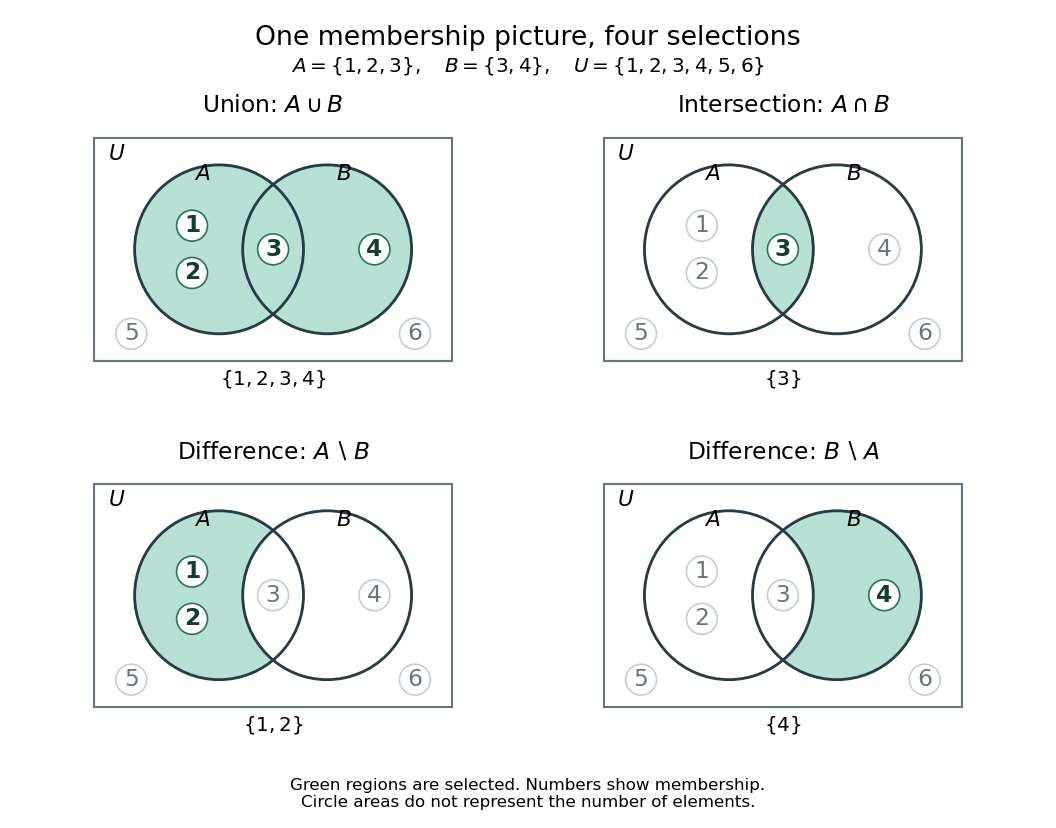

In this Venn diagram, belong only to , belongs to both sets, belongs only to , and belong to neither. The surrounding universal set is . Numbers are placed by membership; circle areas do not represent cardinalities. Each panel shades the region selected by its operation.
For a database illustration, let collect records matching one condition and collect records matching another. Their union selects records matching at least one condition, with a record satisfying both still appearing once. This interpretation turns an abstract operation into a reusable rule for combining selections. For an authored treatment of union, intersection, set difference, and complement, see Lehman, Leighton and Meyer, Mathematics for Computer Science (2015), Definition 4.1.1, pp. 82–83.
More generally, the union contains exactly the set elements belonging to at least one set :The existential quantification expresses “at least one”. With no indexing members, the union is the empty set. Combining a set with the empty set leaves it unchanged: .
Subset Created 2026-09-24 Updated 2026-09-24
Generating set Created 2026-09-24 Updated 2026-09-24
Distinct elements Created 2026-09-24 Updated 2026-10-14
Elements are distinct when they are unequal.
Finite set Created 2026-09-24 Updated 2026-09-28
Hermitian form Created 2026-09-24 Updated 2026-10-14
A Hermitian form is a sesquilinear form on a complex vector space satisfying conjugate symmetry,Hence is a real number for every vector. In a basis, the matrix of a Hermitian form has and obeys , equivalently : it is a Hermitian matrix. The coordinate rule remains . Conjugate symmetry does not imply positivity.[ref]
https://sites.math.washington.edu/~burke/crs/554/lectures/b-lecture4.pdf. Burke, Linear Analysis, Lecture 4, Hermitian symmetry
The diagonal contains more information than might be expected. For any complex sesquilinear form , put . Expanding four expressions gives the complex polarization identity in the linear-first convention:This is an algebraic identity, with no positivity assumption. If every is real, interchanging preserves the first difference and negates the second: use for . The identity then gives . Thus a complex sesquilinear form is a Hermitian form if and only if all its diagonal values are real. Testing only the basis vectors is insufficient: the off-diagonal example in sesquilinear form has zero diagonal entries in its matrix but a nonreal value at .
Consider the indefinite Hermitian formIts values at are . Moreover and are nonzero isotropic vectors: , yet . These vectors do not belong to the radical of a Hermitian form, and the usual Cauchy-Schwarz inequality would incorrectly require . An indefinite Hermitian form records signed geometry rather than defining a norm by .
There is a separate boundary case: is a positive semidefinite Hermitian form, since , but . Its radical of a Hermitian form is the entire second coordinate line. Positive definiteness is exactly the additional condition in a Hermitian inner product. The three examples below show why these distinctions matter: on the real slice , has an ellipse as its unit level, has hyperbolas, and has two parallel lines. These are slices of the complex examples, not drawings of their full four-dimensional domains.
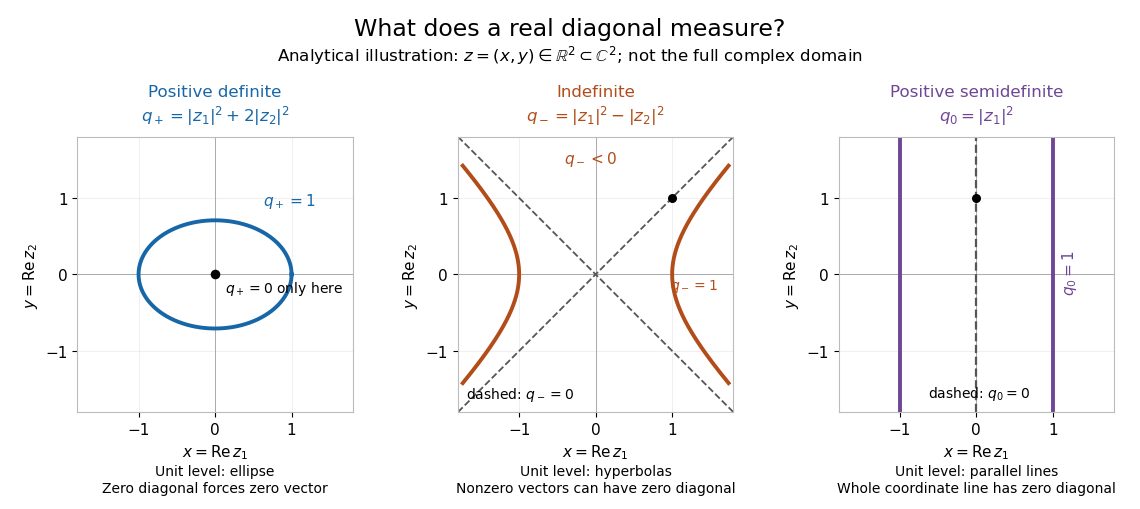
Analytical illustration: real slices of positive definite, indefinite, and positive semidefinite Hermitian forms
. Details. 
Hydrogen ground-state energy Created 2026-09-24 Updated 2026-09-24
Uniform limit Created 2026-09-24 Updated 2026-09-24
A sequence converges uniformly when one index makes the approximation accurate at every point of the domain.
There are unlisted articles, also show them or only show them.