
Maximal spectrum Created 2026-09-24 Updated 2026-09-24
Residue field Created 2026-09-24 Updated 2026-09-24
The residue field at a maximal ideal is the quotient field . At a prime ideal , the residue field is the fraction field of .
Matter-era linear growth factor Created 2026-09-24 Updated 2026-09-24
Cosmic-time matter density modes Created 2026-09-24 Updated 2026-09-24
In cosmic time during matter domination, and the pressureless density contrast obeysIts growing and decaying solutions are and .
Laplace-transform solution of a constant-coefficient vector ODE Created 2026-09-24 Updated 2026-09-24
Cyclic property of the trace Created 2026-09-24 Updated 2026-10-14
If is an -by- matrix and is an -by- matrix over the same field, both products are square matrices andThe products can even have different sizes: for and , and , but both have trace .[ref]
Linear Algebra Done Right by Sheldon Axler (4th edition). Axler, Linear Algebra Done Right, fourth edition, §8D, result 8.49
Grouping all but one factor proves that is unchanged by a cyclic permutation whenever the cyclic products are defined and square. In particular, every commutator has trace zero, since by linearity.
Parent Hamiltonian of a matrix product state Created 2026-09-24 Updated 2026-09-24
An MPS parent Hamiltonian is a sum of local projectors onto the orthogonal complement of the tensor's local support. The MPS is a frustration-free ground state.
Injective matrix product state Created 2026-09-24 Updated 2026-09-28
Caliper matching Created 2026-09-24 Updated 2026-10-14
Covariate balance Created 2026-09-24 Updated 2026-10-14
Regular-graph matching bound from unmatched vertices Created 2026-09-24 Updated 2026-10-14
Matching number Created 2026-09-24 Updated 2026-10-14
For a finite graph , the matching number isIt is the cardinality of a maximum cardinality matching. The vertex capacity constraint gives . The worked path graph examples have and . A perfect matching reaches ; the empty graph has matching number zero.
Maximal matching Created 2026-09-24 Updated 2026-10-14
A maximal matching is a matching in a graph to which no extra edge can be added while retaining all current selected edges. Equivalently, no edge joins two unmatched vertices in a matching; those vertices form an independent set. Every maximum cardinality matching is a maximal matching, but the converse fails.
Take the path graph with vertices and edges . A greedy algorithm that first selects the middle edge produces . Both remaining edges touch a matched vertex, so this size-one matching in a graph is maximal. Yet has two edges. No matching in a graph on four vertices has more than two edges, so is a maximum cardinality matching. The two remaining free vertices of , namely and , are not adjacent; that does not prevent a longer augmenting path in a matching from joining them.
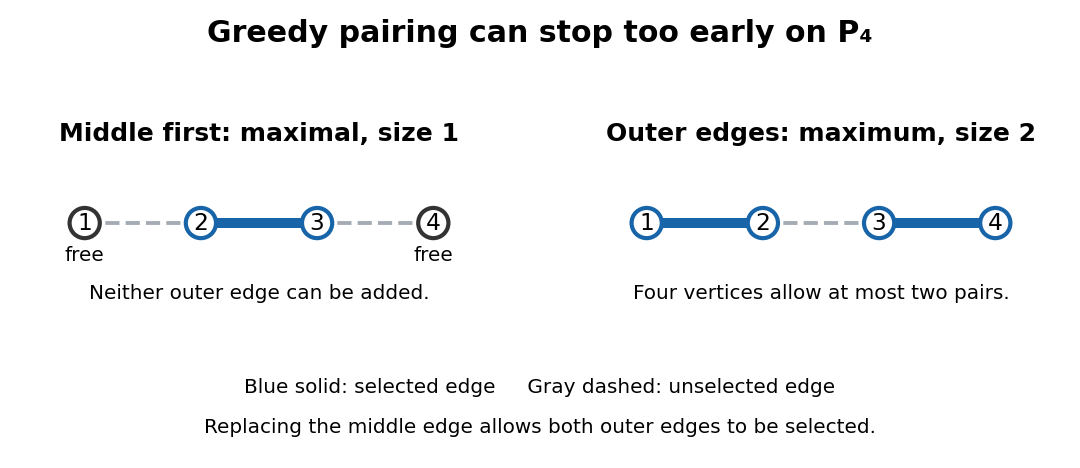
Choosing the middle edge of P₄ gives a maximal matching of size one; the outer edges give a maximum cardinality matching of size two
. Details. Maximality is useful as a quick stopping rule and a modest guarantee. For any maximal matching and maximum cardinality matching in a finite simple graph, every edge of touches an endpoint of an edge of . Assign it to one such edge of . Since has disjoint endpoints, each edge of receives at most two assignments, proving . The P₄ example reaches equality. Thus maximality guarantees at least half the largest cardinality, but says nothing comparable about arbitrary edge benefits. Its selected endpoints also form a vertex cover, as explained under vertex cover.
Perfect matching Created 2026-09-24 Updated 2026-10-14
A perfect matching is a matching in a graph that covers every vertex exactly once. Its edges have no shared endpoints, and every vertex is an endpoint of one selected edge. It is useful when a collection must be divided into disjoint pairs with no element left over.
In a bipartite graph with equally many vertices on its two sides, a perfect matching can assign every person one allowed job and every job one person. The example under permanent of a matrix has three people and three jobs, with exactly three valid assignments. The blue edges below show those three perfect matchings; a crossing in the drawing is not an extra vertex.
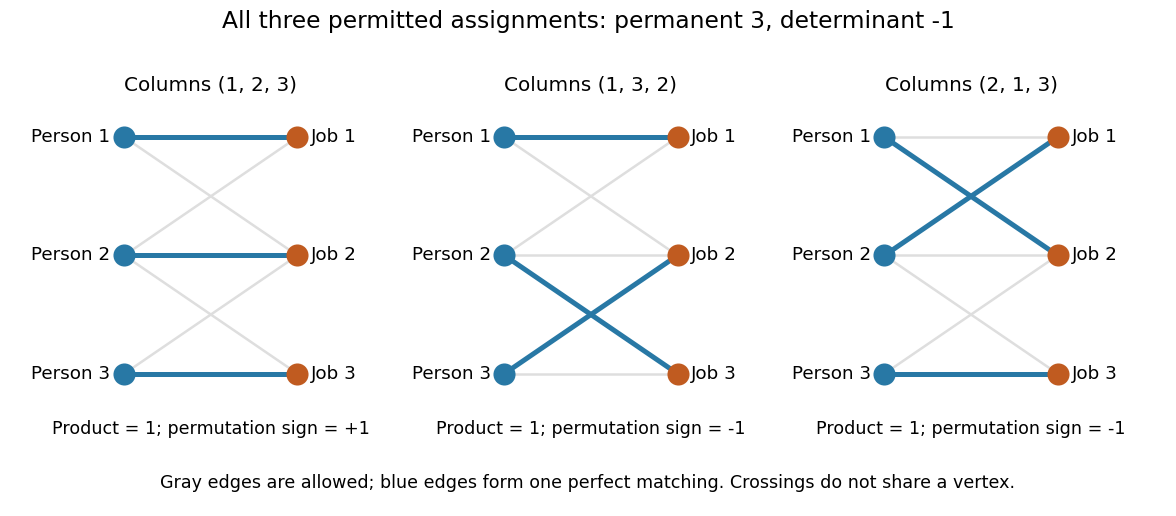


Every selected edge covers two vertices, so a graph with an odd integer number of vertices has no perfect matching. An even integer number is necessary but does not guarantee existence: an isolated vertex cannot be covered. A perfect matching also need not be unique. For example, the complete bipartite graph has two perfect matchings, corresponding to the two ways of assigning two people to two jobs.
Counting all perfect matchings is a different question from finding one. For a zero-one biadjacency matrix of a balanced bipartite graph, the count is its permanent of a matrix. The nonzero determinant criterion for a perfect matching supplies an existence test, but cancellation means that a zero determinant does not rule one out.
Snell envelope Created 2026-09-24 Updated 2026-10-14
The finite-horizon Snell envelope of rewards is defined backward by and . It is the least supermartingale dominating .
Predictable process Created 2026-09-24 Updated 2026-10-14
In discrete time, a process is predictable or previsible when is -measurable for every . In continuous time, predictability means measurability with respect to the predictable sigma-algebra.
Stopping time Created 2026-09-24 Updated 2026-09-24
Supermartingale Created 2026-09-24 Updated 2026-09-24
Doob upcrossing inequality Created 2026-09-24 Updated 2026-10-06
If is a martingale and counts its completed upcrossings of by time , thenEquivalent conventions may add an initial endpoint term.
Symmetric signs forced by the martingale property Created 2026-09-24 Updated 2026-09-24
If every increment of a discrete martingale takes values in , thenIterated conditioning shows that the increments are independent symmetric signs, so is a simple symmetric random walk.
There are unlisted articles, also show them or only show them.