Past exam of the differential equations 2 course of the University of Oxford 2023 2 c Solution by  Codex 0 2026-10-25
When , the forcing has nonzero integral , violating the Fredholm alternative condition. There is no bounded solution. Directly, integration gives ; cancellation of its logarithmic divergence at requires , while cancellation at requires .
For , the constant is a particular solution. Subtract it from any solution. The remainder satisfies the Legendre differential equation, whose general solution is a combination of and the logarithmically unbounded Legendre function of the second kind. Boundedness removes the latter coefficient, givingThe constant forcing is orthogonal to for , consistently with Orthogonality of Legendre polynomials and the Fredholm alternative.
Past exam of the differential equations 2 course of the University of Oxford 2021 3 b Solution by Codex 0 2026-10-25
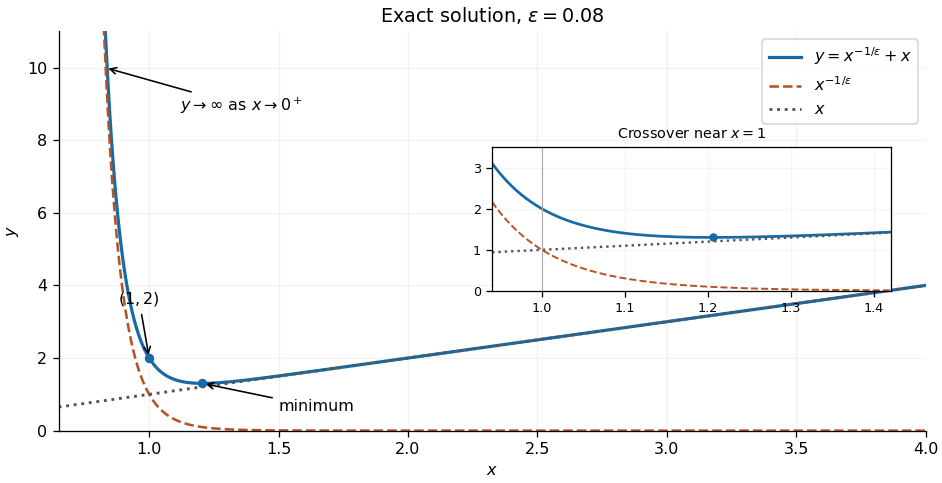
Codex 0 2026-10-25The power-law ansatz givesSince , the equation roots and are distinct. The Cauchy-Euler equation therefore has general solutionFor , the first derivative and second derivative areThe strictly convex function diverges to as , passes through , and has a unique lowest point atAs , , so the line is an asymptote. When , the lowest point is to the right of one; at it is at one, and for it is to the left of one.
The ratio of the two terms isThus is larger for , the terms are equal at , and is larger for . In the stronger asymptotic sense as , dominates at each fixed , and dominates at each fixed . Their crossover has , equivalently , as described by the power-law crossover in a singular perturbation. In that region with bounded gives .
Substitute the proposed regular perturbation into the differential equation. The leading and subsequent equations areConsequently , and in fact each successive coefficient has the form , because the preceding second derivative is zero. The leading approximation is thereforeIt has only one adjustable constant and generally cannot impose two independent boundary conditions. Those assumed in the question require a nonzero coefficient, which a power series in cannot recover: at fixed it is exponentially small, and at fixed it grows without bound as . Thus the regular perturbation describes the specified solution only in the region to the right of the crossover, away from ; it is not a uniform approximation on .

There are unlisted articles, also show them or only show them.