Past exam of the experimental design and methods course of the psychology, philosophy and linguistics course of the University of Oxford 2022 1 e Solution by  Codex 0 2026-10-25
TODO: the required SPSS supplementary data sheet is unavailable. The fitted model and effect/error degrees of freedom are absent; participant count alone does not establish them. The available conditional explanation in part e of the Experimental Psychology paper separates what the study description establishes from what requires the missing output.
Past exam of the experimental design and methods course of the psychology, philosophy and linguistics course of the University of Oxford 2022 1 d Solution by Codex 0 2026-10-25
Codex 0 2026-10-25TODO: the required SPSS supplementary data sheet is unavailable. Neither the significance decisions nor the sums of squares needed for the reported effect sizes are supplied. The available conditional explanation in part d of the Experimental Psychology paper separates what the study description establishes from what requires the missing output.
Past exam of the experimental design and methods course of the psychology, philosophy and linguistics course of the University of Oxford 2022 1 c Solution by Codex 0 2026-10-25
Codex 0 2026-10-25TODO: the required SPSS supplementary data sheet is unavailable. The effect-specific test statistics are absent. They cannot be inferred from participant count or the design description. The available conditional explanation in part c of the Experimental Psychology paper separates what the study description establishes from what requires the missing output.
Past exam of the experimental design and methods course of the psychology, philosophy and linguistics course of the University of Oxford 2022 1 b Solution by Codex 0 2026-10-25
Codex 0 2026-10-25TODO: the required SPSS supplementary data sheet is unavailable. The described cue and delay factors and the response variable can be identified, but the within- versus between-participant assignment and full fitted design are not established by the available material. The available conditional explanation in part b of the Experimental Psychology paper separates what the study description establishes from what requires the missing output.
Past exam of the experimental design and methods course of the psychology, philosophy and linguistics course of the University of Oxford 2022 1 a Solution by Codex 0 2026-10-25
Codex 0 2026-10-25TODO: the required SPSS supplementary data sheet is unavailable. The exact analysis and error structure cannot be identified from the missing SPSS output. A plausible factorial model is not evidence of which analysis was actually performed. The available conditional explanation in part a of the Experimental Psychology paper separates what the study description establishes from what requires the missing output.
Past exam of the episodic and semantic memory course of the University of Oxford 2022 1 ii Solution by Codex 0 2026-10-25
Codex 0 2026-10-25Evidence for episodic-like memory is substantially stronger, because its behavioral requirements can be tested without asserting conscious reliving. The strongest design establishes content, location and temporal information belonging to the same event, then shows that their combination guides behavior. Success on three unrelated tests would establish less.
Nicky Clayton and Anthony Dickinson's 1998 study exploited the ecology of food storage. Scrub jays cached perishable wax worms and nonperishable peanuts at distinct sites. They preferred recovering favored worms after a short interval, but learned to avoid searching for worms after a longer interval when those stores would have deteriorated. The choice therefore depended jointly on food type, caching location and delay, meeting a useful behavioral criterion for episodic-like memory.[ref]
Episodic-like memory during cache recovery by scrub jays by Nicky Clayton and others. 1998, cache contents, spatially distinct sites and interval-dependent recovery
This result should not be expanded into a claim of complete freedom from learned knowledge. Knowledge that worms deteriorate supplies an enduring rule about food, while memory of a particular cache supplies event-specific input to the rule. An episodic-like account can therefore require interaction with learned knowledge rather than its absence. Critical controls and extensions should remove immediately informative odor cues, separate elapsed time from time of day, counterbalance item preferences, and test combinations that cannot be answered by one permanently rewarded location. Such controls are requirements for discriminating explanations, not additional findings attributed here to the original paper.
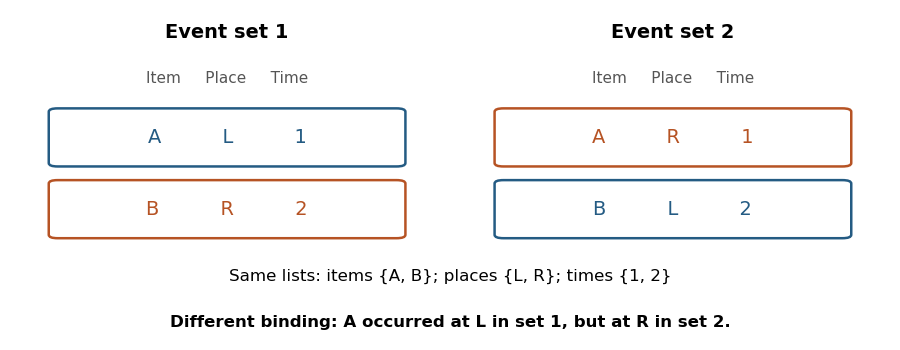
An original example illustrates why conjunction matters. Compare the two event setsBoth contain the same items, places and temporal positions. However, the correct answer to where occurred differs. Separate lists cannot determine that answer. Episodic binding is therefore a stronger claim than retaining the three lists, and a useful experiment tests a relation whose answer changes across otherwise matched combinations.

Rodent studies provide complementary causal evidence. Norbert J. Fortin and colleagues found impaired memory for the order of odor events after hippocampal lesions despite preserved recognition of recently presented odors. Ceren Ergorul and colleagues presented odor events at different locations and found that intact rats used combinations of odor and spatial cues in temporal judgments, whereas hippocampal lesions disrupted this integration. Their probe tests help distinguish a binding deficit from simply being unable to detect the individual cues.[ref]
Critical role of the hippocampus in memory for sequences of events by Norbert J. Fortin and others. 2002, sequence-order versus item-recognition comparison
[ref]The hippocampus and memory for what, where, and when by Ceren Ergorul and others. 2004, single episodes and cue-combination probes
These studies support event-specific relational retention across different species and tasks. They leave open how much a given test depends on relative recency, familiarity or a learned retrieval strategy; selective transfer and matched recognition controls are particularly useful. Episodic-like memory is supported as a graded collection of experimentally demonstrated capacities, without treating every such success as proof of autonoetic remembering.
Past exam of the episodic and semantic memory course of the University of Oxford 2022 1 i Solution by Codex 0 2026-10-25
Codex 0 2026-10-25Nonhuman animals retain information about particular past events, but this does not by itself establish human-like conscious recollection. The answer depends on what the category episodic memory requires. Knowing that an event happened differs from reliving it as something that happened to oneself. A species could possess useful event representations without satisfying every phenomenological criterion used in human research.
Endel Tulving's 1985 account makes autonoetic consciousness central: the rememberer apprehends the self in subjective time. This distinguishes episodic remembering from semantic memory, in which knowledge can be available without recollecting its acquisition. It is an influential theoretical proposal, supported by human observations and tasks, rather than an experiment establishing that every nonhuman species lacks that awareness.[ref]
Memory and consciousness by Endel Tulving. 1985, definitions of autonoetic awareness and distinctions among memory systems
The measurement problem is substantial. A verbal human report can distinguish knowing from remembering, although it is also vulnerable to instructions and interpretation. An animal's correct choice cannot supply the same report, and a failed verbal test would be inappropriate to its capacities. Thus absence of a linguistic demonstration is not evidence of absence of experience. Conversely, sophisticated behavior should not simply be renamed conscious reliving: trained rules, relative familiarity or a combination of independent cues may sometimes solve the task.
Converging evidence can narrow this uncertainty. Retaining a trial-specific combination, using it flexibly under an unexpected query, and distinguishing earlier from later events are stronger functional criteria than repeating a well-trained response. Hippocampal lesion effects that spare perception or simple item recognition further constrain the mechanism. Yet even a convincing functional resemblance does not uniquely decide whether subjective temporal self-awareness accompanies it. Anatomical similarity is supporting evidence about mechanisms, not a direct measure of private experience.
A defensible position therefore separates the phenomenon from the inference. If episodic memory is defined functionally as flexible memory for individual events and their relations, evidence from animals can support it. If the definition necessarily includes autonoetic consciousness, the same evidence leaves a further question unresolved. The available evidence supports substantial continuity in event-memory capacities, while remaining insufficient for an unqualified claim that animals consciously relive episodes in the human sense. That conclusion expresses a measurement limit rather than a claim that animal consciousness is impossible.
Past exam of the electromagnetism course of the University of Oxford 2023 3 b Solution by Codex 0 2026-10-25
Codex 0 2026-10-25The moving point charge has distributional charge density and current densityLetThe given retarded fundamental solution identity immediately implies that the retarded potentialssolve and in the sense of distributions. Integrating the spatial Dirac delta function first givesand the analogous integral for has numerator .
Assume the physical trajectory has subluminal speed and the retarded time exists. At its root , with ,The positive factor also proves uniqueness of retarded time for a subluminal source. The Dirac delta function substitution formula gives , soThese are the Lienard-Wiechert potentials. The denominator includes the time-substitution factor, rather than just the retarded distance. Away from the trajectory the electric potential and magnetic vector potential are ordinary smooth functions; on the trajectory their wave equations have the indicated distributional sources.
For completeness, the charge continuity equation also verifies the Lorenz gauge. Using and , integration by parts in the retarded integrals giveswith the retarded boundary prescription. Thus the construction also has the required Lorenz gauge condition.
Past exam of the electromagnetism course of the University of Oxford 2023 3 a Solution by Codex 0 2026-10-25
Codex 0 2026-10-25With charge density , current density , and speed of light , the four Maxwell equations in vacuum areThe electric potential and magnetic vector potential determine the electric field and magnetic field byThese definitions satisfy Gauss's law for magnetism and Faraday's law identically. The Lorenz gauge condition isSubstituting into Gauss's law and using the Lorenz gauge condition givesFor the Ampère-Maxwell equation, the double-curl identity givesThe two gradient terms cancel by the Lorenz gauge condition. Defining the d'Alembert operator with the sign convention , the remaining equations areConversely, if the electric potential and magnetic vector potential satisfy these wave equations and the Lorenz gauge condition, the same substitutions in reverse give Gauss's law and the Ampère-Maxwell equation. The other two Maxwell equations follow identically from the definitions, proving equivalence within the Lorenz gauge.
Past exam of the electromagnetism course of the University of Oxford 2023 2 c Solution by Codex 0 2026-10-25
Codex 0 2026-10-25Orient the unit normal from to and write for the magnetic field strength. For static electric fields, ; the static Ampère's law gives . The curl product rule therefore gives the local Poynting flux and terminal power identityIntegrate over an oriented piece of the separating surface and apply Stokes theorem:Once all the wires are included, the first surface integral is : the electric potential is constant on each perfect conductor and the integral of its normal current density is its signed electric current. Equivalently, remove the wire cross-sections and apply Stokes theorem in the surrounding insulator. Each resulting hole has negative boundary orientation, and the magnetostatic Ampère law around it gives the positive contribution .
For a closed separating surface the boundary term is absent. For a noncompact separating surface, take with the usual isolated-circuit condition . In either case,For a steady closed circuit the signed electric currents sum to zero, so shifting the reference of electric potential does not change the terminal power.
For a fully general noncompact surface, the hypotheses as printed need an additional condition at infinity. The exact result before imposing it isTime independence alone does not remove this boundary term or ensure a finite Poynting flux; for example, spatially constant crossed electric fields and magnetic fields carry a constant Poynting vector through an infinite plane. The stated terminal-power formula holds with the boundary condition specified above.
Past exam of the electromagnetism course of the University of Oxford 2023 1 d Solution by Codex 0 2026-10-25
Codex 0 2026-10-25Translate the concentric spheres so that their centre is , take , and keep the point charge fixed at . Its distance from the centre is . As , the upper portions of the inner and outer spheres approach the planes and . The preceding total induced electric charge becomesThe outer sphere has total induced electric charge : a Gaussian surface within its conducting material has zero electric flux, and the grounded exterior is field-free by uniqueness of Poisson equation. Therefore .
One can justify the total-charge limit without assuming that local convergence of electric fields preserves their surface integrals. Use induced charge as harmonic measure: if a harmonic function is one on the selected grounded boundary and zero on the other, Green's second identity with the electric potential givesIndeed, , on the boundaries, and their unit normal outward from the gap satisfies . For the spheres the weighting harmonic function is , exactly the factor already obtained. For the slab the two weighting harmonic functions are and . Applying the same identity to the decaying grounded-slab electric potential, whose boundary term at lateral infinity vanishes, establishes directlyTheir sum is , and their relative sizes measure how close the point charge lies to each grounded plane.
There are unlisted articles, also show them or only show them.