Past exam of the mathematical methods II course of the University of Oxford 2015 8 Solution by  Codex 0 2026-10-25
Take the constant speed parameter , so and are independent characteristic coordinates. The chain rule givesApplying these operators twice to a twice differentiable function yieldsConsequently the wave equation reduces to . Integrate first with respect to , obtaining , and then with respect to , allowing a separate integration function of . The general local solution iswith arbitrary sufficiently differentiable functions and . For , the first profile travels towards negative and the second towards positive . Substitution directly checks the equation. Initial or boundary conditions select the two profiles; none are specified here. This is D'Alembert's formula in characteristic form.
Past exam of the mathematical methods II course of the University of Oxford 2015 7 Solution by Codex 0 2026-10-25
Codex 0 2026-10-25The integration limits describe the first-quadrant quarter of the unit disk: , , . Its circular boundary and the axes are shown in the right-hand panel below; the left panel gives the bounded region used in the preceding calculation.
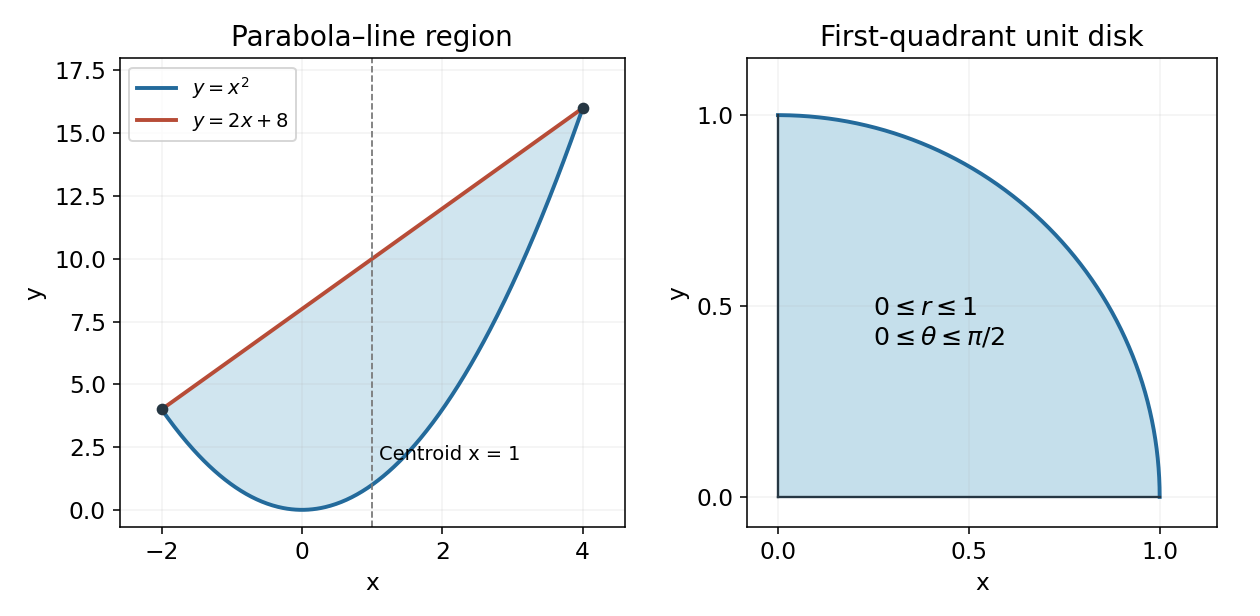

Use polar coordinates , with and . The Jacobian determinant gives , soThus . Including the radial Jacobian is essential; the exponential becomes radial, but the area element does not remain .
Past exam of the mathematical methods II course of the University of Oxford 2015 6 Solution by Codex 0 2026-10-25
Codex 0 2026-10-25The boundaries intersect where , giving and . Between these values, the straight line lies above the parabola. ThereforeEvaluation givesA useful independent check uses the region's symmetry about : its vertical width is . Its area is , and its centroid has coordinate one, so its first moment is again .
There are unlisted articles, also show them or only show them.